
Introduction
Speaking on reparatory justice at the UN headquarters in 2023, Alando Terrelonge, the Jamaican Minister of Foreign Affairs and Foreign Trade, petitioned governments across the Caribbean to “tear down those monuments of old, and erect new ones (…) so that we are not telling the stories of the oppressors, but telling the stories of our freedom fighters” (Garfield, 2023). Terrelonge’s call to tear down monuments echoes numerous protests against imperial memorials and statues across the Atlantic world in recent years, further catalysed by the Black Lives Matter movement in 2020 which famously led to the felling of slave trader Edward Colston’s statue in Bristol, UK. While the fall of Colston provoked wide debate around statuary culture and counter-memory in the UK and beyond, less attention has been paid to formerly colonised landscapes and plantation sites which have—under slightly different circumstances—also been sites of contestation.
In the Anglophone Caribbean, former plantations have regularly become major tourist attractions. For example, Mechelle N. Best and Winston F. Phulgence (2013) reveal the extent to which plantation houses and estates have been converted into hotels (The Jalousie Plantation in St. Lucia and Almond Beach Village in Barbados), restaurants (Bagatelle in Barbados and Le Moulin a’ Cannes at Depaz Distillery in Martinique) and heritage attractions (Rose Hall Great House in Jamaica and Morne Coubaril Estate in St. Lucia). However, the development and preservation of these sites—largely driven by demand from land and cruise tourism—has been contested due to the fact that the history of enslavement and the colonial transatlantic trade is either absent or relegated to the background in the tourist experience. Instead, plantations and landscapes where racist acts of inhumanity and atrocities were commonplace continue to be promoted as places of entertainment, gentility, and architectural grandeur. A major consequence of this cultural and historical amnesia is that the lives of thousands of enslaved Africans remain unremembered.
This article has its roots in a pilot research project called Resisting Silence which aimed to commemorate the lives of the enslaved on former sugar, coffee, and cotton plantations in the regions of Soufriere and Choiseul, St. Lucia. The project combined archaeological evidence, oral history, sound, and archival research, and is done in partnership with two local organisations: the St. Lucia Archaeological and Historical Society (AHS) and Sir Arthur Lewis Community College (SALCC). In 2022, we undertook the pilot phase of the project, which focused on the site of Balenbouche Estate, first established as a sugar and rum producing plantation in the 1740s. We conducted archaeological surveys, archival research, and held site walks and botanical workshops with local students, poets, and community members with the shared aim of commemorating the lives of the enslaved in the absence of any officially sanctioned forms of public memory. The project has since developed into an AHRC-funded study titled Plants, Plantations, and the Anglophone Caribbean led by Dr Arun Sood at the University of Exeter, in collaboration with Dr Tara A. Inniss at the University of the West Indies, Cave Hill.
In this corresponding article, we emphasise the potential in embracing a multi-disciplinary approach towards commemorating plantation histories, suggesting the combined capacity of archives, material culture, community participation, oral histories, and indigenous botanical knowledge to tell the stories of enslaved individuals who had little power to formally shape the spaces and histories of where they lived, and whose knowledge was and is still undervalued. In doing so, the article contributes to scholarship on islands in specific relation to the Anthropocene. As Jonathan Pugh and David Chandler have recently underlined:
the rise to prominence of islands in broader contemporary debates about the Anthropocene has not only come about because islands are high-profile symbols of transforming planetary conditions, or because islands might be understood as smaller and more manageable ‘test tubes’ for policy and scientific experimentation. (Pugh & Chandler, 2021, p. 4)
Given our specific focus on the Caribbean, our approach is also informed by the pervasive influence of Édouard Glissant and Derek Walcott on island ecologies, ruins, the transformations of plantation and post-plantation landscapes. As Walcott famously remarked in his Nobel Prize-winning speech:
Ruins are fragments, yes, but ruins and fragments are also always in need of the poetic work of bringing forth, forming and reforming, and so a kind of beauty-making memory project that loves the past as much as the future. Love reassembles fragments. (Walcott, 1998, p. 69)
In our own attempt to reassemble fragments through collective endeavour and cross-disciplinary approaches, we conclude with a call to include broader perspectives in the ongoing process of commemorating neglected plantation sites and advocates for more creative and inclusive forms of remembrance.
Remembering the Enslaved
Scholars across several disciplines have attempted to reconstruct the lives of peoples subjected to plantation slavery in the Atlantic world. However, such endeavours are often limited by the bureaucratic nature of plantation inventories and slave registries, which reveal little about the lives of the enslaved beyond static datasets. Furthermore, the experiences of the enslaved remain particularly vague in the archipelago that European sailors dubbed the Windward Islands (Martinique, St. Lucia, St. Vincent, and Grenada) due to the lack of written records left by frequently changing colonial powers. Tessa Murphy (2021) notes that what records do remain from the “peripheral” Windwards often leave conflicting accounts and thus fail “to illuminate the full story of the tens of thousands of people who lived and laboured in the archipelago” (p. 15). In St. Lucia alone, for example, the only surviving slave registers that remain are from 1815 and 1819, though in the case of the Balenbouche Estate these are supplemented by a “yearly return” of those enslaved who were punished on the plantation between 1827-1828.
These largely unconsulted archives, few and bureaucratically driven as they are, may not seem much to go on in an attempt to reconstruct or commemorate the lives of the enslaved. However, as Murphy further notes, acute attention to seemingly formulaic registries can yield insights into the life histories and genealogies of the enslaved, including regional identities and the role of reproductive labour in giving rise to female-headed multigenerational families. In recent years, decolonial and indigenous methodologies have also emphasised ways to access “hidden history and understandings” within colonial archives. As Lynette Russell (2005) notes, greater attention to the lives and experiences of those subjugated within archives might at least begin to recover silences around different “knowledge systems” and experiences (p. 161). Yet Katherine Binhammer (2021) also highlights the problems of privileging archival work on historically enslaved or subjugated peoples over “groundedness within a community” (p. 201). Therefore, in an attempt to begin reconstructing—indeed remembering—the enslaved on a specific St. Lucian plantation, we adopt a multi-disciplinary approach that also ensures collaboration between community members, landowners, and poets in an attempt to move beyond epistemological frameworks that either privilege academic archival research or shore up more widely sanctioned modes of remembrance such as statuary culture.
Martiniquan philosopher Édouard Glissant famously proposed “creolization” (1997, p. 34) to describe the heterogeneity of Caribbean literatures and cultures. Drawing on Glissant, the case study below embraces a “creolized method” in which archival research intersects with archaeology, oral histories, sound studies, and indigenous botanical knowledge in order to reveal, indeed remember, the lives of the enslaved on the Balenbouche Plantation. After a historical account of Balenbouche Estate, what follows is a description of the ways in which each component of this “creolized method” contributed, in different ways, to the creation of new collective memories of enslaved peoples who not only laboured on the plantation but also resisted their oppression. While there is nothing particularly novel about an interdisciplinary or mixed-methods approach, by drawing on Glissant’s “creolization” we also hope to better incorporate knowledge systems and epistemologies which have been, and to a large extent continue to be, excluded from academic studies and discourse.
Balenbouche Estate: Plantation Slavery and Saint Lucia
In terms of the establishment of a slave-based plantation society, St. Lucia’s start was much slower and later than its neighbour Barbados, due to the islands’ densely forested and mountainous interior. Furthermore, during the first half the eighteenth-century, Great Britain and France were locked in a battle for possession of St. Lucia that continued for almost 200 years until the island was finally ceded to Great Britain in 1814, a possession that continued until independence in 1979. Between 1722-1745 and 1748-1762, all settlement was officially banned in order to keep the peace between the two colonial powers, thus adding to the relatively slow development of a plantation society on the island. However, despite the official neutrality of St. Lucia between England and France during this period, there was still settlement occurring on the island. The agricultural economy was more diverse than the later sugar monoculture, focused on cotton, cocoa, coffee, cassava, tobacco, and other crops. However, slave ownership per property remained low in comparison to Barbados, with 75% of slave owners owning fewer than 10 enslaved persons in 1756 (Seiter, 2016).
In 1763, as part of the Treaty of Paris, St. Lucia was officially ceded back to France, and with the reshuffling of colonial assets at the end of the Seven Years War there was an influx of French settlers into St. Lucia from other islands recently lost to the British. This infusion of people, capital, and resources aided in boosting St. Lucia’s plantation economy and ushered in the age of sugar. Between 1767 and 1777, the number of sugar estates jumped from five to 53 (Harmsen et al., 2012). Large-scale intensive sugar production also meant the need for a greater work force. Between 1745-1772, the enslaved population on the island grew from 2,470 to 12,795 and from 1772-1789, 5000 new slaves were imported into St. Lucia. By Emancipation in 1838, the island was home to 14,000 recently freed slaves and 1,109 white settlers (Harmsen et al., 2012).
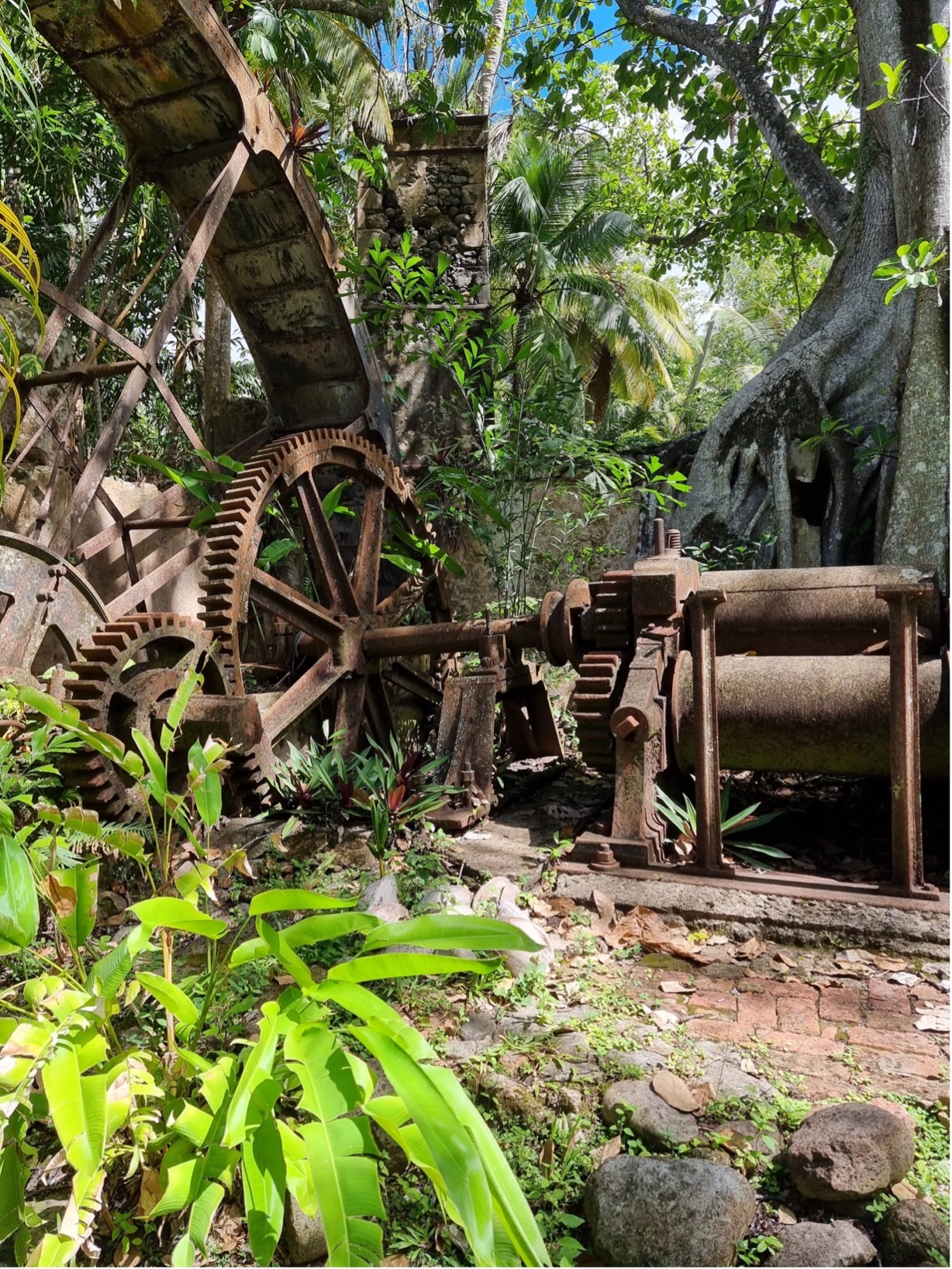
With regards to our case study site, Balenbouche Estate, European colonial settlement began in the 1700s, but prior to that archaeological work shows that the area was settled by Indigenous populations dating back to 1200 CE (Hicks & Horton, 2001). Archaeological survey revealed a coffee works to wash and prepare coffee beans for export which was built on the plantation between 1700-1770. It was not until the 1770s, however, that Balenbouche became fully established as a sugar estate with an enslaved work force, a sugar mill, boiling and curing house, and the first iteration of the estate house. In the 1850s and 1860s, the Sugar Works was refitted with a new wheel and crusher, which survive until today [See Figure 1].

By 1896, the Sugar Works and production on the estate had been almost wholly abandoned reflecting the overall decline of large sugar estates in St. Lucia. Balenbouche had one of the largest enslaved populations on the island. In 1815, 203 enslaved persons were recorded and in 1842, £4174 5s 8d was paid as compensation for the ‘loss’ of 164 enslaved after the passing of the Emancipation Act (Centre for the Study of the Legacies of British Slavery, accessed 2024).
In the 1960s, the estate came into the current ownership of the Lawaetz’, a Danish-West Indian family. Under the Lawaetz family, the property is currently an eco-guesthouse and working farm. Primarily due to the family’s mission of preserving history, and a mission centred around sustainability, authenticity, and community, Balenbouche is one of the few former plantation sites which is accessible, not in disrepair, and not owned by and converted into a large luxury hotel chain. The willingness of the Lawaetz family to preserve Balenbouche as a heritage site which does not obscure “hidden” or difficult histories is also what led to the possibility of our project’s aim to develop methods towards commemorating the lives and experiences of the enslaved who lived on the estate.
To date, most archaeological and historical work at Balenbouche has focused on the built and industrial heritage of the sugar mills, which obscures the vast scale of the monocrop plantation and the large enslaved population who laboured there. At the time of emancipation, the estate was 587 acres, whereas today it is a little over 60 acres (Breen, 1844). Balenbouche also now sits in the River Doree-Piaye Protected Landscape—a governmental nature reserve proposed in 2009. The Protected Landscape is 1120 hectares comprising of the two adjacent valleys of the River Doree and the River Piaye, which both run down from Mount Grand Magasin (the island’s centrally located forest reserve) to the south coast of the island. According to the Organisation of Eastern Caribbean States (OECS) report, the “valleys are steep, densely wooded and contain some of the most diverse and intact natural ecosystems on the island, including many rare and endangered plant and animal species” (Haffey, 2009, p. 14).
The steep, wooded valleys of the surrounding landscape might also be linked to the several runaway attempts at Balenbouche in the early nineteenth century. It is worth noting that the famed Brigand runaway slave settlement of Fond Gens Libre or Valley of the Free People, was located 12km west from Balenbouche, on Gros Piton (a 2,530 ft high volcanic plug and part of the Pitons World Heritage site). In 1795, these settlers had won several skirmishes against the invading British Army, in an attempt to keep the emancipation that the French had temporarily awarded them (Harmsen et al., 2012). While those 12 kilometres consisted of valleys, deep gorges, and wooded terrain, the proximity and tales of the Brigand would have likely been known and spurred the Balenbouche enslaved into action. The connections between the possibility of liberation from enslavement and landscapes has been well documented in Atlantic contexts. Famously, in Jamaica, the hilly and cave ridden ‘Cockpit Country’ in Trelawney Parish served as the base for the Maroons, from which they also staged guerrilla-style attacks on colonial powers, even becoming a sub-culture within themselves (Besson, 2015). Similarly, the Dismal Swamp that encompasses large tracts of southeast Virginia and northeast North Carolina, historically served as a settlement for indigenous and enslaved persons fleeing from settlers and slave owners (Grant, 2016). The case of the repeated runaway attempts at Balenbouche is not dissimilar in terms of landscape enabling emancipatory attempts.
The 1827-1828 Reports of Protectors of Slaves for the island of St Lucia note that from 26 March to 8 July 1827, there were eight emancipatory attempts at Balenbouche. On 17 May 1827, four enslaved persons, “Philippe,” “Ch. Margueritte,” “Etienne,” and “Eustache” all unsuccessfully attempted to gain their freedom. Three months later on 18 July 1827, “Ch. Margueritte” and “Etienne” once again tried to runaway but were apprehended; their first “offense” cost them 40 lashes and confinement, their second 50 lashes and confinement (Anon., n.d.-b). It is “Ch. Margueritte” and “Etienne’s” second attempt that suggests the premeditated nature of their endeavour and also demonstrates some form of connection between the two persons. Under a section in the report titled “where such offense was committed,” all eight attempts were significantly listed as occurring in the “Woods” (Anon., n.d.-b). This reoccurrence also suggests that either it was the viable space within the estate to facilitate escape or it had proven to be a successful route to the settlement of Fond Gens Libre in the past.
Archaeology is often perceived as a discipline rooted in “remembering” to the point in which scholarship of the last twenty years has increasingly looked to memory as an archaeological tool. However, the hierarchal dynamics between archaeologists/archaeological institutions and local stakeholders/sites can create spaces in which forgetting often occurs, as our following case study at Balenbouche demonstrates.
Most formal and major archaeological fieldwork in the Caribbean is undertaken by non-Caribbean institutions. In St. Lucia, for example, the University of Vienna (Austria), Leiden University (Netherlands), and University of Florida (USA) have all conducted major archaeological excavations on the island, and although work has been undertaken alongside local groups such as the Archaeological and Historical Society of St Lucia (AHS), the non-local universities often maintain most of the financial and scholarly power. While these institutions have genuine intentions to conduct archaeological research, the American-European hegemony in motion should not be ignored, especially as St. Lucia has no official cultural heritage patrimony laws in place, leaving the legal ownership of archaeological material culture excavated in St Lucia in a precarious position. Furthermore, archaeological research in St. Lucia has historically been focused on the pre-Columbian era, and much less attention has been paid to the landscapes of the numerous colonial estates and the lives of enslaved people who laboured on them.
With regards to Balenbouche Estate, from 2000-2002, the University of Bristol (UK) held two field schools at Balenbouche which were used to teach undergraduate students the basics of field archaeological methods. A PhD dissertation was also part of these field school seasons, but focused on the built industrial heritage of the site (see Hicks, 2007). In Spring 2002, a team from Leiden University and the Florida Museum of Natural History (FLMNH) spent a day at Balenbouche digging shovel test to investigate pre-Columbian archaeological material (see Hofman et al., 2004). The shovel test pits took place on an adjacent site that was part of the original Balenbouche Estate, but has been subsequently sold. In 2022, the authors received funding in collaboration with the AHS and Lawaetz family to survey and excavate test pits at Balenbouche in areas where enslaved people would have lived. Upon arriving at the site, however, we found hundreds of excavated materials under the estate house (glass, earthenware, ceramics, and metal) that were not catalogued. The excavated material originated from the 2 years of field schools by the University. From 2000-2021, the excavated materials had not been re-visited or analysed, which led to considerable deterioration and an infestation of pests. Luckily, most of the packing material was marked with excavation areas and trench numbers that we could correspond to an unpublished field report written as part of the field school.
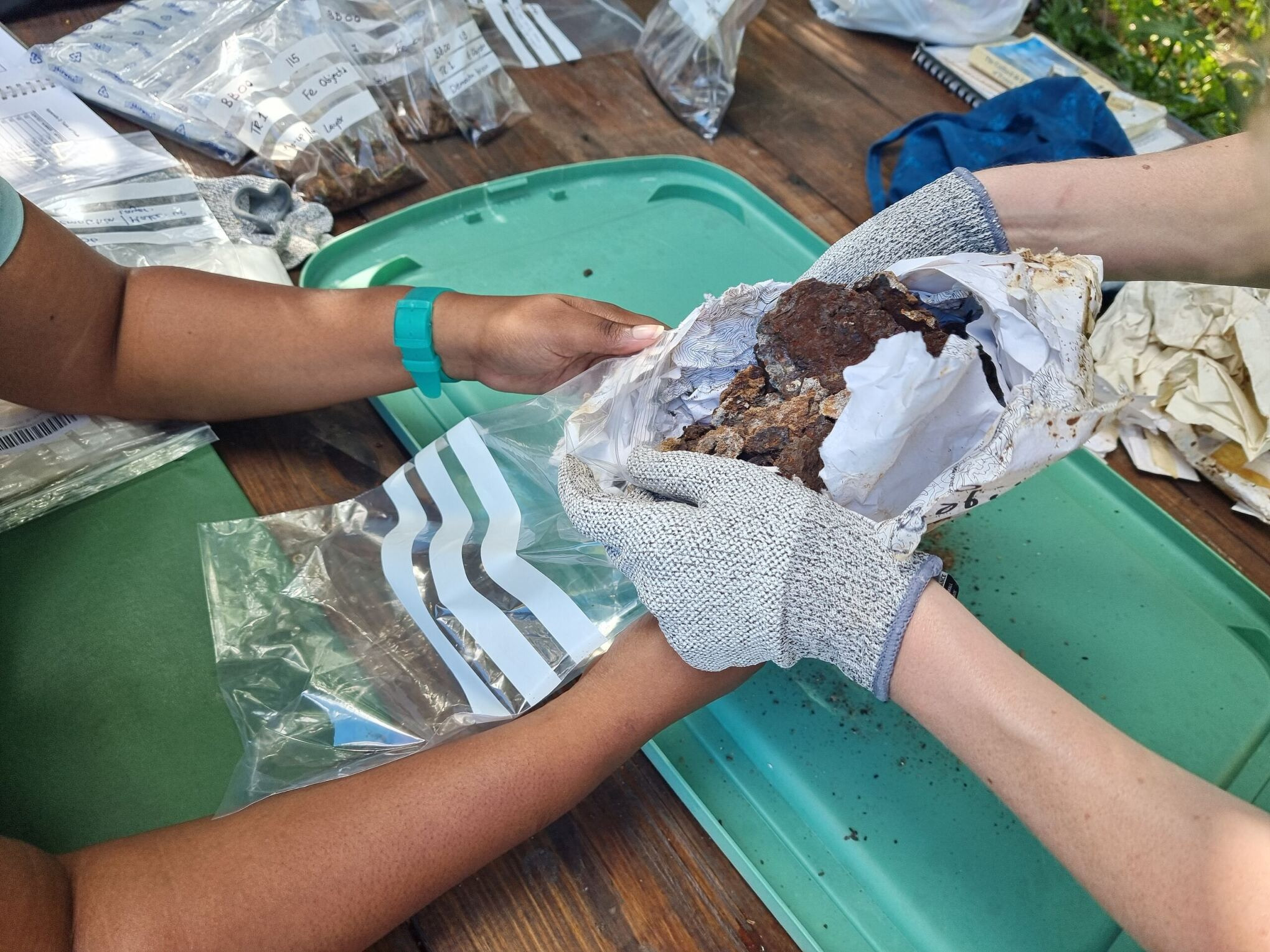
As a team of multi-disciplinary researchers, the state of the excavated material we found at Balenbouche was difficult to comprehend. There is a lack of legal recourse in St. Lucia for parachute archaeology where foreign researchers excavate and research for one or two field seasons, and then leave the objects with no plan for their future care or research. The irony here is that the Balenbouche Estate represents the rare example of a plantation site with landowners willing to engage in difficult histories. The hierarchies and power structures at play have meant that the process of remembering partly became complicit in neglect and forgetting. This raises questions about the responsibility of foreign institutions of power regarding the ethical and culturally appropriate safeguarding of material culture, especially in the absence of local legal protection. Archaeological field schools should encompass the students analysing, cataloguing, and storing the archaeological material in post-excavation skills training. The field schools at Balenbouche did not incorporate this training, leaving the family at Balenbouche with boxes of uncatalogued cultural material. In light of this unfortunate history of archaeological excavation, rather than our team conducting further excavation, our efforts turned to stabilising, re-bagging, photographing, and cataloguing this important archaeological material so that it can be analysed in future [See Figure 2.]

After this process, we found multiple clay tobacco pipes, which were found in areas of the estate where enslaved people lived and dated to the period of the sugar plantation. These pipes have been sent for ancient DNA testing at the University of Illinois (USA), with the potential to determine little known lineages and even links between enslaved people and living descendants in Saint Lucia today.
Despite the change in the archaeological fieldwork we proposed at Balenbouche, the process did reveal future potential for commemorating the lives of the enslaved with archaeological material culture and living histories through future display and interpretation and display at the Estate.
Ethnobotany and Remembering
The exercise of “remembering” the enslaved is partly rooted in the contestation “zero-point epistemology;” whereby the knowing European coloniser maps the world, observes its people (without being observed themselves), and projects an assumed universal knowledge. In order to contest who is remembered and forgotten in this world order involves, in Walter D. Mignolo’s terms, a form of, “epistemic disobedience.” For Mignolo, “epistemic disobedience’ involves ‘delinking from the web of imperial/modern knowledge and from the colonial matrix of power’” (2009, p. 34). This is a form intellectual resistance against dominant ways of knowing that have served to obscure, subjugate, or erase global knowledge systems and epistemologies. The ethnobotany aspect of the project was especially rooted in “epistemic disobedience” as it aimed to:
-
Centre Indigenous, African descendent and local botanical and medicinal knowledge about Balenbouche on plantations more broadly.
-
Reposition the plantation as a site not solely on which colonial ideology was enacted upon, but also where subaltern agency existed in shaping the landscape.
-
Partake in establishing generational knowledge and those links injured and severed by coloniality.
This part of the project was done in collaboration with Sir Arthur Lewis Community College (SALCC) students pursuing an Associate Degree in Biology. The project was built into the course as a practicum component and it consisted of two parts: place-based learning (day research visit and tour of Balenbouche) and laboratory work. Place-based learning was essential to the process of ‘remembering’ as it disrupts the Eurocentric normative route of learning and develops students’ sense of place and learning through physically connecting with their environment (Zandvliet, n.d.). The place-based session comprised of a mixture of tour and field-walking of the estate facilitated by estate-owner Uta Lawaetz, and Coutu and Thompson-Odlum, who lectured the students on the history, archaeology, built heritage, and terrain of the estate, focusing on medicinal flora known to be used by the enslaved population. The tour spurred the students to think about the layout of the estate and possible relations between the sugar mill, enslaved quarters, small slave gardens, and the various types of medicinal flora.
Although all fourteen of the students were local St. Lucians none of them had been to the site of Balenbouche nor engaged with the history of enslaved communities on plantations despite the site being publicly accessible. However, throughout the duration of the field visit, a pattern began to emerge in which the students started to recognise the local names of many types of flora and recount personal experiences or family oral histories about the usage of those plants. The students expressed surprise at the historical use of the plants and the probable link to enslaved ancestors, and the stories that arose during the field walk suggests that oral transmission of knowledge and remembering is still occurring across generations.
Significantly, much of this indigenous and African-descendent knowledge was framed in the students’ minds as “folk remedies” and “old wives’ tales,” stories that their nenen would recount that lacked a “legitimate” (colonial) epistemological framework. The lab-based part of the project, conducted at Sir Arthur Community College, served to bridge the gap between the imagined cognitive dissonance of ancestral and “scientific” knowledge. The students collected plant samples from the estate, simultaneously noting the coordinates with GPS units as to better geo-spatially understand where medicinal plants were growing across the estate. Over the course of two months, the students ran a series of experiments to test for the antibacterial/antimicrobial properties of the thirteen botanical specimens. By creating extracts from the samples and testing the efficacy of the extracts against E. Coli on agar gel, the students were able to observe and record the formation of a zone of inhibition which is a primary indicator of antimicrobial activity, and therefore demonstrate, or even “legitimise” the ancestral use of these plants as medicine. See table of results below:
Of course, it should not be the case that ancestral, indigenous, and African-descendent knowledges should in any way need “legitimization” through Western or Eurocentric ways of knowing, which might risk shoring up the colonial foundations which Mignolo’s “disobedient” approach seeks to disrupt. However, in underlining congruences, we hope to have encouraged our own form of disruption. Specifically, for the students, the site transformed into a place of ancestral knowledge, instilling a better understanding and trust in their epistemological inheritance. The ethnobotany aspect of our project inaugurated the collective remembrance (and privileging) of local knowledge and environment. Balenbouche Estate and its history was revitalised through the process of engaging with the SALCC students and introduced the students to their first foray of “epistemic disobedience,” which may have further ramifications for ongoing local commemoration of plantation sites.
Creativity and the Archive
While some scholars have noted the limitations of the “slavery archive” (broadly considered here as colonial documents, bookkeeping, and administration) in recounting the experiences of the enslaved, Stephanie E. Smallwood considers it a “contested site of knowledge production” which can “never fully conceal the counter-history it seeks to disavow” (Smallwood, 2016, p. 117). For Smallwood, the slavery archive can also animate and embody the immeasurable weight of black lives in the Atlantic world forgotten and silenced by the violence of slavery and its afterlives. As Toni Morrison suggests, creative engagement with the material remnants of the past can help to remember those “who didn’t make it from there to here and through” (Morrison qtd in Kastor, 1987).
In the final workshop, we invited esteemed Saint Lucian poets and writers—Kendel Hippolyte, Jane King, George Goddard, Gemma Weekes, Esther Hovey, and MacDonald Dixon—to Balenbouche to respond to the site as well as the excavated objects and archival materials. Following a similar structure to the session conducted with students from Sir Arthur Community College, the workshop began by field-walking the estate with a focus on indicating medicinal flora that was known to be used by the enslaved population. Adopting a multi-sensory approach, heightened attention was also placed on the sounds of the estate, with field recordings taken throughout the day and contact microphones placed on the sugar works and the remains of built heritage. Our approach to capturing the sounds of the site was informed by the concept of “acoustic ruins,” whereby the sounds of place can function in a mnemonic capacity to imaginatively recover “long-forgotten traces of past experiences” (Hall, 2010, p. 86). This not only provided further stimuli for the poets’ but also later informed a forthcoming suite of soundscapes to commemorate the site. Following the field walks, we returned to the estate house veranda where Thompson-Odlum provided context on the restored excavations. The workshop culminated in the composition of a series of responsive poems which were subsequently recited and recorded in the main room of the estate house. The full text of each poem follows below:
The taste of sugar
(after a visit to the former slave plantation at Balenbouche)
By Kendel Hippolyte
the hand feeding the sugar cane
into the iron rollers
stalk after stalk after stalk
the cane skin splintering
the squish and sigh of juice
dripping between the cylinders chomping
and crushing flat whatever slips between
the hand feeding the pale gold stalks of cane
the crack, the split, the crunch
the sweetness oozing, slicking the cylinders
the steady, not-so-slow revolving of the horizontal metal drums
the thin slit between them like lips slightly open, almost closing shut
but for the yellowing cane slipped in between
the clasp and crush, the
sudden yet slow slipping of the hand
feeding its fingernails, its knuckles,
its metacarpal bones, its veins, its tendons,
the yellowing cane juice reddening, the sugar bittering
and the quick shock of the thwack of the cutlass
cutting through the half-devoured wrist
this is the taste of sugar
and why a rusted iron spanner from more than a century ago
is jammed into the maw, the stuck iron jaws
of a rusting metal behemoth, balked
within the crumbling masonry of empire
I Prefer the Shadows
By Esther Cowie
Even Jesus kept his scars.
See. The holes. Didn’t Peter stick
his fingers through?
But you installed a large wooden god
in the main house,
his light shadowing our ghosts.
You burnt incense, chanted.
A place for healing, you argued.
But what did you know about our past,
only that you liked the master’s house,
the jalousie windows, the cedar floors,
the furniture old and priced at the value of a small car.
And so, your people came from the North,
how they bounced across the grass
their limbs untroubled by memory,
their bright laughter catching on the lily-filled
sugar cauldrons, the rusted unmoving wheel.
I preferred the shadows. Long silences.
The air thickening like molasses.
The gone horror hardening into fossil.
A thing to find. To press this body given
into the welts. The spaces that once
held limbs. To sing along to a forest
of notes rooting in a razed tongue.
You are calling for me. A room to clean.
Another guest soon come. Shhh.
I am under the overseer’s house lighting
a match, holding it close to the wooden stilts,
while above, your guests shift
into downward dog.
Balenbouche 2022
by Mac Donald Dixon
Too many things are happening at once
five senses are not enough to hold
the present firm in present tense.
The world stops spinning here
molasses thins to ride on air⸺
a sugar mill falls under the spell
of Ficus in hot embrace, all is well.
Time cackles with bamboo,
flamboyant runs wild,
sugar was once the crop of choice⸺
what else is new?
There is no grief, no pain
moaning about a past
staring (at us) through ornamental palms.
The evil here is gone,
nothing hides behind window flaps.
Jalousies wear thin
diffusing birdsongs in a syrupy air.
The bell that summoned workers from the fields
has lost its tongue, grass screams
for a taste of dew. Any moment now
Lisette will walk out on the lawn from the fields
to ask: where did my children go?
A breeze combing wild pines
high up in the casuarinas
has been there since emancipation,
world wars, coronation, the like,
to conspire with sea grape, allamanda,
and wild béléjenn,
to form a grove by the steps that lead
to a veranda that witnessed more deals
than the estate has aged.
The mind falls in love with seashells
whether surf is alive on this coast
or dead like the river emptying its bile
Into the cavilling brown sea…
It’s not enough to change things,
let the past play dead rather than store
this stagnant dust in boxes for a future
that will tell us nothing. Subjects we know
are no longer eager to learn the truth.
Balenbouche
by Gemma Weekes
rust is how
metal bleeds
blood furring
the boilers
the mill
the wheel
that wouldn’t stop
even as
jambe coupe
watched his leg
drift downstream
leaving the river in ruins
now only the bamboo weeps
rust is how metal
remembers us
as time
stills our screams
to birdsong
and makes our
blood to bloom
a slow conscience
reclaiming metal for soil
and industry for nature
we stand in
the dirt that
was once a river
bloody with the
machines
that built your world
In keeping with Smallwood’s view of the archive’s capacity to “embody” forgotten and “unremembered” black lives, the poems—in addition to responding to the physical landscape, built heritage, flora, and fauna—respond to names and episodes from the archive, effectively creating new collective memories of the enslaved. Mac Donald Dixon’s poem, for example, imagines that “Lisette will walk out on the lawn from the fields/ to ask: where did my children go?,” referring to eighteen year old “negresse,” “Lisette Tierney,” listed in the 1815 registry of the enslaved on Balenbouche as being “Aunt of Jeanne Rose, Prosper, Rose, and Susanne Tierney.” Dixon’s speaker also describes how “The bell that summoned workers from the fields/has lost its tongue,” partly evoking the idea that “The evil here is gone.” This partly contrasts with Esther Cowie’s poem, whose speaker appears to probe the contested nature of plantation as sites of tourism, leisure, and wellbeing:
I am under the overseer’s house lighting
a match, holding it close to the wooden stilts,
while above, your guests shift
into downward dog.
Rather than the “master’s house,/the jalousie windows,/the cedar floors, the furniture old and priced at the value of a small car,” it is the "shadows and “Long Silences” that the speaker prefers among the “gone horror hardening into fossil,” with the latter seemingly alluding to the remnants of material culture.
Both Gemma Weekes and Kendel Hippolyte evoke the enslaved in relation to the violence of the sugar works and built heritage. Hippolyte’s speaker imagines:
the hand feeding the sugar cane
into the iron rollers
stalk after stalk after stalk
the cane skin splintering
the squish and sigh of juice
dripping between the cylinders chomping
and crushing flat whatever slips between
The speaker also references a large spanner sighted on our field walk, which was physically lodged in between iron rollers (visible in Figure 1). The poem emphatically ends:
this is the taste of sugar
and why a rusted iron spanner from more than a century ago
is jammed into the maw, the stuck iron jaws
of a rusting metal behemoth, balked
within the crumbling masonry of empire
Here, Hippolyte’s poem combines the remains of built heritage with archival knowledge of “runaways” to inaugurate evocative collective memories of those who actively resisted their oppression. Weekes’ poem similarly evokes the violence of the sugar works:
rust is how
metal bleedsblood furring
the boilers
the mill
the wheel
that wouldn’t stop
Further imagining the violent experiences of the enslaved, the speaker subsequently laments how “jambe coupe/watched his arm/drift downstream.” With seeming reference to the abundance of flora that has since replaced vast monocrop canefields, the speaker does, though, evokes some sense of reclamation:
a slow conscience
reclaiming metal for soil
and industry for naturewe stand in
the dirt that
was once a riverbloody with the
machinesthat built your world
The final image of reclaiming “industry for nature” suggests a return to ancestral knowledge and biodiversity. Here, Malcom Ferdinand’s idea of the “Plantationocene” (2021, p. 4) comes to mind— a term he uses to describe how plantations vastly altered biodiverse landscapes, placing colonialism, racism, and plantation histories at the centre of climate change. With “soil” and “nature” slowly reclaiming the bloody “machines/that built your world,” a sense of future hope might just be traced at the culmination of the poem.
Conclusion
Despite an increased scrutiny on monuments and memorials of the transatlantic slave trade in recent years, many of the plantation sites on which slavery took place remain neglected in terms of commemorating the lives of the enslaved in the Anglophone Caribbean. In the absence of officially sanctioned forms of commemoration, the pilot phase of our project combined the work of academics, poets, landowners, local communities, and students to demonstrate possibilities for commemorating the enslaved on Balenbouche Estate.
The “creolized” method adopted has shed light on archives as a “site of knowledge production,” as well as the importance of a community-centred approach whereby living ancestral knowledge is able to manifest, as demonstrated by our ethnobotany workshop with students from Sir Arthur Community College and creative response to the archive through collaboration with poets; all of which has combined to reveal and reconstruct the lives of peoples subjected to plantation slavery in the Atlantic world.
However, as previously noted, plantation sites in Saint Lucia (and the broader Anglophone Caribbean), remain relatively inaccessible due to either neglect or the monopoly posed by large-scale tourism. Consequently, the methods and acts of remembrance proposed in this paper are highly dependent upon the co-operation of private landowners until broader movements to commemorate plantations as sites of heritage emerge.
Funding Declaration
The research for this article was made possibe by the AHRC Catalyst Award (Project Lead: Dr Arun Sood) and a TORCH Knowledge Exchange Fund (Project Leads: Dr Ashley Couto, Dr Marenka Thompson-Odlum).