
1. Introduction
Shamian Island is located in the Pearl River within the vast city center of the South China megacity of Guangzhou. Shamian covers an area of approximately 0.3 square kilometers, with a length of about 862 meters from east to west and a width of about 287 meters from north to south. Following the destruction of the Thirteen Factories foreign trade area in the Second Opium War (1856-1860), Shamian was constructed as a haven for foreign merchants, officials, visitors, and their families, mixing business and leisure areas (Lin & Su, 2022, 2024). In the late 1800s and early 1990s, foreign consulates, commercial firms, banks, and churches were built on Shamian, forming a group of buildings that differed strongly from the local architectural style of Guangzhou. In 1996, the architectural complexes on Shamian Island were listed as protected cultural heritage by the government. Today, Shamian is known not only as an excellent place for leisure and entertainment but also as a popular location for taking wedding photos. On social media platforms such as Xiaohongshu (RedNote) and Douyin (Chinese version of TikTok), Shamian has become one of the most popular check-in scenic spots for tourists to Guangzhou.
A central interest of island scholars is the relationship between islands and mainlands. Complete isolation from the mainland is not the only characteristic of an island. Some islands are physically connected to the mainland by fixed links (bridges, tunnels, causeways, or even land reclamation), but all islands are relationally connected to other pieces of land through social, cultural, economic, political, and administrative systems (McDougall, 2019; Su & Grydehøj, 2022). Although islands are frequently regarded as footnotes to the mainland, their roles in mainland-centered processes are multilayered and complex (Hong, 2020). From the theme of boundedness flow the tropes that have become part of the ‘island studies’ lexicon, such as vulnerability/resilience, leaving/staying, routes/roots, tradition/modernity, dependency/autonomy, belonging/exile, prison/paradise—states of continuum which islanders across the world grapple with (Brinklow, 2012). Shamian’s specific sociohistorical characteristics have created a cultural atmosphere that is at once distinctive and in alignment with broader (present-day) mainland desires. In this paper, we use in-depth interviews and text analysis methods to explore how a digital sense of place has been created on Shamian in China’s mediatized society, elucidating relationship construction and emotional connections between individuals and the island. We ask how digital sense of place is generated through the mutual integration of individually embodied participation and media practices as well as how this continual generation of digital sense of place through the intervention of media technology and sociocultural practices impacts human-island relations. Through an analysis of media practices, we seek to understand how people generate emotional bonds with Shamian and how characteristics of Shamian itself influence digital sense of place and human-island relations. Stratford (2013) put forward that the idea of the archipelago suggests relations built on connection, assemblage, mobility, and multiplicity.
Islands are generally defined as pieces of land surrounded by water. For Conkling (2007), a sense of ‘insularity’ comes from the experience of isolation that is reinforced by the fearsome and impassable boundaries of water bodies. Hay (2006) believes that the edge of an island is an important manifestation of insularity, giving islanders a strong sense of community and a unique identity. Cottrell (2017) points out that the relatively isolated history of Saaremaa Island in the past has led the islanders to consider this island community as safe and independent, with insularity being the main factor that makes islanders different from the ‘others.’ However, the universality of this isolation-centered sense of island place has been challenged, with scholars emphasizing the importance of recognizing that people sense many different kinds of islandness, which are influenced by the inevitability and relationality of island-to-island, island-to-mainland, and island-water connections (Foley et al., 2023; Grydehøj et al., 2025; Kelman, 2023). Islandness is more than just—or even mainly—insularity (Baldacchino, 2008; Ronström, 2021; Zhang & Grydehøj, 2021). ‘Water-place’ (Wang & Su, 2024) is itself crucial to the construction of the sense of island place.
Sense of place is an important concept in human geography. In the 1970s, in the face of concerns surrounding the disappearance of local characteristics and the blurring of local identities caused by accelerated urbanization, geographical research began shifting towards the humanities, giving rise to the ‘place turn’ (Zhou et al., 2011). Some scholars regard places as physical spaces imbued with human connotations, re-examining human-land relations and investigating perceptions, experiences, and behaviors during the process of the mutual construction between humans and places. Tuan (1979) and Relph (1976) were at the vanguard of conceptualizing sense of place within human geography, arguing that sense of place originates from human experiences, and these experiences transform natural features into places with meanings and identities. Steele (1981) further points out that sense of place is a sense of belonging, which is entangled with sense of time.
In a mediatized society, there is a profound connection between media and social life. Ash et al. (2018) interpret the expanding influence of digital communication technologies on geography as a ‘digital turn’. Some scholars integrate the study of the media with that of sense of place. They believe that while the media presents places, it also shapes the relationship between individuals and places; sense of place has gradually evolved from an understanding of the environment to a dynamic concept of human-environment interaction (Zheng, 2020). For example, theorizing media ‘deterritorialization’, Meyrowitz (1986) points out that traditionally, rooms have confined people not only physically, but emotionally and psychologically as well. Now, physically bounded spaces are less significant as information is able to flow electronically through walls and across time.
In the current era of intertwined digitization and mediatization, the formation of digital sense of place relies on the interaction between individuals and places through digital media. Behind this lies the interaction between multiple important elements such as society, technology, economy, culture, and place. The shaping of pre-digital sense of place mainly stems from the perceptions is related much more strongly to individuals’ experiences in the physical geographical space as well as to the diverse relationships constructed between people, the surrounding environment, other individuals, and society as a whole during this process. Shamian’s historical construction of space was also mediatized through written, illustrated, and other texts; today’s digital channels of communication are both faster and wider, with more obvious performative and communicative characteristics. When people participate in the production of the digital sense of place, they often engage in self-display behaviors. Within digital space, places often serve as a node that connects people, events, and objects.
With the deep embedding of digital media in daily life, digital sense of place is further subdivided. Relph (2021) notes how digital media can facilitate the construction of digital sense of place rooted in the places of daily life. Wilken (2008) believes that, rather than media technology liberating people from places, it actually refocuses individuals’ attention on the fluctuations and fleeting experiences of places and that such technologies have transformative impacts on the structure of daily life. Digital sense of place embedded in daily life experiences was theorized early on as consisting of three dimensions: place attachment with physical absence from the place, place dependence, and place identity (Jorgensen & Stedman, 2001). In her investigation of the sense of place of German professors who immigrated to Singapore, Bork-Hüffer (2016) finds that mediatized content and discourses may stimulate people’s feelings and emotions towards a place and may also contribute to people’s deep participation in and attachment to this place: The use of online media can change people’s behaviors in offline spaces and evoke people’s complex feelings towards the places in the city that have never been explored offline.
Given the tension between island isolation and interconnection, it is unsurprising to find that the development and penetration of digital technologies have facilitated the ‘opening up’ of individuals’ sense of island place construction. Physical geographical elements that for some people symbolize islandness (e.g., coastlines, cliffs, and unique geological landscapes) are now widespread in digital space in the form of photos and videos. Even islands that are remote from major population centers or located at a great distance from continents and that in the past would have been deemed mysterious simply because of limited information dissemination are now widely accessible via image and video online. The island aesthetic today combines near and far, physical and virtual.
2. Methods
This paper’s exploration of digital sense of place on Shamian and how this affects ideas of islandness is grounded in in-depth interviews and text analysis. A total of 30 people were interviewed. There are two main types of interviewees: one is users of Xiaohongshu and tourists, and the other is local residents and merchants on Shamian Island. Interviews were undertaken in Mandarin Chinese, and all quotes from interviews and other Chinese language sources given below have been translated into English by the authors. The interview content was recorded with the permission of the interviewees, and the total duration was approximately 160 minutes. The interview mainly adopted a semi-structured method, with most questions being open-ended. Regarding the selection of interviewees, we conducted judgment sampling around the research questions on Shamian Island. According to the Xiaohongshu active users research report, the majority of users are aged 18-34 years old, accounting for 79% of the total active user base, so the interview sample selection is biased towards a younger demographic. As a sampling survey method, judgment sampling involves the selection of samples based on the subjective judgment of the investigator. It can be specifically divided into judgment sampling relying on practical experience and judgment sampling following the theory framework. The core of this method lies in proceeding from the objective reality of the audience group, selecting samples through scientific and reasonable judgment, which can usually effectively reflect the basic characteristics of the survey population.
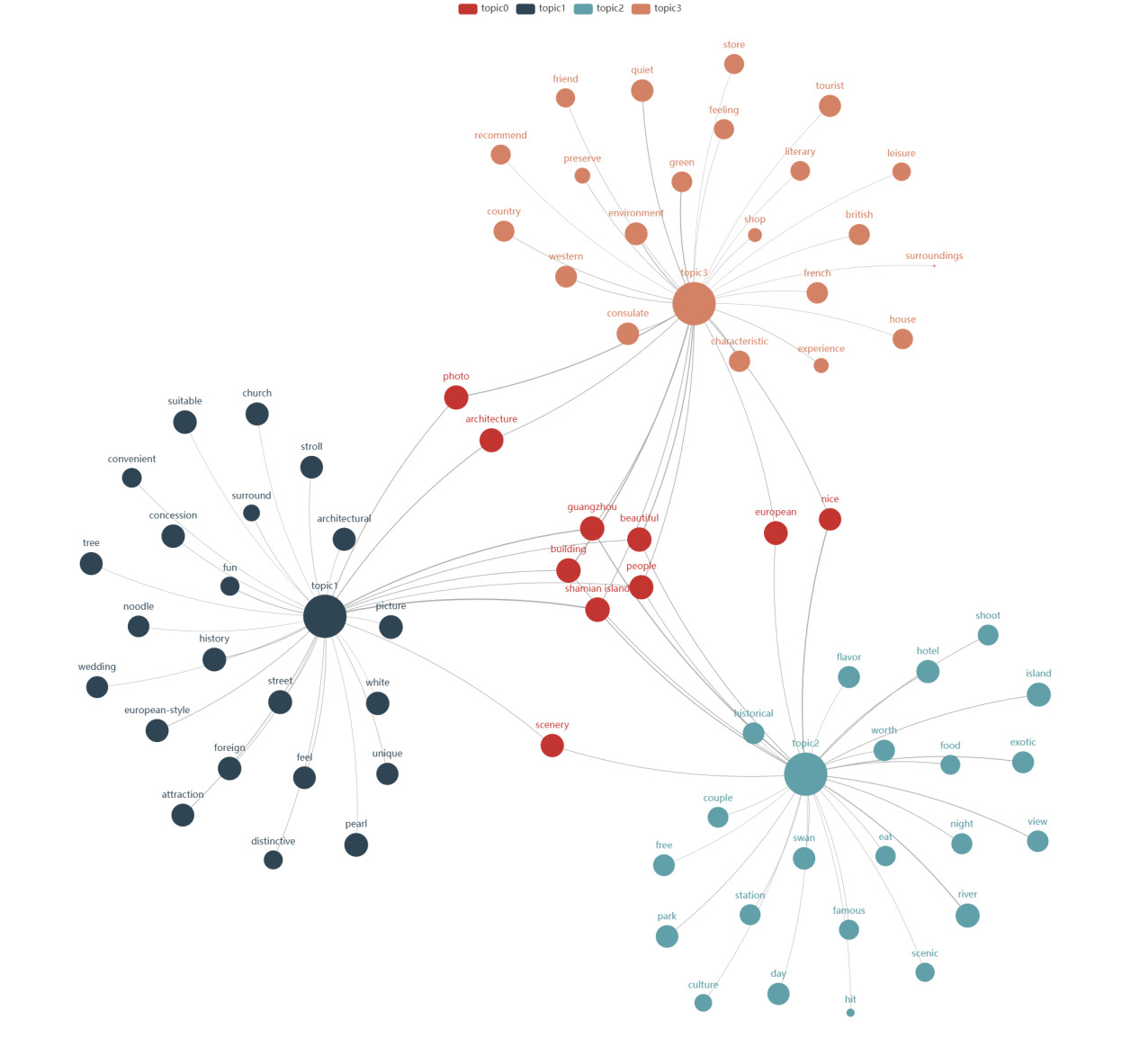
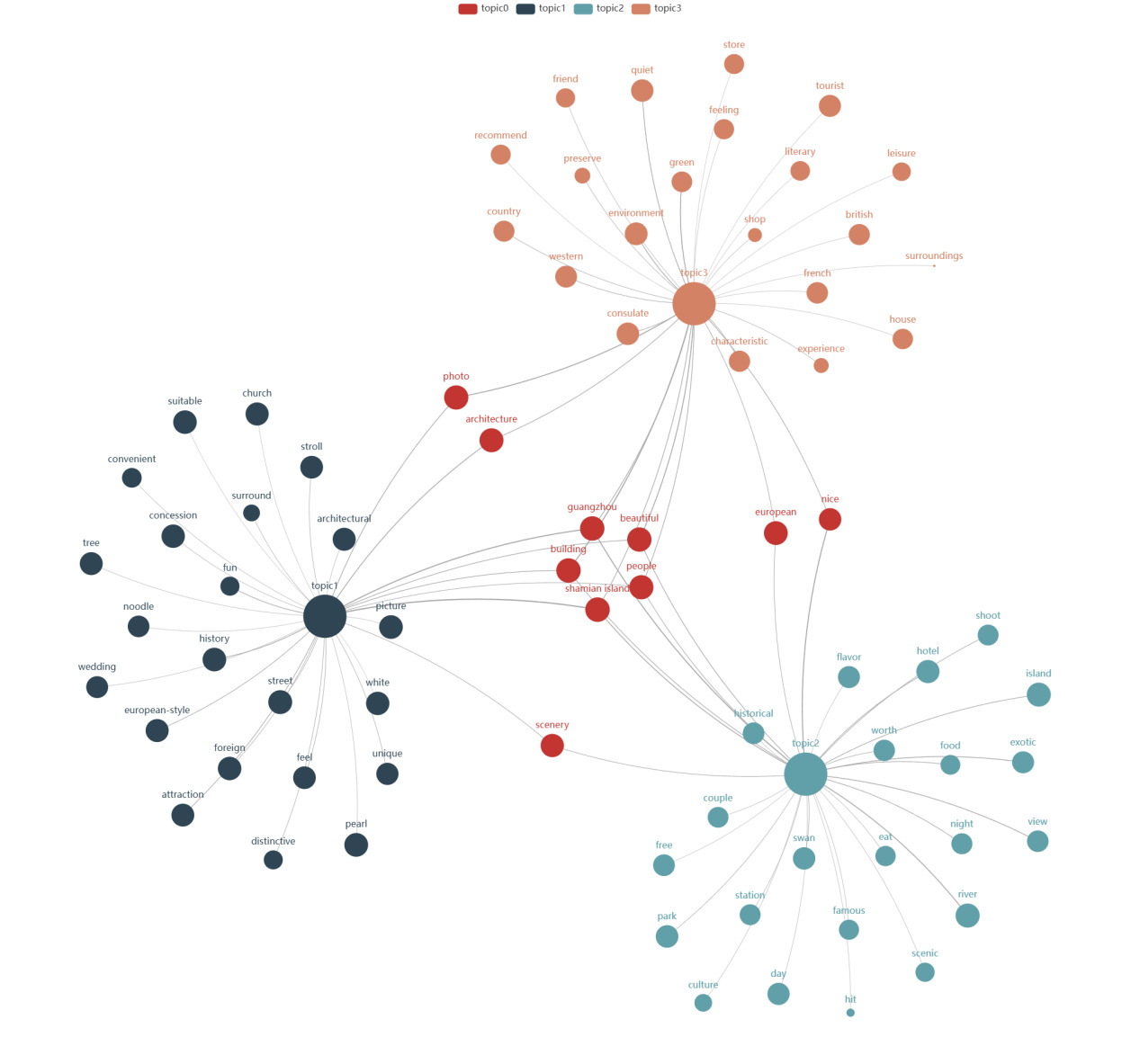
Python software was used to crawl 2,998 written reviews and evaluations about Shamian Island on the Ctrip travel agglomerator platform. The data collection period is from October 2015 to December 2024. Additionally, on the Xiaohongshu platform, relevant information was collected using the (Chinese-language) keywords ‘Shamian’, ‘Shamian in Guangzhou’, and ‘Shamian Island’ to enrich the research materials, which also serve as a supplement to the interview materials. We then conducted an LDA (Latent Dirichlet Allocation) topic clustering analysis on these contents (see Figure 1.
3. Strolling in the Clouds: Perceiving Shamian Island on Media Platforms
Thanks to its history and its official planning and cultural heritage protection, Shamian Island has preserved a striking cultural landscape. On social media platforms such as Xiaohongshu and Douyin, Shamian is listed as a popular check-in scenic spot for online influencers in Guangzhou. Through embodied interactions and experience at a distance, tourists generate a digital sense of place based on social media platforms.
People have different definitions of travel. The travel writer Liu (2021, p. 68)describes travel in a poetic language: “Travel is a journey that follows the folds of the earth and enters a completely bewildering realm. The greatest uncertainty in it is not about arriving, but how to arrive.” In the current era of highly developed digital media, most tourist destinations are presented and disseminated in a panoramic and multidimensional manner, and those ‘completely bewildering realms’ that were once difficult to reach are gradually decreasing. At the same time, empowered by digital media, ‘arrival’ has taken on a new form of expression: the ‘digital flaneur’.
The concept of ‘digital flaneur’ (Yan et al., 2014) originates from Walter Benjamin’s categorization of the character images in Charles Pierre Baudelaire’s works as ‘urban flaneurs’. Benjamin’s description of flaneurs implies the construction of a subjectivity of landscape consumption: This subjectivity is constructed by treating the urban landscape as the ‘other’ and conducting visual consumption of it. In mediatized society, the leisurely viewing through which the subjectivity of landscape consumption is constructed has shifted to reliance on image media. Through various visual media, the viewing subjectivity of the flaneurs has shifted from on-site construction of the urban landscape to the virtual space of non-presence, thus giving rise to digital flaneur (Yan et al., 2014). With the continuous integration of social media into daily life, the dream of motorized infantry described by Dziga Vertov (1929) in Man with a Movie Camera is gradually coming true: People are all equipped with their own cameras and can capture various aspects of life in big cities. In the imagined media city, the crowd is no longer composed just of onlookers and witnesses but also producers and participants (McQuire, 2008). With the popularization of digital technologies, the power of viewing has been further decentralized. The subjects who view the city through digital media have shifted from the previous power elites to a large number of media users scattered across all social strata. This shift not only means that the understanding and interpretation of urban landscapes is no longer limited to the traditional ruling class but also that tourists have the possibility of remote viewing.
The travel agglomerator Ctrip is the most influential one-stop online travel service platform in mainland China. There are many introductions and evaluations of tourist destinations on these online platforms. We used Python to crawl 2,998 evaluations and reviews about Shamian on the Ctrip platform and then conducted an LDA (Latent Dirichlet Allocation) topic clustering analysis on these contents (see Figure 1 below). It was found that the online presentation of Shamian Island mainly revolves around theme words such as ‘building’, ‘beautiful’, ‘photo’, and ‘European’. Digital flaneurs also mainly perceive the local characteristics of Shamian Island from these aspects. Our analysis found that the online presentation of Shamian Island mainly revolves around theme words such as ‘building’, ‘beautiful’, ‘photo’, and ‘European’. Digital flaneurs also mainly perceive the local characteristics of Shamian from these aspects. For example:
[Shamian] was the place I was most curious about before I went to Guangzhou, because it has a strong literary and artistic flavor and a fresh and delicate style. (Ctrip user ‘Florafifle’)
I had been looking at it online for a long time. The transportation is convenient, it has an antique charm, a long history, and picturesque scenery. It’s really worth a visit. (Ctrip user ‘181****2266’)
Shamian can be said to be one of the most famous scenic spots in Guangzhou. The buildings there indeed have a unique style. I read a lot of positive reviews before I went there. (Ctrip user ‘Anlala-Jiaodiudiu’)
As can be seen from the thematic map (Figure 1), the Shamian Island presented by the media is nice, fun, and attractive. People can appreciate the unique charm of the European-style buildings on Shamian online as well as the mottled scenery where sunlight and tree shadows interlace, which evokes the imagination of the living scenes of the islanders at the end of the 19th century and the beginning of the 20th century. It is frequently said that when people are on an island far from the mainland, they will feel a sense of isolation because they cannot easily depart by car or train. However, on the online platform, ‘convenient’ is the most intuitive feeling people have about transportation to and from Shamian. Shamian is separated from mainland Guangzhou by a narrow stretch of water, and although this channel is crossed by bridges, it produces an elusive insularity that heightens the experience of island place. When people view Shamian remotely, they have a sense of connection between the land and the water.
Between separation and connection, Shamian’s special charm is related to its intermediate or interstitial character, to its location in between other sites (Zhang & Grydehøj, 2021). Under the conceptual island-mainland dichotomy, the formation of an island often depends on a series of complex geographical, historical, and political factors and positionings (Kelman, 2023). Since terms such as ‘remote’, ‘isolated’, and ‘marginal’ are often used to describe islands, going to an island usually makes people feel a sense of distancing from the city center. The Shaji Channel separates Shamian from the mainland, and this physical separation strengthens people’s imagination of the island’s exotic or ‘other’ atmosphere. However, the gap does not mean complete separation; it also implies the possibility of connection. For more remote islands, ferries and airplanes are common ways of connecting the island to the mainland or other islands, but they serve different purposes from, provide less predictability than, and foster different senses of islandness than do fixed links (Grydehøj & Zhang, 2020; Hayfield & Pristed Nielsen, 2022; Leung & Baumeister, 2024). On Shamian, there are three bridges specially designed for slow-moving traffic (such as pedestrians and bicycles etc.) and two bridges that can accommodate motor vehicles with two-way two lanes. These bridges connect the island and the mainland, making passage to and from Shamian convenient, fast, and possible in all weather.
The emergence of location media has provided people with new approaches and perspectives to understand Shamian. Location media refers to media with location awareness functions. Social media platforms such as Xiaohongshu, Weibo, and WeChat all allow users to choose to mark their location when posting information. Users can not only maintain contact through the online social functions of location media but also learn about the places marked by location media through the virtual traces left by their friends or family members (Humphreys & Liao, 2013). Moreover, people attach great importance to others’ descriptions of geographical locations and use others’ past experiences to prepare for their own experiences when getting to know a place. In the online evaluations of Shamian, locations such as ‘station’, ‘church’, and ‘consulate’ often appear (Paay & Kjeldskov, 2007). Evidently, the marking of online location media helps digital flaneurs obtain a preliminary perception of Shamian.
In addition, words such as ‘historical’, ‘exotic’, ‘unique’, and ‘distinctive’ are often used online to describe Shamian’s environment. Schalansky (2010) writes:
An island offers a stage: everything that happens on it is practically forced to turn into a story, into a chamber piece in the middle of nowhere, into the stuff of literature. What is unique about these tales is that fact and fiction can no longer be separated: fact is fictionalised and fiction is turned into fact. (pp. 19-20)
Shamian provides a stage for exotic imaginations. People can freely view it through digital media, adjust the viewing angles and distances, and ‘enter’ or ‘leave’ at any time. On social media platforms, users view Shamian through rapid visual appropriation behaviors. The consulates, churches, banks, foreign firms, clubs, hotels, and other buildings on the island, as well as the clean and orderly streets shaded by green trees, are carefully composed in photography and presented with filters, becoming ideal scenes of island life, constructing the viewers’ preliminary perceptions of Shamian.
4. Embodied Practices: Media Pilgrimage and Scenic Spot Check-in
In recent years, on social media, ‘check-in’ has gradually become a general term for a type of behavior: people go to a certain destination and share their travel experiences of that destination in the form of texts, photos, videos, etc. When an individual is attracted by the media narrative of a tourist destination, goes there in person and shares the experience, this behavior becomes a media pilgrimage. Turner and Turner (1978, p. 99) regard ‘pilgrimage’ as a kind of ‘symbolic journey’, during which people “show great respect and have a full sense of participation”. Nick Couldry (2002, 2005) transplants Turner and Turner’s interpretation of pilgrimage into mediatized tourism and believes that the behavior of contemporary tourists traveling to actual places in order to participate in media narratives is itself a ‘media pilgrimage’; media pilgrimage transcends the inner and outer worlds of the media. That is, the boundary between the media and reality becomes blurred. As a kind of travel experience, it has changed the ways, places, and demands of people’s travel, making travel more of an activity in pursuit of symbolic meaning, rather than having absolute expectations for the ‘authenticity’ and ‘differences’ of landscapes as in traditional tourism (Jiang & Guo, 2020). Whenever a tourist attraction or a travel mode becomes popular online, it is very likely to trigger a ritual carnival within a certain range, and people will replicate the same group photos with fixed camera positions and postures at the check-in spots. Therefore, check-in is not limited to physically arriving at a certain place but also requires the completion of a series of stylized rituals required by media pilgrimage (Couldry, 2005). People’s perception of places is constantly refreshed in the interweaving of the virtual and the real.
The check-in behavior, as a real-world extension of digital flaneur, stems from people’s expectation to verify the authenticity of the digital sense of place and satisfy their inner attachment to the place. Sometimes, the symbolic meaning of arrival surpasses the tour itself. Virtual reality, social media, online maps, and other digital tools have enriched the possibilities for individuals to connect with physical or virtual places (Dai & Liu, 2024). People obtain the perception of Shamian from the travel texts in online communities, which triggers their yearning for exotic customs and their desire for unique spatial experiences. Therefore, they flock to Shamian Island to verify it in person.
The sense of distancing inherent in the island itself provides a script for the imagination of defamiliarization. As Lin and Su (2022) write of historical textual representations of Shamian in the late 1800s and early 1900s:
A vague ‘Italianness’ provided a sense of pastoral, nostalgic, and warmhearted prettiness that was a signifier of the utopian ideal that the architecture and their literary and cultural representations strove to express. … an Edenic, paradisical, picturesque, orderly, and harmonious society. (pp. 42-43)
However, neither the utopian island in historical textual representations nor the remoteness pursued by today’s tourists is a geographical isolation in the true sense. Instead, it is more of a spiritual distancing. This is reflected in the online comments of tourists:
When I arrived in Guangzhou, my friend recommended that I visit Shamian Island, so I made a special trip there. As expected, it is a place with unique characteristics. Its terrain is an island, but it can be directly accessed via several bridges. Shamian Island can be regarded as a complex of architectural masterpieces from various countries. There are more than a hundred European-style buildings with different styles, as well as various sculptures, churches, and so on. Obviously, from these remaining buildings, one can feel that this place used to be a place that highlighted Western culture. Ancient banyan trees can be seen everywhere on the roads. They are lush and full of vitality, with their dense foliage blocking out the sun, and the air is particularly fresh. Judging from the signs on the doors of some well-known buildings, one can tell the original stationed institutions, and overall, they are all well-preserved. When entering Shamian Island, it feels like stepping into a Western-style garden. There are quite a few tourists, and there are also many people taking wedding photos. Of course, finding a café and sitting down to have a cup of coffee is also very charming, and the exotic atmosphere is extremely strong. (Ctrip user ‘Qiuqu’)
Shamian… There are many unique European buildings on the island from the end of the 19th century… It is still under semi-closed management nowadays, with traffic restrictions in place. It is really special to have such a place in the bustling city of Guangzhou. (Ctrip user ‘Sally Moxue’)
Shamian forms a natural spatial break with the old urban area of Guangzhou’s adjacent Liwan District through the waters of the Shaji Channel and the Pearl River. At the same time, it maintains convenient accessibility by means of bridges, creating a special locational state of being neither fully integrated into the city nor completely isolated from it. This just-right sense of distance helps people to detach from their daily lives to a certain extent and motivates them to make a media pilgrimage to the island. The tourist descriptions of ‘semi-closed management’ and ‘traffic restrictions’ further reveal Shamian’s perceived otherness. That is, even though urbanization processes have shaped Guangzhou into a ‘vertical city’, Shamian’s historical and cultural protection policies preserve it as a utopian enclave that counters the anxiety of modernity.
Of course, during the in-person media pilgrimage, some people will feel that the on-site visit does not fully match the sense of place shaped by the media, thus creating a psychological gap of expectation violation. This gap is due to the filter effect or one-sided presentation of the media, which is an almost inevitable practical problem in media pilgrimage. However, it is precisely these psychological gaps that have reconstructed people’s sense of place towards Shamian. Some tourists say in interviews and online:
Actually, the scenery of Shamian Island is still very beautiful. But after I came here, I felt that there were quite a lot of people, and cameras were everywhere. Some of the photos on the internet have obvious signs of being retouched. Online merchants and travel bloggers only show the good aspects of Shamian Island. After I came here, I realized that there is actually a certain gap. (YTJ, 19 years old, student)
I went to Shamian Island on the weekend and found that it has become a paradise for photo shoots in Guangzhou. The streets are full of young people taking photos… I even had to queue up for an ordinary camera position. It’s so scary! (Xiaohongshu user ‘Yijiu Wuhuanan’)
The check-in route maps on the internet transform the buildings scattered across the island into locational media, connecting the points into lines in the form of images. The historical introductions to these locations, provided by signage, reveal the unique cultural connotations of each coordinate. Tourists walk along the established route, stereotypically looking for one geographical landmark after another, and taking photos in poses imitating those in online posts, thereby completing the media pilgrimage ceremony planned in the travel guide. These filtered depictions echo Baudrillard’s concept of simulacra, wherein the mediated ‘Shamian’ replaces the lived reality of the island. In this process, tourists shuttle between physical location and virtual space, and conduct interactions across time and space with the bloggers and netizens behind the online texts, verifying one by one the sense of place shaped by the digital flaneur. Here, the media pilgrimage behaviors of tourists, such as checking in at scenic spots and taking check-in photos, are like an unorganized, trend-following orienteering game, shaping a new local landscape and reconstructing Shamian’s local culture.
5. Dual Co-Constitution: The Tourist-Merchant Nexus in Weaving Sense of Place
Although digital media provide platforms for constructing place identity, individuals are not merely transient visitors to places; through their interactive engagement with locales, people continuously reinforce their roles as co-producers of place imagery and participate in the reproduction of local discourses (Zhong, 2018). In the mediated practices of Shamian Island, neither tourists nor merchants merely mechanically reproduce cultural symbols through visual representations. Instead, they integrate multisensory experiences (visual, auditory, olfactory, and gustatory) evoked by cultural symbols into their affective networks, thereby constructing authentic lived experiences and subjective perceptions of place identity. These personalized place experiences are subsequently amplified through digital media channels, ultimately giving rise to collective cognitive frameworks of place.
Descriptions of Shamian Island often include words like ‘sunlight’ and ‘light and shadow’. Tourists and merchants intentionally select and edit images that conform to contemporary aesthetics. Strong colors can catch the eye and attract traffic at first sight, coupled with delicate and warm words, presenting viewers with a dreamlike island scenery:
Sunny days are perfect for strolling on Shamian. Bathed in sunlight, the island exudes an inherent dreaminess. Elegant European buildings stand silently, with sunlight filtering through foliage to dance across walls in autumn breezes. (Xiaohongshu user ‘Titi’)
I wish to recommend this romantically enchanted place to every friend—for its beauty lies even in how sunlight weaves patterns through the foliage. (Xiaohongshu user ‘CoffeeBeanUtopia’)
Traditional historiography and literature have long constructed islands as autonomous visual symbols. Yet in the digital media era, as individuals are immersed in multisensory environments mediated by technology, there emerges a tendency to integrate multisensory experiences (visual, auditory, olfactory) into the local perception of Shamian from a synaesthetic perspective:
Elderly people singing, dancing, and playing the harmonica as well as schoolchildren’s reading voices and laughter fill the air. (Xiaohongshu user ‘Wangwangma’)
Birds chirp melodiously at 7 a.m. every morning outside the hotel. (Xiaohongshu user ‘Spring’)
The air is permeated with camphor tree fragrance. (Xiaohongshu user ‘Zl83325’)
A breeze carries floral fragrance, invigorating the senses and intoxicating the soul! (Xiaohongshu user ‘Emilee77’)
In today’s mediatized society, the human concept of space is undergoing a structural transformation: Space is no longer the extensibility of material movement, but rather concrete sites constituted by human activities and their relations. Space ceases to be abstract, homogeneous, and infinite; it becomes heterogeneous, concrete, and finite (Wang X.F., 2009). Shamian, separated by water from Guangzhou’s bustling urban scene, stands as an otherworldly enclave with exotic charm, fulfilling the consumer era’s longing for rustic authenticity:
The aromatic scent of plants in the air is enough to dispel the fatigue of overworked professionals all day…There’s no need to worry about getting perfect photos or planning check-in routes—every corner radiates beauty. Even aimlessly wandering allows one to soak up abundant energy… Alone here, one can fully enjoy cozy and leisurely moments. (Xiaohongshu user ‘Titi’)
Take an afternoon off from work to stroll around—both body and mind will feel relaxed and rejuvenated, filled with a sense of calm. (Xiaohongshu user ‘Finger Puppet Breeder’)
[Shamian] is ideal for leisurely walks, observing every building and tree. Adjacent to the Pearl River, the evening river views are equally stunning. (Xiaohongshu user ‘Heysunny9’)
In an accelerated society, people often experience spiritual emptiness within the media-fashioned fast-paced and fragmented spatiotemporal context, seeking resistance through digital cloaking or returning to nature to attain temporary psychological relief. The acceleration of technology, societal transformation, and temporal rhythms has resulted in the distancing of modern society’s spatial-temporal mechanisms. Space, it seems, virtually ‘contracts’ and loses its significance for orientation in the late modern world; processes and developments are no longer located, and locations become ‘non-lieux’, without history, identity, or relation (Rosa & Scheuerman, 2009, p. 82). Places increasingly become ‘non-presences’ detached from history, identity, or relationality. Media strategically deploy curated images, texts, audio, and video to construct successive ‘dream islands’, arousing desires to escape urban cacophony and seek spiritual refuge. Increasingly, people are beckoned by these ‘fantasy archipelagos’, flocking to the islands before weaving their individual experiences of ‘leisure’ and ‘tranquility’ into the local perception of place.
Under the influence of digital media, Shamian’s physical geographical presence is expanded—often romantically and fantastically—online. Working in a symbolically laden site of cultural-geographical import, endowed with feelings such as habitation, freshness, and healing, Shamian’s vendors cultivate an atmosphere of tranquil beauty. On digital platforms, coffee, tea, aromatherapy products, and handicrafts are juxtaposed with backgrounds of blue skies, white clouds, and river views. The poetic atmosphere of the island is infused into commercial products and offerings. Products symbolizing ‘slow living’ align with Shamian’s environmental ethos, creating distinctive local experiences for visitors. In this way, tourist productions of the island online drive commercial product development and marketing, which in turn feed back into tourist experiences and representations. Shamian becomes a zone of continual visitation, consumption, and transformation as a heritagized leisure enclave within the bustling metropolis.
6. Human-Island Relations: Affective Bonds, Mnemonic Geographies, and Relational Reconstruction
Digital media’s discursive construction of Shamian simultaneously shapes local spatial imaginations and fosters affective connections among tourists, residents, and the island itself. Beyond serving as a geographical coordinate, Shamian functions as a socio-spatial container for both individual and collective memories. For its inhabitants, the island represents not only a living community but also an emotional nexus and mnemonic site. The widespread dissemination of its historical and cultural narratives attracts visitors to engage in ‘place-checking’ practices, invisibly reinforcing local residents’ identity formation and cultural pride:
Ancient Shamian remains worthy of recommendation both past and present. While renovations have transformed many areas, traces of familiar ambience persist. Shamian has always been Guangzhou’s unique gem, preserving this irreplaceable character. (CDG, 68, retired worker)
For former residents, viewing Shamian’s check-in posts on digital platforms evokes cultural memories and place attachment:
As a child, I lived here with my grandparents. Later we moved away, but I still recall the dark, creaking staircase and the shared kitchen at the end of the corridor. My memories are fragmented, yet Shamian today—after multiple renovations—still retains traces of that era. While it wasn’t particularly good in the past, those memories remain precious. (Xiaohongshu user ‘Bunbun’)
Sharing Shamian check-ins becomes a performative exhibition of tourists’ personal experiences. Through carefully crafted digital narratives (textual, visual, and video content), tourists construct aesthetic representations of the island’s charm, receiving social validation and recognition through media interaction. As a Ctrip user observes:
This place can be fully explored in two hours. Its architectural uniqueness truly embodies Guangzhou’s historical evolution—more captivating than any modern steel-and-glass structures. Many couples were taking wedding photos there, creating such a poetic atmosphere. It is perfectly suited for artistic youths who appreciate ambiance in every corner. (Ctrip user ‘Keen’s Bag’)
The Shamian Historical-Cultural District renovation and enhancement project was completed in 2019, focusing on three key aspects: architectural facades, municipal roads, and lighting systems, aiming to restore the island’s European continental aesthetics. For instance, spotlights were enhanced on neoclassical and neo-Gothic buildings, while the contrast of light and shadow on Gothic gables was accentuated—spatial translations of social media’s visual aesthetics and precise responses to users’ nocturnal photography demands. Simultaneously, spatial layout optimization involved demolishing eight originally scattered parking lots and converting these areas into public activity zones totaling 8,200 square meters, thereby enhancing the island’s visitor reception capacity. Driven by these initiatives, Shamian was designated as a National 3A-Level Tourist Attraction in 2022, ranking among Guangzhou’s top travel destinations on major Chinese tourism apps, demonstrating its pivotal role and influence within the city’s cultural tourism industry.
However, after the implementation of these environmental renovation projects and the completion of corresponding commercial projects, tensions have emerged in the human-island relationship. On the one hand, tourism development has brought economic benefits and employment opportunities to local residents. On the other hand, the influx of large numbers of tourists has impacted local residents’ attachment to and sense of familiarity with Shamian’s cultural environment. This prompts reflections concerning conflicts between the protection of cultural heritage and tourism development.
It used to be very quiet. There were only two bridges, and no vehicles could enter. Now that it’s opened up, the whole island has become very lively. (CSG, 72 years old, retired)
I’ve come across numerous posts criticizing Shamian’s inadequacies—insufficient restrooms, limited dining options, parking scarcity, and suboptimal planning. As a local resident, I fully concur with these critiques! This was fundamentally designed as a leisure-oriented enclave. How could it possibly accommodate such overwhelming tourist influx? The island’s infrastructure, from buildings to road networks, follows century-old urban blueprints. Vacant lots don’t automatically translate to expandable tourism facilities. (Xiaohongshu user ‘A Brief History of Time’)
These individual narratives highlight the subtle transformations in traditional human-island relations during Shamian’s formation of a digitally mediated sense of place:
Some residents take pride in living here, considering the environment superior to areas beyond the island; others hold contrasting views. Younger generations aspire to reside in high-rise buildings equipped with modern amenities like elevators for convenience. However, Shamian Island’s century-old architecture remains legally protected under governmental preservation mandates prohibiting structural modifications. (CSG, 72 years old, retired)
This interviewee’s perspective embodies the intergenerational divergence in residential environmental preferences within Shamian’s distinctive cultural-historical spatial context. For some residents, the island transcends mere physical habitation, evolving into a semiotic entity through which they perform identity articulation and affective belonging on digital platforms.
Furthermore, media-savvy users actively advocate on digital platforms for governmental intervention to safeguard Shamian’s historical integrity and tranquil ambiance. This dynamic underscores that while governmental authorities hold a pivotal role in cultural heritage conservation through policy formulation and implementation, historical-cultural sites should not be reductively framed as mere resources requiring conservation.
7. Conclusion
Scott McQuire (2008) posits that the media assemblages characterized by increasing fluidity, real-time mutability, and permeation into localized spatial matrices collectively constitute the foundational architecture of contemporary society’s distinctive experiential modalities. The significance of digital media for Shamian Island lies not only in providing a new stage for constructing its digitally mediated sense of place, but also in compelling individuals to continually reinforce their agency within participatory place-image production through island interactions. Under the dual dynamics of mediatization and globalization, the human-place relationship at Shamian manifests novel complexities—where Lefebvre’s lived space collides with Baudrillard’s hyperreal simulacra, and local memories negotiate with algorithmic curation. The media city is not simply a city represented through media, but a city whose very material fabric and social dynamics are reconstituted through media processes (Yuan & Zhao, 2021).
Emergent media technologies and platforms have redefined Shamian’s semiotic value and symbolic significance as an island and as a tourist destination, forging a digitally mediated sense of island place that transcends physical spatial constraints. Digital practices have reshaped the logic of connection between humans and Shamian Island. Check-in sharing and image communication linked by social media algorithmic recommendations have transformed Shamian Island from a physical space into a time-space-transcending carrier of digital symbols, rendering human-environment relations no longer confined to embodied interaction based on physical presence but endowed with the dual dimensions of virtuality and reality. Simultaneously, practices of ‘media flâneur’ and ‘media pilgrimage’ intensify tourists’ cognitive-affective bonds with the island, transforming it from local residents’ lived space into an open influencer tourism space. This process not only involves the mediatized representation of place identity, but also triggers local residents’ reflections on cultural belonging and place attachment. While commercial redevelopment has generated substantial economic returns for Shamian Island, it has inevitably disrupted the cultural ecology and community fabric. Such impacts manifest through material spatial restructuring and profoundly reshape residents’ mnemonic geographies, cultural identification, and affective ties to place. In an era of infinitely fluid and permeable place boundaries, critical questions demand urgent interrogation: how can we reconcile digital mediation with place-based cultural logics, and how can we strategically leverage digital platforms while safeguarding local distinctiveness? These constitute pressing dilemmas requiring sustained theoretical and practical engagement.
Funding
The authors disclose receipt of the following financial support for this research: This work was supported by General Program of the National Social Science Fund of China (grant number 21BMZ021).