
1. Introduction
Tourism employees are central to tourism services and the visitor experience, and to the prospects of achieving Agenda 2030 and the Sustainable Development Goals (SDGs). If employees are treated fairly in terms of wages, working conditions, training, and benefits, the sector can become a vehicle for poverty reduction (SDG 1), gender equality (SDG 5), inclusive growth through decent work (SDG 8), and reduced inequalities (SDG 10). A growing body of research supports the premise that fair remuneration, adequate working environments, structured training pathways, and comprehensive social protections constitute a critical vector for advancing multiple SDGs. The institutionalisation of decent work contributes to poverty alleviation through income regularity and stability (D. Lee et al., 2015; Naidoo et al., 2019), facilitates gender equity by enhancing women’s access to formal labour markets and professional trajectories (Ngo et al., 2023), and attenuates socioeconomic disparities in structurally dependent tourism economies (Hampton et al., 2018).
Evidence from small island contexts further reveals that tourism employees often face heightened economic vulnerability and lower levels of well-being, particularly in times of systemic crisis (Peterson & DiPietro, 2021). Beyond these immediate effects, recent studies have drawn attention to the strategic interlinkages between SDG 8 and SDG 14 in island states, arguing for integrated policy frameworks that embed skills development and labour protections within ocean-based economic planning (Nisa et al., 2022). Taken together, these contributions reaffirm the centrality of employment quality in tourism not only as a mechanism for safeguarding individual well-being, but as a structural pillar for inclusive and sustainable development in island economies.
While recent literature has begun to link employee well-being with service quality and sustainable development (Chen, 2020; Sigala, 2021), the human dimension of sustainability remains under-examined, particularly in tourism-dependent and structurally vulnerable contexts. In SIS, the intersection of tourism dependency, weak institutional capacity, and exposure to external shocks magnifies the importance of employment quality as a vector of sustainable development.
From a broader development perspective, there is a notable absence of a holistic-centred agenda for sustainable tourism employment within the wellbeing frameworks guiding tourism development in many destinations (Ioannides et al., 2021; Maggi & Vroegop, 2023). In this context, the present work conceptualises such an agenda as an integrated approach that links the material conditions of work—such as employment stability, fair remuneration, and the enforcement of labour rights—with the broader social and developmental functions of employment. Sustainable tourism employment, in this sense, refers to forms of labour that not only fulfil baseline standards of decency and security but also expand employees’ capabilities and contribute to the resilience and cohesion of tourism-dependent communities. Employment is thus understood not merely as an economic output but as a mechanism that links livelihoods to collective aspirations for equity and sustainability.
Yet, despite the growing relevance of this perspective, the concept of sustainable tourism employment remains underdeveloped in current wellbeing-oriented tourism agendas (Maggi & Vroegop, 2023; Robinson et al., 2019). This oversight in tourism scholarship is of concern because employment precarity in the tourism sector seems to be a widespread problem in a significant number of economies (Antonucci, 2018; Hampton et al., 2018). The tourism industry, focused as it is on guest satisfaction, is inherently at odds with the objectives centred around attaining a harmonious equilibrium between professional commitments and personal life, and far from tackling systemic and structural challenges to the delivery of decent work opportunities as mandated under SDG8 (Robinson et al., 2019). If not properly managed, tourism sustains employment precarity and contributes to deep social cleavages and socioeconomic inequalities (Robinson et al., 2019).
Because of the COVID-19 pandemic, the situation of tourism employees was aggravated when they faced mass lay-offs, affecting their psychological well-being, placing them in difficult financial circumstances, and forcing many to take jobs outside the sector (Chen, 2020; Kimbu et al., 2023). Thus, the importance of employment quality has escalated to become a top priority for many tourism employers and policymakers with the assumption that prioritising personal well-being will lead to improved productivity and service quality (Maggi & Vroegop, 2023).
In SIS, limited economic diversification leaves labour forces with few alternatives beyond the tourism sector. This structural dependency heightens workers’ exposure to job insecurity and precarity, as tourism employers often operate as de facto monopsonies in local labour markets (Hampton et al., 2018; J. S. Lee et al., 2015). The resulting asymmetry of power constrains employees’ ability to negotiate working conditions and undermines their well-being (Ngo et al., 2023). In this context, tourism becomes both a livelihood and a limiting structure, shaping the boundaries of individual capabilities and reinforcing socio-economic vulnerabilities endemic to island economies.
However, the literature on this topic remains largely grounded in Global North contexts, relying on market-based logics and individualised notions of well-being that fail to capture the socio-cultural and structural realities of Global South settings. In the case of SIS, limited economic alternatives heighten workers’ dependence on tourism, reducing their bargaining power and increasing exposure to precarity (D. Lee et al., 2015; Ngo et al., 2023). Employers often exercise disproportionate influence over local labour markets, shaping working conditions in ways that directly affect employees’ well-being and capacity to negotiate better terms (Hampton et al., 2018).
It is thus of concern that there are limited number of research articles on tourism employee well-being in SIS (D. Lee et al., 2015; Naidoo et al., 2019; Norizan et al., 2016; Sinclair-Maragh et al., 2017; Yosuke et al., 2012). There is a need to consider measurement approaches that are suited to SIS particularities. In response to these gaps, this study pursues two main aims: (1) to critically examine the limited integration of employment quality and employee well-being within sustainable tourism agendas in Small Island States (SIS); and (2) to build a multidimensional framework for assessing sustainable tourism employment, grounded in existing literature and empirical insights in SIS.
While the island territories discussed in this study are commonly classified as Small Island Developing States (SIDS) under United Nations frameworks, we adopt the broader term Small Island States (SIS) throughout this article. This choice reflects our focus on structural and geographical conditions—such as insularity, economic concentration, and labour market fragility—rather than on development status per se. This allows for a more inclusive and flexible analytical lens that can accommodate both Global South and Global North island contexts, and aligns with the conceptual emphasis on islandness as a structural condition influencing employment and well-being. Moreover, the study is primarily concerned with addressing the limitations of Global North-derived frameworks by adapting them to the socio-economic and institutional specificities typically found in Global South Island settings.
To achieve this, the article is structured in three parts. First, it reviews the literature on employee well-being in tourism and introduces a multi-level model of sustainable human development in tourism. Second, it presents empirical data from fieldwork conducted in five SIS between 2019 and 2022, leading to a tailored framework for assessing employee well-being in these contexts. Finally, it concludes with policy recommendations to align labour practices in SIS with the objectives of Agenda 2030.
2. Literature review: tourism employee well-being in academic discourse
In this section, a critical examination of the literature was conducted to identify the main dimensions that should be used to measure tourism employee well-being.
2.1. The role and measurement approaches of tourism employee well-being
Most studies on tourism employee well-being stem from Global North perspectives, adopting capitalist standards and offering fragmented views mainly focused on organisational and HR-oriented approaches. In contrast, research on SIS often adopts more holistic perspectives (D. Lee et al., 2015; Naidoo et al., 2019; Norizan et al., 2016; Sinclair-Maragh et al., 2017; Yosuke et al., 2012), aligning better with the goals of decent work (SDG-8, SDG-5), inequality reduction (SDG-10), and poverty alleviation (SDG-1). If Global North frameworks are adopted uncritically in SIS contexts, they may lead to biased conclusions and promote precarious employment policies.
Following the COVID-19 pandemic, interest in the multidimensional nature of employee wellbeing has grown (Baum et al., 2020; Chela-Álvarez et al., 2022; Matanzima & Nhiwatiwa, 2022; Ngo et al., 2023). Dileep et al. (2022), for instance, propose a psychological well-being model including stages from apathy and panic to recovery and adaptation. This shift reflects a trend toward moving beyond job satisfaction as the primary proxy for well-being (Carrillo et al., 2020; Y. Lee et al., 2022; Reijonen, 2008; Wan & Chan, 2013), favouring the more inclusive concept of quality of work life, which considers economic, health, educational, and personal needs (Demirdelen & Alrawadieh, 2022; Uysal & Sirgy, 2019; Wahlberg et al., 2017; Xu et al., 2022).
Nonetheless, the organisational lens still centralises the employer as the main actor responsible for wellbeing, while broader sustainable tourism agendas remain underdeveloped (Ioannides et al., 2021). The concept of tourism precarity (Yang et al., 2022) has revealed how Global North criteria—such as salary, temporality, and job security—neglect broader social and ethnic inequalities present in tourism employment across diverse contexts (Porto & Garcia, 2022; Valente et al., 2023). For example, Hampton et al. (2018) show how ethnic stratification in Mabul (Malaysia) affects salaries and job quality, demanding inclusion in wellbeing frameworks.
In SIS, tourism dependency and the lack of robust welfare systems heighten vulnerability (Hampton et al., 2018; Ngo et al., 2023; Robinson et al., 2019). Crisis management responses often exacerbate inequalities and unemployment (Matanzima & Nhiwatiwa, 2022), and despite rising tourism demand, structural precarity persists (Bates et al., 2019). For instance, Lee et al. (2015) highlight that Seychelles’ reliance on external frameworks fails to improve employment quality substantively. Therefore, holistic approaches are essential to address broader wellbeing concerns in SIS (Naidoo et al., 2019).
Recent research has integrated broader life dimensions, including relationships with the natural environment (Valdivielso & Mackenzie, 2022), convivial wellbeing—such as family and social life (Carrillo et al., 2020)—and civic dimensions (Peters et al., 2019). Yet, well-being remains a variable concept, shaped by the researcher’s focus. For example, Sinclair-Maragh et al. (2017) assess well-being in Jamaica through job satisfaction and conclude that “the majority of the employees are happy,” though this approach risks oversimplification. Similarly, Norizan et al. (2016) claim that tourism in Langkawi is “quite rewarding,” as it provides alternatives to traditional livelihoods. However, well-being perceptions also depend on the standards held by individuals themselves (Alrawadieh et al., 2020; Ari et al., 2020).
2.2. The multi-level model of the sustainable human development of tourism
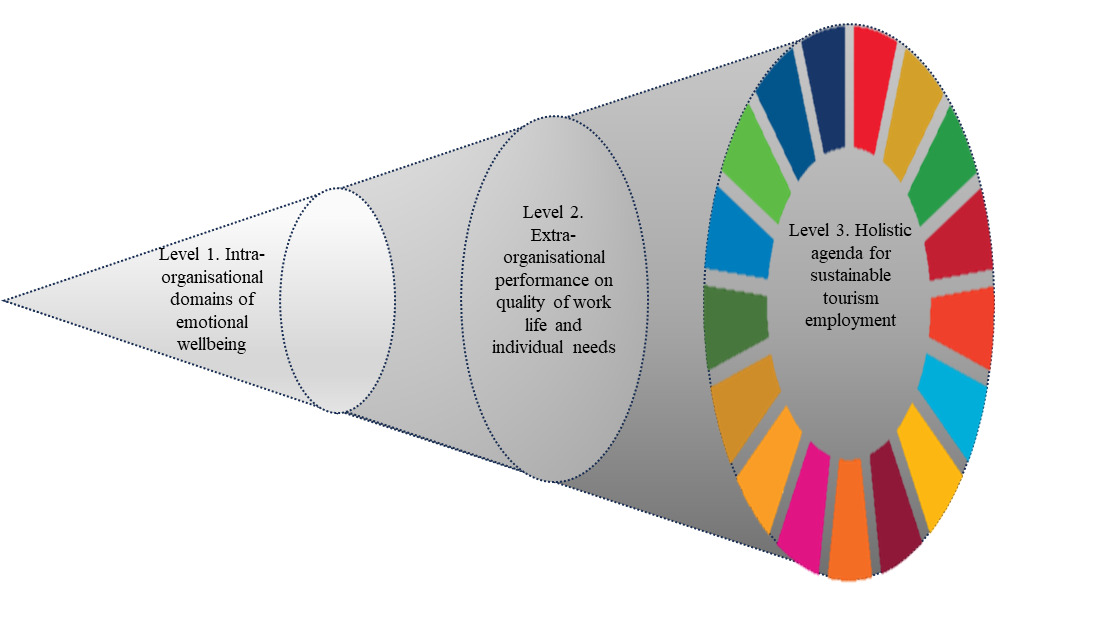
Building on the need to integrate human sustainable development into well-being agendas—particularly in Small Island States (SIS)—this study proposes a multi-level model to assess tourism employee well-being. Derived from a structured review of the literature, the model identifies three interrelated levels that reflect both the evolution of academic approaches and the expanding scope of well-being dimensions in the tourism sector (Figure 1).
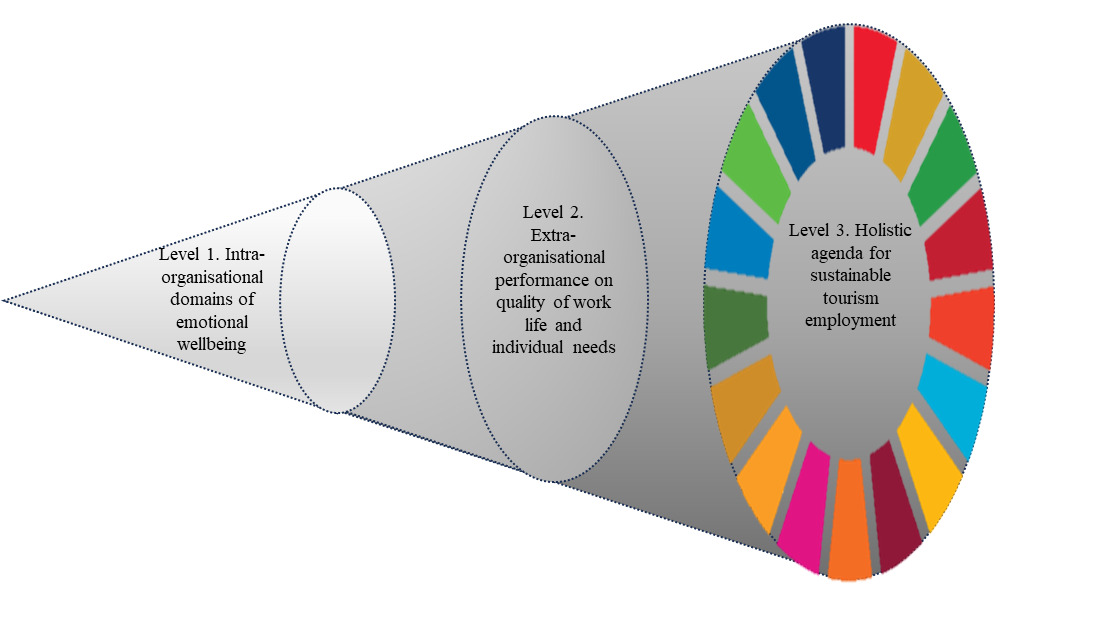
The first level focuses on intra-organisational well-being and is typically associated with pre-pandemic research, where employee well-being was primarily assessed through job satisfaction and workplace-related factors. This includes indicators such as salary, workload, organisational structure, and relationships with colleagues. Such dimensions were largely confined to the internal environment of tourism organisations (Carrillo et al., 2020; Lillo-Bañuls et al., 2018; Reijonen, 2008; Sinclair-Maragh et al., 2017; Wan & Chan, 2013) and continue to dominate much of the academic discourse (e.g., Ariza-Montes et al., 2021; Bai et al., 2023; Y. Lee et al., 2022; Tripathi & Kumar, 2023).
The second level broadens the scope to extra-organisational well-being and gained prominence during the COVID-19 pandemic, which exposed the entanglement of work and personal life. The crisis introduced unprecedented challenges that affected not only the workplace but also individuals’ health, economic stability, educational trajectories, and social well-being (Alrawadieh et al., 2020; Carrillo et al., 2020; Chang et al., 2019; Demirdelen & Alrawadieh, 2022; Dileep et al., 2022; Matanzima & Nhiwatiwa, 2022; Ngo et al., 2023; Porto & Garcia, 2022; Uysal & Sirgy, 2019; Valdivielso & Mackenzie, 2022; Xu et al., 2022). This level incorporates how tourism employers influence these broader life domains, recognising that employee well-being extends beyond the workplace to include family life, physical and mental health, and interaction with natural and cultural environments. Although some earlier works had already advocated for a more holistic understanding of well-being (e.g., Hsiao et al., 2015; Inoue et al., 2012; Lillo-Bañuls et al., 2018; Terry, 2018; Wahlberg et al., 2017), the pandemic intensified their relevance and made them more visible in mainstream research.
The third level introduces a systemic perspective: a holistic agenda for sustainable tourism employment aligned with global development goals such as decent work (SDG-8), gender equality (SDG-5), poverty reduction (SDG-1), and reduced inequalities (SDG-10). It emphasises that well-being outcomes are not solely the result of organisational policies, but are shaped by broader institutional, policy, and community contexts. This perspective is grounded in recent scholarship advocating for shared responsibility among employers, governments, and civil society (Ari et al., 2020; Ioannides et al., 2021; Maggi & Vroegop, 2023; Peters et al., 2019; Robinson et al., 2019). The far-reaching impacts of the pandemic on employment, public health, and social cohesion underscore the limitations of narrow, organisation-centric approaches. This level, therefore, calls for co-constructed strategies that engage multiple actors in the promotion of sustainable and equitable tourism employment.
As a key conclusion of this stage, it became clear that most existing studies focus on countries in the Global North, where labour conditions and employment protections differ substantially from those in Global South contexts. These approaches are often underpinned by individualist and productivity-driven standards and offer a fragmented and partial vision of employee well-being (Table 1). Although a limited number of studies address SIS and highlight relevant particularities (D. Lee et al., 2015; Naidoo et al., 2019; Norizan et al., 2016; Sinclair-Maragh et al., 2017; Yosuke et al., 2012), none provide a comprehensive framework for measuring employee well-being tailored to the structural realities of these territories.
This gap is particularly problematic given that, in SIS, tourism often constitutes not merely one economic sector among others but the primary engine of national development—typically in contexts marked by geographic isolation, limited labour market diversification, high seasonality, and dependence on external demand. These structural conditions—collectively conceptualised as islandness—tend to undermine workers’ bargaining power and perpetuate forms of precarity (Hampton et al., 2018; Ngo et al., 2023). Tourism employment thus functions simultaneously as a lifeline and a constraint, generating income while heightening vulnerability to systemic disruptions and exploitative dynamics.
These dynamics expose the limitations of prevailing models—largely developed in and for Global North contexts—which often fail to capture the interdependencies between employment, community, and structural constraint in island economies. For this reason, the present study takes the multi-level model introduced above as a conceptual starting point and proceeds to adapt it through empirical insights drawn from five tourism-dependent SIS to develop a context-sensitive framework that responds to the lived realities and structural particularities of these territories.
3. Methodology
This study responds to two complementary aims: (1) to critically examine the limited integration of employment quality and employee well-being within sustainable tourism agendas in Small Island States (SIS); and (2) to build a multidimensional framework for assessing sustainable tourism employment, grounded in both existing literature and empirical insights from diverse SIS contexts
To address these aims, the methodological strategy combines a critical review of conceptual and empirical contributions in the fields of sustainable tourism, decent work, and island studies, with a cross-case integration of qualitative fieldwork conducted across five tourism-dependent SIS. The proposed framework emerges from a multi-stage process that includes the construction of a three-level model of sustainable employment and the triangulation of narrative accounts from more than 700 tourism employees. This mixed-sources approach allows for the development of a context-sensitive framework that reflects both structural conditions and culturally embedded understandings of well-being in island tourism economies.
3.1. Construction of the multi-level model of the sustainable human development of tourism
The construction of the multi-level model followed a two-phase process that integrated a systematic literature review with empirical fieldwork in tourism-dependent SIS. The aim was to develop a framework capable of capturing the complexity of tourism employee well-being while accounting for the structural and socio-cultural specificities of insular contexts.
The first phase involved a targeted review of academic literature to identify existing conceptualisations of tourism employee well-being. Searches were conducted in SCOPUS and Web of Science (WoS) using the Boolean operators touris* AND (job OR work OR employ*) AND (well-being OR quality of life), which yielded 386 and 343 records, respectively. A complementary search on precarious work (touris* AND precari*) returned 22 results in SCOPUS and 109 in WoS. Filters were applied to include only peer-reviewed journal articles in English, excluding books, book chapters, editorials, and conference proceedings. After removing duplicates and excluding studies that did not focus on tourism employees (e.g., those centred on residents or tourists), a total of 37 articles were selected based on their relevance and theoretical contribution.
Thematic analysis of the selected literature revealed three recurring analytical levels of well-being. The first, intra-organisational well-being, centres on job satisfaction and conditions internal to the workplace. The second, extra-organisational well-being, expands the focus to include how employers influence workers’ lives beyond the workplace, incorporating factors such as health, education, and family dynamics. The third level, holistic sustainable employment, introduces systemic, policy-driven, and community-based dimensions, reflecting a broader agenda aligned with global development goals. This conceptual progression, accentuated by the COVID-19 pandemic, provided the main elements for the proposed model.
In the second phase, this preliminary model was refined through the integration of qualitative fieldwork conducted between 2019 and 2022 across five SIS: the Dominican Republic, Samoa, Fiji, Vanuatu, and the Cook Islands. Drawing on more than 700 narrative accounts from tourism employees and stakeholders, the fieldwork enabled the identification of context-specific aspects of well-being often overlooked in the literature, such as high seasonality, informal employment, geographic isolation, and dependence on external markets. These insights were used to adapt the model to reflect the lived realities and structural constraints characteristic of island-based tourism economies. The resulting framework, structured around three interrelated levels, offers a context-sensitive basis for assessing sustainable employment and employee well-being in structurally vulnerable tourism systems.
To ensure the relevance and applicability of this model within these contexts, the following section presents its alignment with fieldwork conducted in SIS, detailing how empirical insights informed the development of an integrative evaluation framework tailored to these territories.
3.2. Alignment with fieldwork in Small Island States
To adapt the multi-level model to the specific context of SIS, insights were integrated from previous fieldwork conducted by the authors between 2019 and 2022 in five islands (Puig-Cabrera, 2021; Puig-Cabrera & Foronda-Robles, 2019; Scheyvens et al., 2023a, 2023b): the Dominican Republic, Samoa, Fiji, Vanuatu, and the Cook Islands. were integrated. The fieldwork aimed to understand the factors influencing tourism employees’ well-being in these contexts to develop a tailored measurement framework in SIS.
The Dominican Republic, a leading tourist destination in the Caribbean, provided a valuable context for exploring tourism employee well-being in a SIS environment. Fieldwork was conducted in two phases between 2019 and 2021 across ten diverse tourist locations, including nature-based sites, sun-and-sea destinations, and cultural heritage areas. This diversity ensured a comprehensive understanding of different tourism settings within the country.
A qualitative approach was employed, combining open-ended and closed-ended questionnaires, as well as informal discussions with 497 tourism employees from various sectors such as hospitality, food and beverage services, handicrafts, and tour guiding. The closed-ended questions offered a general understanding of employee perceptions, while the open-ended questions and discussions provided deeper insights into their personal experiences. The questionnaires and discussions were structured around five key dimensions: material well-being, emotional well-being, community well-being, cultural identification, and governance.
The second data pool draws from research conducted between October 2021 and February 2022 in tourism-dependent communities in Fiji, Samoa, the Cook Islands, and Vanuatu. Due to COVID-19 travel restrictions, local research associates (RAs) carried out the fieldwork, selected for their expertise, cultural competence, and sectoral connections.
Using semi-structured interviews and talanoa sessions—a traditional Pacific dialogic method—the study gathered 214 valid responses (57 from Samoa, 51 from Fiji, 52 from the Cook Islands, and 50 from Vanuatu). Participants included current/former tourism employees, business owners, and other community members affected by tourism.
Discussions explored six dimensions of well-being—spiritual, mental, physical, financial, environmental, and social—through closed-ended Likert-scale questions and corresponding open-ended prompts. Participants described the impacts of reduced tourism over the previous two years, especially regarding economic stability, social ties, and cultural practices.
The research also investigated coping strategies, including informal economies, diaspora connections, remittances, and digital fundraising, revealing significant community resilience. Respondents shared both positive and negative experiences concerning health, income, and cultural life.
Finally, participants reflected on the future of tourism in their countries—expressing hopes, concerns, and preferences for its return, including desired safeguards and equitable benefit distribution.
The development of the framework presented in Section 4 is grounded in the triangulation of qualitative data collected during fieldwork across five tourism-dependent Small Island States (SIS) in the Caribbean and Pacific. This process enabled the identification of recurring patterns and context-specific meanings associated with employee well-being in insular tourism economies.
Although the fieldwork instruments included quantitative items, these were primarily used to flag areas of aggravated precarity or systemic deficiency. The present analysis focuses on the open-ended responses of over 700 tourism employees, which provided rich narrative accounts and revealed latent dimensions of well-being embedded in island contexts.
Thematic integration was carried out iteratively. Initial coding followed a logic of meaning condensation and thematic clustering, which facilitated cross-case comparison while respecting the cultural and discursive particularities of each island setting. Particular attention was given to how tourism employment shaped experiences of social cohesion, cultural identity, institutional trust, material conditions, emotional well-being, and perceptions of agency and voice—both within the workplace and in the broader community.
As a result, the study advances a composite framework that reflects not only shared structural constraints, but also culturally situated understandings of employment in SIS. Rather than imposing pre-defined categories, the structure is grounded in the lived perspectives of those working within island tourism economies.
4. Building a framework for measuring well-being in Small Island States contexts: insights from previous fieldwork
This section presents a context-responsive framework for evaluating tourism employee well-being in SIS, derived from qualitative fieldwork conducted across five territories in the Caribbean and Pacific (Puig-Cabrera, 2021; Puig-Cabrera & Foronda-Robles, 2019; Scheyvens et al., 2023a, 2023b). The framework is informed by a three-level model of sustainable human development in tourism, including intra-organisational dynamics (Level 1), extra-organisational factors (Level 2), and conditions for holistic, sustainable employment (Level 3).
In contrast to existing models developed in and for Global North contexts, the framework is grounded in the structural and socio-cultural specificities of SIS. These include geographic insularity, high tourism dependence, seasonality, limited labour market alternatives, and restricted institutional capacity. These features—often theorised under the notion of islandness—shape the interconnections between employment, community, and individual well-being in insular tourism economies.
Rather than applying externally defined metrics, the framework builds directly on the situated perspectives of over 700 tourism employees across five island contexts. The resulting structure synthesises their lived experiences into a coherent set of dimensions and sub-dimensions, each aligned with the three analytical levels noted above. Table 2 provides an overview of this alignment and illustrates the integrative logic of the framework.
In the analysis of tourism employee well-being, the literature includes a series of common measurement standards based on the Global North approach (level 1), such as wages, self-realisation, welfare, temporality and security, and work-leisure conflict, as key components of employee well-being (Ariza-Montes et al., 2021; Bai et al., 2023; Tripathi & Kumar, 2023; Valente et al., 2023; Yang et al., 2022). In the case of SIS contexts, tourism employee well-being measurement should take into consideration a series of intrinsic factors so that it reliably relates to their contexts. We have drawn from fieldwork with tourism employees in the 5 SIS mentioned earlier in order to discern their key concerns regarding wellbeing. These aspects directly inform the construction of items under (I) “individual wellbeing” and (II) “organisational commitment and engagement” by focusing on physical and mental health, job security, fair treatment, compensation benefits, and professional growth opportunities.
The dimension I. Individual well-being considers personal aspects of island employees’ health and job security. Some of the captured sentiments illustrate how working in tourism provides ‘a roof over our heads and food on the table,’ covering basic needs such as food, clothing, and housing, while also addressing mental health and sleep quality. These insights echo the mantra “one more day on the Earth is a gift,” while tourism yet represents “a sense of security here that I haven’t found elsewhere.” Thus, job security and fair treatment, including the security, stability of the job, and the equitable distribution of income across the work year, are revealed as important aspects to be measured. Furthermore, an ephemeral approach to living day by day could hinder the ability to make medium- to long-term individual and community plans that ensure stability and well-being. It is also important to highlight that the balance between physical health and mental health is crucial. Employees have noted that having the opportunity to focus on their physical well-being had a positive impact on their mental health, allowing them to “slow down and focus on health” and find time to “exercise and prepare healthy meals.” This suggests that an integrated approach to health, which considers both physical and mental aspects, is essential for overall well-being. As a result, this dimension is measured with a total of seven items regarding two sub-dimensions: I.1. physical and mental health and I.2. job security and fair treatment, as shown in Table 3.
Additionally, the dimension II. Organisational commitment and engagement measures how organisational factors can condition the well-being of tourism employees in SIS, considering both individual growth and the organisation’s role in community support. On the one hand, it considers compensation and benefits as a means to face the lack of “value of the human side” of tourism employees, in issues such as the balance between workload and time shared with family and community members (e.g., “My kids were sickly when I was working, they were eating junk”). Also, it was revealed that the value of non-financial benefits, such as access to healthcare, which is greatly desired for providing “peace of mind” to employees, their families, and the community. On the other hand, concerning professional development and personal growth, two different realities were captured from the same contexts contrasting from “big companies should not offer the same limited promotion opportunities as small ones” to “moving up in my job means more than a title; it’s an opportunity to make a bigger impact, both at work and in my community” highlighting the necessity of assessing companies’ potential to offer personalized career paths, educational opportunities, and greater responsibilities. These factors are key not just for professional advancement but also for enabling individuals to ‘lead by example’ in their community environments to build a “strong sense of loyalty”, attributed to shared values and daily practices such as “morning prayers”. The proposed framework to measure this dimension includes seven items within two sub-dimensions: II.1. Compensation and benefits and II.2. Professional development and personal growth, as shown in Table 4.
On the other hand, the literature review emphasises the extra-organisational environment (level 2), including perceived organisational support and the interaction with natural and cultural environments, guides the inclusion of (III) community-oriented well-being measures (Alrawadieh et al., 2020; Demirdelen & Alrawadieh, 2022; Dileep et al., 2022; Ngo et al., 2023; Porto & Garcia, 2022). This broader perspective reflects an understanding that employee well-being extends beyond the workplace into the wider community and environment. The dimension III. Community-oriented well-being is based on a fair distribution of earnings, the organisational growth in relation to community well-being, active participation in community development projects, and organisational support to the community in cases of natural or health crises. It is based on the need to link individuals’ benefits (“what I earn”) to “fulfilling the community interests” together with organisational support to “guarantee the integrity of the islands” and face the increasing number of health and natural disasters such as “hurricanes being more usual” in SIS. Finally, it is important to consider the influence of transnational companies to ensure a balance that supports both economic benefits and the preservation of local culture and environment. Although the tourism industry brings economic benefits, it is vital to “look after the island first” to prevent it from becoming “too busy, too crowded, too commercial,” which can result in the island “not feeling like home”. This dimension has one sub-dimension and seven items: III.1. Income distribution and community support, as shown in Table 5.
Finally, the literature review calls for a holistic agenda (Ioannides et al., 2021) in tourism policies (level 3), with a focus on decent work, reducing inequalities, and enhancing skills and knowledge, which inspires the inclusion of (IV and V) legal, social, and industry-specific dimensions (Ari et al., 2020; Maggi & Vroegop, 2023; Peters et al., 2019; Robinson et al., 2019). These areas consider the standards and benefits provided by the employment legal framework, the social and cultural engagement opportunities, and the existing impacts and opportunities within the tourism industry.
The dimension IV. Legal and social framework measures the influence of legal standards and social supports on employee wellbeing, reflecting both individual rights and community benefits. On the one hand, the need of a “more robust legal framework” to fill in “several gaps in law that need to be covered” was revealed. This includes the need to measure employment standards and benefits in terms of the regulatory environment surrounding employment, including wage standards, holiday policies, leave entitlements, and the availability of social security benefits, which are fundamental to ensuring decent work conditions. On the other hand, despite the salary being a “small part of the gift we are given thanks to the tourism sector,” it was still necessary for “tourism leaders” to “protect us from unfairness.” These insights reveal the need to assess the access to trade unions or similar bodies, pride in cultural identity through work, and the capacity of employment to support cultural heritage preservation. This dimension is measured according to ten items and two sub-dimensions: IV.1. Employment standards and benefits and IV.2. Social and cultural engagement, as shown in Table 6.
Finally, the dimension V. Tourism industry-specific perspectives dimension focuses on the particularities of the tourism sector in SIS, exploring its economic, social, and cultural impacts. Specifically, the appeal of the tourism sector as a workplace when compared to others was captured as a relevant sentiment suggesting that “the salary is only a small part of the gift we are given thanks to the tourism sector.” Also, while being “tourism the path that God has chosen” for islanders, it is a fact that SIS are becoming “the second home for many tourists,” thus, making the need to compare quality of life when facing the impact of tourism growth on key issues such as personal purchasing power or the growth of foreign supply chains that “are assumed to be better” than local ones. The COVID-19 pandemic revealed “the dangers of relying solely on tourism” by exposing serious vulnerabilities in economies heavily dependent on this sector. Initially, seeing the beaches empty made locals question “what are we without these people [tourists]?” but over time, they appreciated “locals taking their families to the beach,” spending time together and enjoying their environment. This shift suggests that while tourism brings economic benefits, it is also crucial for communities to find a balance and not lose their sense of identity and local cohesion, involving them in the tourism sector. This dimension thus recognises that while tourism can drive economic growth, it is essential to maintain a sustainable approach that does not compromise the cultural and social fabric of the islands. This includes fostering resilience by diversifying economic activities and ensuring that the local population continues to benefit from and enjoy their natural and cultural heritage. This dimension has a total of seven items within sub-dimension V.1. Tourism industry and economic impact as shown in Table 7.
5. Conclusion, implications, limitations, and future research directions
This study responds to the lack of context-sensitive frameworks for assessing tourism employment in SIS by advancing a three-level model of sustainable human development that reflects the structural and socio-cultural particularities of island labour markets. Unlike dominant Global North models, this framework captures the intersection of tourism dependence, institutional limitations, and community realities.
Grounded in empirical research across five SIS and informed by development theory, the model offers a multidimensional, operational tool for evaluating tourism employee well-being. It articulates five dimensions and 39 items, integrating material conditions, institutional dynamics, and the concept of islandness. Employment is reconceptualised as a foundation for resilience, cohesion, and inclusive development, contributing to both theoretical and applied debates aligned with Agenda 2030.
5.1. Theoretical implications
This study advances theory in sustainable tourism employment and island studies. First, it introduces a context-responsive framework that challenges Global North conceptualisations privileging intra-organisational variables—like motivation or satisfaction—while neglecting the structural constraints of tourism-dependent, peripheral economies. In contrast, this model foregrounds structural determinants such as insularity, mono-sectoral dependence, and limited labour alternatives.
Second, this work shifts the analytical focus from the micro-dynamics of individual employment relations to the meso- and macro-level processes that shape employment outcomes in tourism-reliant insular societies. The framework promotes a place-based theorisation of decent work in tourism, enabling future research to interrogate the relevance of Global North labour paradigms in SIS and broader Global South contexts.
5.2. Practical implications
The model provides DMOs, policymakers, and employers with a typology for assessing employee well-being and identifying barriers to decent work across workplace, sectoral, and systemic levels. It supports context-sensitive and inclusive labour strategies in tourism-dependent island settings.
5.3. Limitations and future research directions
This framework was developed in response to the lack of context-sensitive models for measuring employee well-being in tourism-dependent SIS. The fieldwork includes data from over 700 tourism employees across island contexts in the Caribbean and Pacific, enabling the construction of a tailored framework reflecting the specific realities of tourism-reliant insular societies.
Although the indicators are presented in a standardised format, the framework is adaptable. The dimensions could be explored using alternative methods—such as open-ended interviews, focus groups, or participatory roundtables—depending on each island’s context. Policymakers, Destination Management Organisations (DMOs), scholars, and practitioners are encouraged to view the framework as a robust starting point, which can be further refined according to tourism modality, employment structure, and socio-economic conditions in each SIS.
Future studies could apply the framework comparatively across different island types—e.g. low-income vs. upper-middle-income SIS, or high vs. low seasonality—or use it to examine intra-sectoral differences (e.g. accommodation, transport, tour operations). Integrating qualitative narratives could enhance explanatory depth, revealing latent dimensions of subjective well-being and further aligning the model with lived experiences.
Another area warranting exploration is the shifting generational dynamics within island labour markets. Many younger workers are disengaging from tourism, choosing to leave the sector or migrate in search of better opportunities. These patterns pose challenges for the long-term viability of tourism employment in SIS and require research into how youth aspirations and mobility trends intersect with the structural vulnerabilities of island economies.
Funding
This paper work was financed by National Funds provided by FCT- Foundation for Science and Technology through project UID/04020/2025 (CinTurs)