
1. Introduction
Within the landscape of global tourism, small island destinations emerge as unique ecosystems that offer travelers with such a wide array of experiences as unseen natural beauty, rich cultural heritage, and distinctive local cuisines (Crouteix, 2024). As stated by Sharpley (2012), small islands can be categorized by their land area, which is often less than 10,000 square kilometers and populations fewer than 500,000 inhabitants. Despite their limitations, especially regarding capacity and natural resources, small islands largely contribute to the local, national, and global tourism economies (Croes et al., 2018). For example, in 2019, the Small Island Developing States (SIDS), a group of 38 UN member states and 20 associate members of United Nations regional commissions, received approximately 44 million tourists with tourism revenue of US$ 55 billion, accounting around 3% of the world’s total tourism receipts (UNWTO, 2020). Given the importance of small island destinations, small islands in both SIDS and other associated island destinations are reflected as cases in point.
Following the COVID-19 pandemic, small island destinations continue to face the dual challenge of not only attracting travelers but also retaining their loyalty (Fakfare & Wattanacharoensil, 2023; UNWTO, 2020). While previous studies have examined tourist loyalty in various destination contexts, including nature-based (Kras & Keenan, 2023), wellness (Leou & Wang, 2023), and event-based tourism (Choo et al., 2022), the dynamics of tourist loyalty in small island environments remain under-theorized, particularly regarding how psychological, affective, and risk-related factors interact. Prior research has identified individual predictors of destination loyalty, such as motivation, perceived image, risk perception, and components of the theory of planned behavior (TPB) (Moon & Han, 2018; Więckowski & Timothy, 2021). However, these constructs have typically been examined in isolation or through linear models. Consequently, theoretical integration remains limited, and interdependencies among these factors are rarely explored.
To address this gap, this study applies an integrated theoretical framework combining TPB and cumulative prospect theory (CPT) to investigate tourist loyalty in small island destinations. This integration is both timely and theoretically appropriate. TPB is a robust socio-cognitive model widely used in tourism to explain intention-based behavior, incorporating key predictors such as attitude, subjective norm, and perceived behavioral control (Ajzen, 1991). However, TPB tends to focus on volitional control and normative influence, often underestimating risk perception and emotional loss aversion. These factors are especially salient in resource-constrained, and geographically isolated destinations (Moon & Han, 2018). CPT by contrast, offers a behavioral economic lens that explains how individuals make decisions under uncertainty by evaluating potential gains and losses (Kahneman & Tversky, 1992). By integrating CPT with TPB, this study bridges rational intention-based models, producing a more comprehensive framework suitable for the complexities of tourist decision-making in small island contexts.
In this study, risk perception is intentionally conceptualized as a direct predictor rather than solely a mediator or moderator. While previous research has commonly treated risk as a conditional or intervening variable (Wattanacharoensil et al., 2023), this study argues that tourists cognitively weigh perceived risks and potential benefits in parallel, not hierarchically. Especially in high-risk or high-involvement travel contexts such as small islands, risk is not merely a background variable but a core evaluative input that coexists with motivational, attitudinal, and affective judgments (Miller et al., 2022). This treatment of risk reflects a conceptual refinement rather than a contradiction of earlier models, acknowledging its context-specific salience in tourism behavior. Furthermore, this study goes beyond prior replication studies by proposing a novel conceptual approach grounded in configurational logic. It employs fuzzy-set qualitative comparative analysis (fsQCA) and necessary condition analysis (NCA) to uncover causal complexity, moving beyond traditional linear assumptions of variable independence and net effects. Most studies on tourist loyalty employ symmetric techniques such as SEM, which assume homogeneity and linear causality (Fakfare & Wattanacharoensil, 2023; Moon & Han, 2018, 2019). In contrast, this study seeks to identify multiple sufficient paths and necessary conditions, acknowledging that loyalty can emerge from diverse combinations of psychological, cognitive, and risk-related configurations.
Thus, the present study contributes to tourism theory and island studies in three key ways: (a) it advances theoretical integration by combining TPB with CPT, offering a more psychologically comprehensive explanation of tourist loyalty formation; (b) it applies innovative configurational methods (fsQCA and NCA) to uncover causal asymmetries and equifinality; and (c) it reconceptualizes risk not as an intervening variable but as a contextually grounded, direct evaluative factor in loyalty development. Therefore, this study aims to uncover the drivers of traveler loyalty in small island destinations by examining the interactive roles of motivation, TPB constructs, destination image, and risk factors through the lens of CPT. More specifically, the objectives of this research are to 1) explore the motivation, TPB, image, and risk factors as determinants of traveler loyalty through both variable- and case- base analysis, 2) to examine the influence of risk factors (time, financial, safety, and equipment risks) on traveler loyalty, 3) assess the effect of motivation factors (push and pull motivations) on traveler loyalty, 4) investigate the impact of TPB factors (attitude, subjective norm, and perceived behavioral control) on loyalty, 5) examine the influence of image factors (cognitive and affective image) on loyalty, 6) identify the conditions necessary for tourist loyalty for small island destination, and 7) develop the causal recipes (optimum combination of the motivation, TPB, image, and risk variables) leading to traveler loyalty toward small island destinations by using a fuzzy-set qualitative comparative analysis (fsQCA).
2. Literature Review
2.1. Small island tourism
Small islands are considered isolated land masses, typically characterized by land areas below 10,000 square kilometers and populations of fewer than 500,000 people (Filter, 2024; Sharpley, 2012). Compared to continental or mainland destinations, small islands tend to possess limited physical resources, fragile ecosystems, and constrained infrastructure, making them especially vulnerable to external shocks and systemic challenges. These include climate change-induced sea level rise, extreme weather events, environmental degradation, and pressures on freshwater and energy supplies (Nurhasanah et al., 2023). Additionally, overtourism, often driven by rapid and unregulated growth in visitor arrivals poses a mounting threat to the social fabric, carrying capacity, and cultural integrity of small island communities (Koh et al., 2022). These intersecting challenges increasingly call into question the long-term sustainability of island tourism development.
Despite these vulnerabilities, small island destinations continue to exert strong appeal due to their natural aesthetics, seclusion, cultural richness, and experiential uniqueness, offering romantic getaways, eco-tourism opportunities, and heritage-based attractions (McLeod et al., 2021). Their distinctive landscapes and “islandness” afford travelers emotional and symbolic value that differentiates these destinations from other tourism types. As a result, small islands remain significant contributors to global and local tourism markets (Croes et al., 2018), even as they walk a precarious line between economic dependency on tourism and ecological-social fragility.
Extant research related to island destinations has focused on psychological factors, such as tourist attitude, motivation, perceived risk, image, and behavioral intentions (Fakfare & Wattanacharoensil, 2023; Moon & Han, 2018, 2019). Domínguez et al. (2015) further identified a strategic framework incorporating ICT for the development of smart island destinations. In Croes and Ridderstaat’s (2017) study on the impacts of business cycles on tourism demand flows in small island destinations, negative cycles were found to have greater impacts than positive cycles. Based on the information provided by UNWTO (2020), rapid development has been identified in SIDS and other island destinations. As Connell (2018) emphasized, the tourism sector highlights the inherent difficulties of pursuing sustainable development in small island settings, where livelihood opportunities are often scarce and the potential for substantial structural change is limited. Thus, while island destinations have increasingly embraced tourism as a pathway to economic growth, the complexity of balancing development with sustainability remains unresolved (Baldacchino, 2013).
Although prior studies have extensively explored travelers’ psychological responses and behaviors when visiting island destinations, it is important to recognize that the landscape of island tourism is evolving rapidly. Exploring the evolving psychological dynamics affecting tourist loyalty in the context of small island destinations can help academics, destination managers and policymakers adapt their strategies to meet the overall desirability and changing needs of tourists. Furthermore, tourist loyalty is a critical outcome for the long-term sustainability of small island destinations (Więckowski & Timothy, 2021). Due to the significant development of small island tourism worldwide, this study examines how psychological factors such as motivation, perceived risk, TPB, and image factors can predict traveler loyalty. Arguably, comprehending the intricate interplay of these psychological factors can provide valuable insights into the tourists’ decision-making processes that drive them to return to small island destinations.
2.2. Risk and motivation factors
As claimed by Olya and Han (2020), risks and motivations are multifaceted factors that hold significant influence in the tourists’ decision-making process, when planning to visit a particular destination. According to Crompton (1979), the key driving forces behind tourists’ decision to select a destination involve socio-psychological motivations, such as the desire to escape from a daily routine, seek adventure, fulfill personal needs, attain prestige, and engage in social interactions. Furthermore, cultural motivations, such as educational opportunities and the search for novel experiences, contribute significantly to tourists’ decisions (Wattanacharoensil et al., 2023). Fakfare et al. (2020) have identified additional motivations that significantly impact the behavioral intentions of travelers, including the pursuit of knowledge, relaxation, and the desire for family togetherness. Arguably, tourists are driven by a curiosity to acquire new knowledge, seeking to expand their horizons and understanding of the world (Ezel & Arasli, 2021).
Considering insights from CPT, a study conducted by Olya and Han (2020) revealed motivation factors that can be categorized into two distinct categories: push and pull motivations. Similar to Anton et al. (2017), these motivational types can have a considerable impact on tourists’ behavioral intentions. Push factors reflect the intrinsic desires of travelers, such as seeking knowledge, ego enhancement, and pride (Fakfare et al., 2020). Conversely, pull factors encompass external motivations that entice tourists to visit specific locations. In the context of small island destinations, these motivations can include the enjoyment of local cuisine, allure of marine resources, and participation in water-based activities. As argued by Moon and Han (2018), island tourists who are highly engaged in and motivated by positive experiences during their visit are more likely to develop loyalty to the destinations.
Scholars have increasingly emphasized the importance of perceived risks in the context of tourists’ decision-making processes, travel experiences, and evolving behaviors when planning a holiday (Olya & Han, 2020; Wattanacharoensil et al., 2023). As Van Der Pligt (1998) stated, risk can be understood by considering two aspects: (a) likelihood of an undesirable outcome, and (b) severity of such an outcome. In the context of decision-making, Mitchell (1992) argued that risk is related to the assessment of the probability of unfavorable results occurring and the potential negative impacts associated with those results. In the area of social networking, Currás-Pérez et al. (2013) found different risk factors, such as psychological, privacy, social, and time-loss risks, as well as travel motivation to be related to customer loyalty, although the effects of perceived risks were not positive. In the tourism domain, Olya and Al-Ansi (2018) explored halal consumers’ risk perceptions concerning the consumption of halal items and services. Their research revealed intricate interactions between different risk factors, including psychological, health-related, social, environmental, quality-related, financial, and time-loss risks. Interestingly, all the identified risk factors play a critical role in shaping the behavioral intentions of Muslim tourists. Furthermore, Reisinge and Mavondo (2005) have comprehensively identified 13 distinct types of risks (e.g., equipment/functional, financial, physical, psychological safety, and time risks) that can potentially influence tourists’ decision-making processes, and their behavioral responses when taking a holiday.
Given the context of a small island destination, it is reasonable to presume that risks related to time constraints (TR), financial considerations (FR), safety concerns (SR), and equipment functionality (ER) would be particularly relevant in influencing tourists’ risk perceptions and decision-making processes. For instance, time constraints can significantly impact tourists’ experiences on small island destinations. This is because limited time may lead to rushed itineraries to explore natural resources on the islands. Financial considerations, including the cost of travel to and within the island can affect tourists’ choices. Safety concerns, particularly in terms of personal safety and the safety of their belongings are important for tourists and can have an impact on their risk perceptions. Additionally, the functionality of equipment, such as in-land or water transportation and accommodation facilities, can directly affect the quality of tourists’ experiences. These factors are likely to play a significant role in shaping tourists’ overall desirability and loyalty toward an island destination. Following this logic, we postulate the following hypotheses regarding tourist motivations and perceived risks on tourist loyalty:
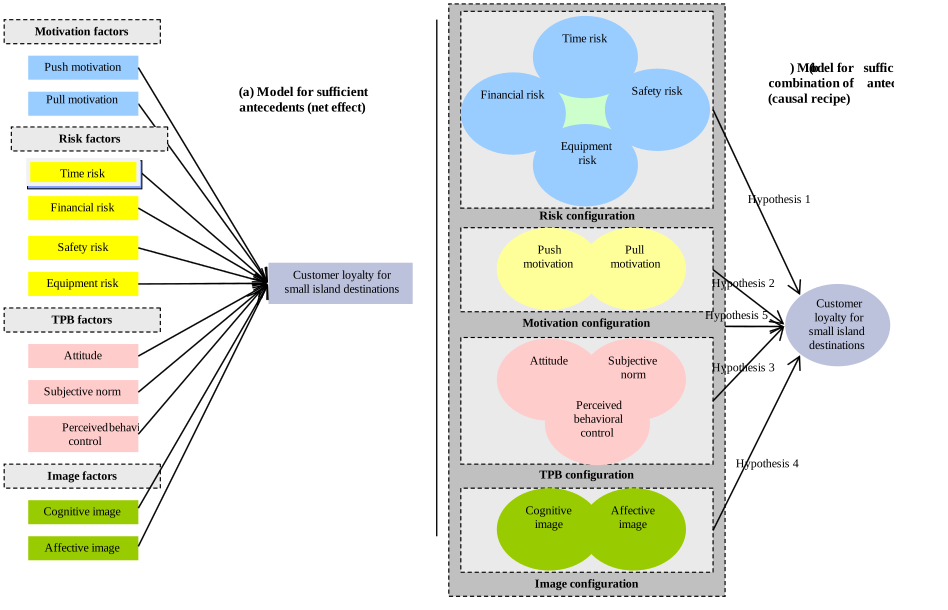
Hypothesis 1: Motivation factors (push and pull motivations) have a significant effect on tourist loyalty.
Hypothesis 2: Risk factors (time, financial, safety, and equipment risks) have a significant effect on traveler loyalty.
2.3. TPB factors
TPB is a well-known model that helps explain how individuals make decisions. According to the TPB, what we intend to do largely influences our actual actions (Ajzen, 1985). This intention is shaped by three primary elements, including our attitude towards the behavior (how we feel about it), the social pressure or expectations we perceive (what we think others think we should do), and our sense of control over the behavior (whether we feel we can actually do it). As Han (2015) stated, the TPB goes a step further than its predecessor (i.e., theory of reasoned action) by considering not just the elements we have complete control over (volitional factors) but also dimensions that might be out of our hands (non-volitional factors). The integration of non-volitational dimensions, such as normative belief–subjective norm, makes TPB a stronger model for predicting why people act the way they do, especially in situations where they might not have full control (Wattanacharoensil et al., 2024).
Researchers have found TPB to be very useful in understanding various types of behavior. It has also been particularly effective in areas like hospitality and tourism (Han et al., 2015) Kim & Hwang, 2020). For example, TPB been used to explore why travelers attend animal-related tourism (Wattanacharoensil et al., 2024), what drives business travelers to attend sustainable conventions (Han, 2015), and even how they engage eco-friendly behavioral practices in the context of drone food delivery services (Kim and Hwang, 2021). Chen (2016) further investigated the effects of customer attitude, subjective norm, and perceived behavioral control on green loyalty to a public bike system. The findings revealed that the TPB factors, such as attitudes (ATT), subjective norm (SN), and perceived behavioral control (PBC) exert a notable influence on customer green loyalty. Presumably, applying TPB in the context of small island destinations could yield valuable insights into various aspects of tourism and customer loyalty. For instance, attitudes toward the destination, influenced by such elements as the beauty of the island, cultural experiences and diverse water-based activities, and the subjective norm, shaped by reviews, recommendations, and social influences, can have an impact on understanding visitors’ loyalty intentions. Additionally, perceived behavioral control over factors like transportation options, accommodations, and accessibility can play a role in determining whether tourists intend to return to the small island or recommend it to others. Considering the aforementioned logic, we postulate the following hypothesis in the small island destination context:
Hypothesis 3: TPB factors have a significant effect on traveler loyalty.
2.4. Image factors
The term destination image is used to encapsulate the amalgamation of beliefs and impressions held by an individual regarding a specific destination (Baloglu & McCleary, 1999). This composite destination image is constructed from the multitude of interactions with various aspects of the destination, including its physical and social features (Jin et al., 2020). Building upon the idea of destination image, this study focuses on a small island image, which represents the overall destination image that takes shape as a result of tourists’ experiences while interacting with a small island destination.
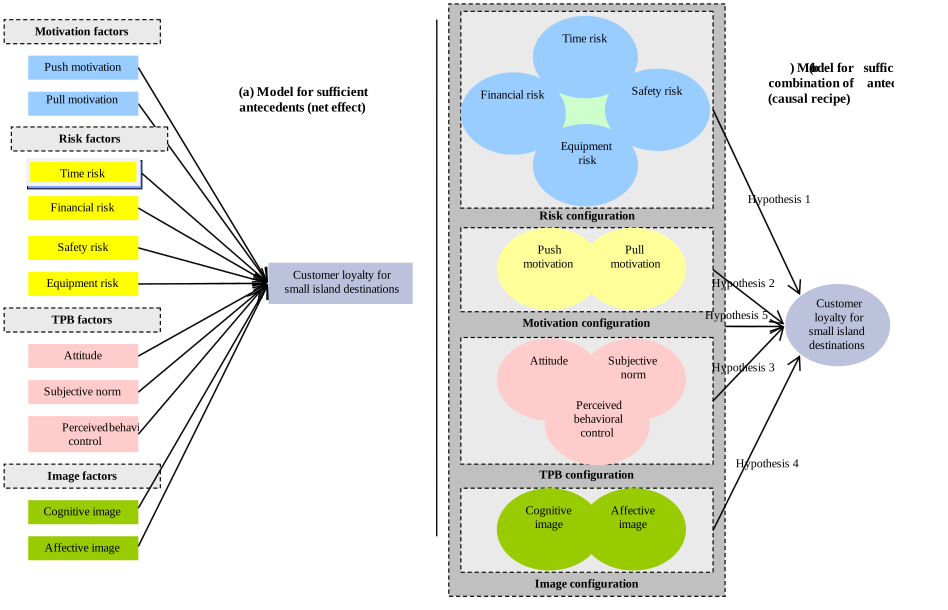
In the context of tourism, a destination image is closely related with the tourist perceptions and experiences during their visits at the destination. When tourists find genuine enjoyment, such as appreciating the diverse array of resources that an island destination has to offer, there is a high tendency that they will cultivate a positive attitude toward that destination. This positive attitude can, in turn, lead to various relational behaviors and actions (Loureiro, 2014). Jin et al. (2020) investigated the role of place attachment and destination image on tourists’ revisit intention. In their study, destination image is divided into two aspects: cognitive (CI) and affective image (AI). While cognitive image can be understood as the composite assessment of an individual’s beliefs and knowledge concerning the physical attributes of a particular site or destination, affective image takes into account the broader aspect of tourists’ emotions and feelings toward the destination (Baloglu & McCleary, 1999; Jin et al., 2020). In the small island destination context, cognitive image involves evaluating such tangible aspects as the unspoiled environment, the leisurely atmosphere, cultural/historical attractions, and beautiful scenery/natural attractions. In contrast, affective image involves evaluating subjective experiences and emotional responses, including whether traveling to a small island destination elicits emotions ranging from sleepiness to arousal, unpleasantness to pleasantness, gloominess to excitement, and distress to relaxation (Croes et al., 2018; Moon & Han, 2018). When tourists perceive an island destination as attractive, this perception can enhance their cognitive and affective image of the destination, subsequently developing loyalty to the destination (Jin et al., 2020; Moon & Han, 2019). Given this, we proposed the following hypothesis: Hypothesis 4: Image factors have a significant effect on traveler loyalty. Figure 1 displays the research model.
2.5. Cumulative prospect theory
Prospect theory is a psychological framework that has often been employed to understand consumer behavior in scenarios involving risk (Wolff & Larsen, 2017). Building on the foundation of prospect theory, Kahneman and Tversky (1992) introduced an advanced model, called cumulative prospect theory (CPT). CPT goes beyond merely risky situations to those encompassing uncertainty. It is distinguished by its capability to handle multiple outcomes and its provision for distinct weighting functions for gains and losses, thereby offering a more comprehensive understanding of decision-making processes (Mehran et al., 2020).
According to Kairies-Schwarz et al. (2017), CPT covers two critical aspects in understanding how individuals make decisions in the context of risks and uncertainties, including diminishing sensitivity and loss aversion. Diminishing sensitivity reflects the tendency of individuals to exhibit risk aversion when dealing with potential gains, while illogically demonstrating a tendency for risk-seeking behavior when confronting potential losses. In simpler terms, individuals are more cautious when presented with opportunities for financial gain, but conversely, they tend to adopt a more courageous attitude when faced with potential financial losses. In contrast, loss aversion highlights the observation that when individuals find themselves making decisions amidst both risk and uncertainty, the psychological impact of potential losses significantly outweighs the impact of equivalent gains. In practical terms, people tend to attach greater importance to avoiding losses than to achieving gains when confronted with uncertain outcomes (Olya & Han, 2020).
Compared to alternative theories such as expectancy-value theory (EVT) or protection motivation theory (PMT), CPT offers distinct advantages for the current study context. EVT is primarily designed to explain behavior based on expected utility and perceived likelihood of achieving desired outcomes (Luong, 2024). However, it does not account for how individuals distort or subjectively weight probabilities, nor does it adequately capture emotional responses to potential losses. Similarly, while PMT accounts for perceived severity and vulnerability (i.e., cognitive risk appraisals), it is rooted in protective behavioral responses and lacks the granularity required to model trade-offs between non-protective gains (e.g., enjoyment, image, satisfaction) and perceived risks in recreational settings (Wang et al., 2019). In contrast, CPT provides a robust and behaviorally realistic framework for examining how tourists weigh both anticipated benefits (e.g., affective image, destination satisfaction) and perceived risks (e.g., time, financial, or safety risks) when forming loyalty intentions (Olya & Han, 2020).
In the field of travel and tourism, Anton et al. (2017) employed prospect theory to shed light on the influence of heritage visitors’ motivation regarding the relationship between their satisfaction and loyalty. Mehran et al. (2020) further applied CPT to evaluate the risk and motivational factors involved in canal boat tours and predict tourists’ behavioral intentions. In the specific context of small island destinations, these psychological principles suggest that travelers may assess numerous potential gains, such as personal gratification, destination image, and memorable experiences, alongside various types of risks, notably related to time, finances, safety, and equipment, when taking a trip to small island destinations (Moon & Han, 2018). Their ultimate decision is shaped by the careful evaluation of these potential losses and gains. More recently, Han et al. (2025) examined the determinants of tourists’ behavior toward ChatGPT in the tourism sector. Through a cumulative prospect theory lens, they found that risk, motivation and innovative aspects of ChatGPT were important determinants of approach behaviors. Given these effective applications of CPT in hospitality and tourism contexts, this study adopts CPT to uncover the decision-making dynamics that underlie tourist loyalty in small island destinations. CPT proves particularly suitable in this context due to its alignment with our proposed conceptual models, which encompass a wide array of risk factors, as well as various motivation, image, and TPB factors. Moreover, the usefulness of CPT in explaining nonlinear interactions among indicators when predicting social phenomena has been demonstrated in prior studies (Han & Olya, 2020; Mehran et al., 2020). In our research, we also operate under the assumption that both linear and nonlinear interactions exist among risk, motivation, image, and TPB factors when predicting tourist loyalty for small island destinations. Considering this justification, CPT is adopted in this research.
2.6. Proposed model for fuzzy-set qualitative comparative analysis and necessary condition analysis
Unlike conventional approaches to achieving desired outcomes, Woodside (2014) argued that the relationships between various constructs can be highly complex. He emphasized that it is possible to achieve desired outcomes by considering a combination of these constructs, known as configurations. Such configurations can be examined through the application of fuzzy-set qualitative comparative analysis (fsQCA) (Manosuthi et al., 2024; Mehran et al., 2020). Considering the potential intricacy of the relationship between the causal antecedents (risk, motivation, image, and TPB factors) and the desire outcome (tourist loyalty for small island destination), it is justifiable that this research will adopt fsQCA to identify the potential solutions that sufficiently develop the outcome.
In fsQCA, the significance of antecedents is determined by evaluating their attributes in relation to other predictors. Furthermore, each factor may exhibit either a positive or negative influence on predicting the desired outcome, depending on the characteristics of the other predictors involved (Woodside, 2014). The fsQCA results also highlight the principle of equifinality, in which combinations of causal factors (configurations) can lead to the attainment of desired outcomes. Considering the limitation of the symmetric tests through traditional approaches, this study employs fsQCA following the GSCAM and NCA methodologies. The objective is to explore how various antecedents combine to influence the tourist loyalty for small island destinations. Given this, we propose the following hypothesis:
Hypothesis 5: Risk, motivation, TPB, and image factors have an optimum combination influence on traveler loyalty for small island destinations.
Apart from the fsQCA approach, this research further adopts necessary condition analysis (NCA), a cutting-edge method that considers necessity logic to recognize necessary conditions for the desired outcome to manifest (Dul, 2016). Traditional research methodologies have often relied on symmetric-quantitative analyses, such as SEM or regression, which are based on sufficient logic. Although net-effects provide a useful overview relationship within the studied phenomena, they have their limitations. Hauff et al. (2021) consider the predictors that significantly influence the outcomes but are not essential as “should-have” elements. In contrast, NCA offers a more detailed perspective by identifying the “must-have” conditions for the desired outcome to materialize. Considering the importance of essential conditions for achieving desired outcomes and the underutilization of the necessity logic within the field of tourism research, this study will adopt the NCA approach to identify necessary factors, encompassing risk, motivation, TPB, and image factors that lead to the tourist loyalty for small island destinations. Following the methodology outlined by Dul (2016) for conducting NCA, we propose the following hypothesis. Figure 1 illustrate the theoretical framework.
Hypothesis 6: Risk, motivation, TPB, and image factors are essential for the manifestation of tourist loyalty.
3. Research Methods
3.1. Measurement development
Measurement items were developed based on the constructs previously developed and verified in prior research. Risk was assessed across four dimensions: time, financial, safety, and equipment, with three items for each dimension (Olya & Han, 2020; Reisinger & Mavondo, 2005). Motivation consists of two dimensions, including push and pull motivation, with five and six items, respectively (Jo et al., 2021). Image consists of cognitive image and affective image, with three items each (Jin et al., 2020). TPB was evaluated across three dimensions—attitude, subjective norm, and perceived behavioral control—with three items each (Ajzen, 1991; Perugini & Bagozzi, 2001). The measurement items for tourist loyalty for small island destinations were adopted from Kazakova et al. (2025) and Choi and Kim (2024). All items were assessed on a 7-point Likert scale, and they were modified to fit this study.
3.2. Data collection process and respondent profile
The self-administered survey was distributed by an online research firm in Korea. The firm manages more than 1.6 million panels in the country and employs screening and incentive systems to monitor and encourage genuine and honest responses from participants. The online questionnaire was sent to the participants, and those who had visited small islands within the country in the past five years were eligible to respond to the survey. At the beginning of the survey, filtering questions were used to exclude individuals who did not meet the required experience criteria. After filtering out incomplete and unengaged cases, a total of 410 cases were used for further analysis. Additionally, boxplots were utilized to inspect outliers, and no extreme cases were identified.
Of the 410 total responses, 50.7% were male, and 49.3% were female. The average age of the respondents was 44.49 years old. A wide range of occupations was found among the respondents, with the majority being office workers (32.7%), followed by homemakers (16.8%), individuals in specialized professions (8.3%), self-employed individuals (8%), and others (34.2%). In terms of education, 59.5% earned a bachelor degree, followed by high school diploma (17.3%), associate degree (12.9%) and postgraduate (10.2%). Finally, more than half of the respondents (55.9%) responded that their monthly income ranged from US$ 1,500 to US$ 4,500 or higher.
4. Data Analysis and Results
In this research, the proposed hypotheses were tested through variable- and case-based analyses to explore the influences of risk, motivation, image, and TPB factors on tourist loyalty for small island destinations (LOY). This study adopts a multi-method analytical strategy combining both variable-based and case-based approaches to investigate the drivers of tourist loyalty in small island destinations (LOY). Specifically, we employed structural equation modeling (SEM) to test traditional net effects, and then extended our analysis using necessary condition analysis (NCA) and fuzzy-set qualitative comparative analysis (fsQCA). This combination allows us to move beyond the limitations of linear, symmetric models and capture the causal complexity and configurational nature of loyalty-related behaviors in tourism contexts. While SEM remains a widely used technique for testing hypothesized relationships and estimating net effects among latent constructs, it assumes additivity, linearity, and unifinality, which may not fully reflect the reality of tourist decision-making processes in small island environments. In contrast, fsQCA and NCA are designed to uncover asymmetric, non-linear, and conjunctural causality (i.e., how different combinations of conditions may lead to the same outcome (equifinality), or how certain conditions may be necessary but not sufficient, or sufficient but not necessary for the outcome to occur) (Dul, 2016; Woodside, 2014). In the context of this study, tourist loyalty is presumed to be influenced by interdependent psychological variables, which may function differently depending on the presence or absence of other conditions. Therefore, relying solely on SEM would overlook the configural and threshold-based dynamics that characterize complex social phenomena like destination loyalty
SEM was first conducted to obtain scores for twelve factors, including push and pull motivation, time, financial, safety and equipment risk, cognitive and affective image, attitude, subjective norm, perceived behavioral control, and tourist loyalty. The calibrated dataset was then subjected to single NCA to assess the importance of each factor based on variable-based analysis. To identify influential determinants of traveler loyalty, we first validated all hypotheses using necessary and traditional sufficient logic (variable-based analysis). During this stage, we identified both the single necessary conditions and sufficient conditions that have a critical role in influencing the outcome. Next, we implemented a case-based approach by utilizing fsQCA to bolster the internal validity of our analysis. The dataset was calibrated by calculating membership scores using three different cutoff values: 0.05 (indicating full exclusion), 0.5 (representing maximum ambiguity), and 0.95 (signifying full inclusion). This method allowed us to cross-validate and reinforce the findings obtained from the variable-based technique. The available dataset was divided into training (80%) and testing (20%) datasets. In this stage, single and multiple necessary conditions of each factor for positive and negative outcomes were also tested based on SUIN conditions (sufficient but unnecessary part of a factor that is insufficient but necessary for an outcome). Then, we attempted to identify the optimal combination of causal factors that sufficiently explain the development of tourist loyalty. The integration of SEM, NCA, and fsQCA allows for a more comprehensive understanding of loyalty formation, capturing both net effects and complex interdependencies that cannot be detected using traditional methods alone. These approaches enhance the explanatory power, validity, and practical relevance of the findings for theory and practice in island tourism.
4.1. Results of variable-based analysis
The measurement model was first validated through GSCAM analysis. According to Hwang et al. (2017), GSCAM produces results that are similar to those achieved through traditional maximum likelihood (ML) estimation methods. However, GSCAM has a remarkable capability to avoid improper solutions, making it a robust choice for estimating complex research frameworks (Manosuthi et al., 2021). This study analyzed the measurement model through R with cSEM package (Rademaker & Schuberth, 2020). Internal consistency was verified, considering the Dijkstra–Henseler’s rho_A and Cronbach’s alpha scores were above 0.7 (Henseler et al., 2015). Factor loadings and the AVE values were also greater than the cut-off scores of 0.5, hence confirming the convergent validity. Furthermore, the advanced heterotrait–monotrait ratio of correlations were generally found to be lower than the suggested threshold (0.85), therefore verifying the discriminant validity (Roemer et al., 2021). VIF scores were all less than 5 (Hair et al., 2019), thus the multi-collinearity issue is not a concern. Fit measures were next investigated, and the results revealed acceptable fit the data (χ2/df = 2.18, RMSEA = 0.058, CFI = 0.88, NNFI = 0.86). Therefore, the research model is reliable and valid.
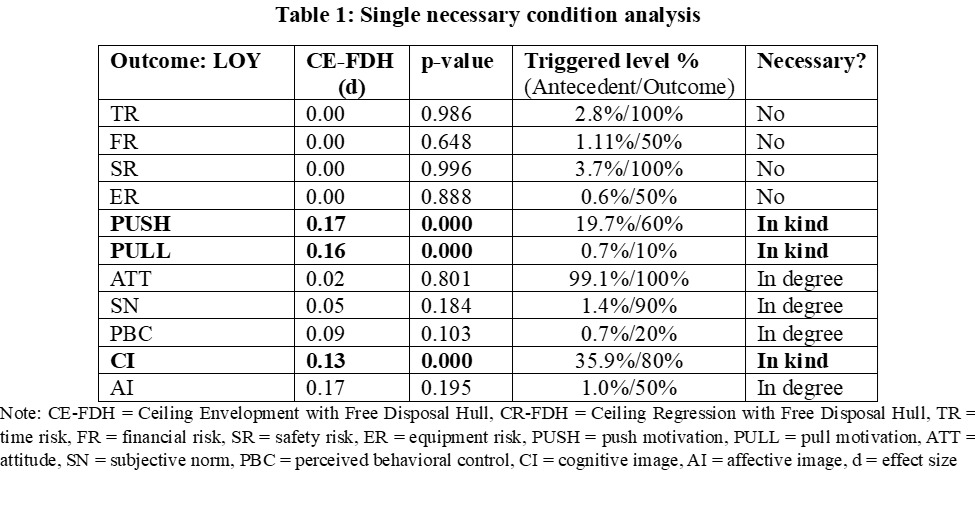
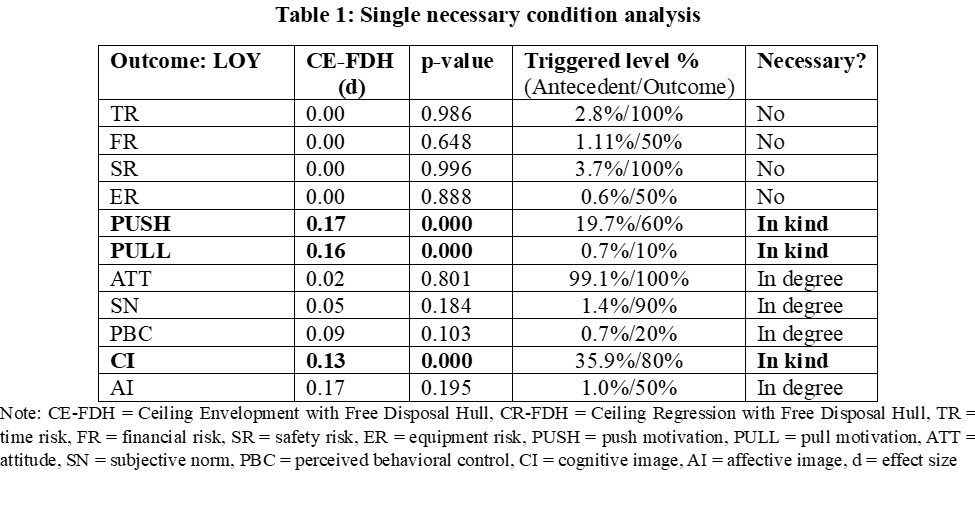
Next, we extracted factor scores and utilized them to identify necessary relationships and net-effects among the study variables. Through the NCA analysis, we found that all factors are considered single necessary conditions for the occurrence of tourist loyalty. While three factors, including push motivation, pull motivation, and cognitive image are considered necessary factors in kind, four factors, including attitude, subjective norm, perceived behavioral control and affective image, are considered necessary conditions in degree. Given time risk, financial risk, safety risk, and equipment risk have zero effective size (d), they are considered non-necessary for the occurrence of tourist loyalty. Considering the results obtained at this stage, we can conclude that Hypothesis 6 is partially supported. Table 1 displays the tabular presentation of NCA results.
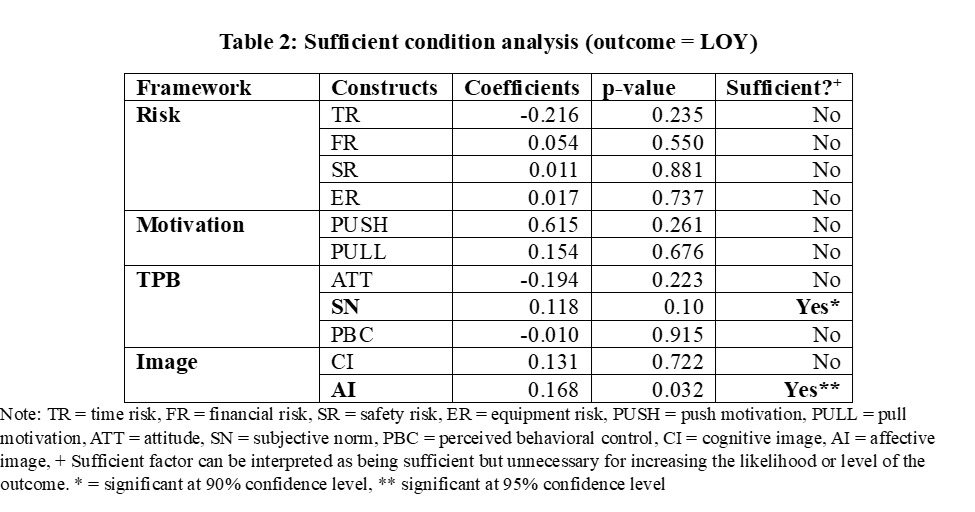
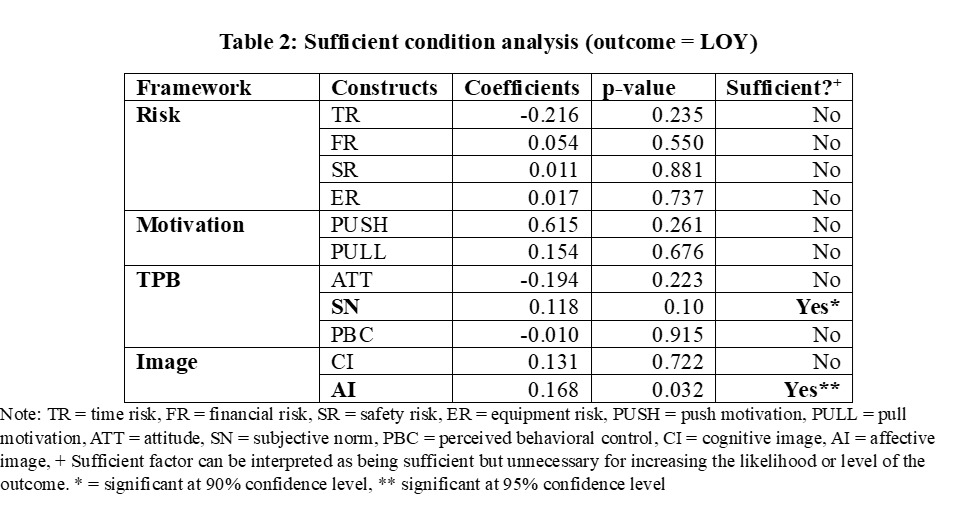
Sufficient condition analysis (SCA) through GSCAM was next performed to examine hypotheses 1-4 (Table 2). Considering the sufficient logic, the key dimensions of TPB and image, especially the subjective norm (b = 0.118), and affective image (b = 0.168) can sufficiently develop the tourist loyalty for small island destinations, thus partially supported hypotheses 3 and 4. Surprisingly, the risk and motivation factors were found to insufficiently produce the level of tourist loyalty, hence hypotheses 1 and 2 were not supported. Regarding motivation, the non-significance of push and pull motivational factors as sufficient conditions for tourist loyalty may be explained by the conditional nature of motivation in the tourism decision-making process. Although intrinsic and extrinsic motivations prompt the initial intention to visit (Crompton, 1979; Jo et al., 2021), they may not directly result in loyalty unless they are reinforced by affective experiences and normative validations. This supports the notion that motivation alone is insufficient without affective engagement or post-visit fulfillment. The finding aligns with recent evidence from Moon and Han (2019), who argue that image mediates or moderates the path from experience quality/motivation to loyalty.
Second, the insignificance of perceived risk factors in influencing tourist loyalty is especially noteworthy, given that much of the existing literature identifies risk perception as a major deterrent in destination selection (Olya & Han, 2020; Reisinger & Mavondo, 2005). However, this study’s findings suggest that tourists may discount or rationalize risks when evaluating small island destinations. One possible explanation relates to the destination type. Small islands are often viewed as escapist, tranquil, or idealized spaces, which can psychologically buffer the salience of potential risks (Shaayesteh et al., 2025). Moreover, this behavior aligns with the principles of Cumulative Prospect Theory, specifically diminishing sensitivity and loss aversion. Tourists may place greater psychological weight on anticipated gains (e.g., scenic beauty, relaxation, cultural enrichment) than on potential losses (Kahneman & Tversky, 1992).
Additionally, tourists may engage in cognitive reframing of risk, interpreting it as a normal part of the travel experience rather than a deterrent. Especially in leisure or adventure contexts, some level of risk may even be construed as part of the appeal, enhancing excitement or authenticity (Schlegelmilch & Ollenburg, 2013). As a result, risk becomes a background factor, not a primary driver of post-visit loyalty. These findings suggest that while risk perception remains an important consideration in destination choice, it may not exert sufficient influence to shape loyalty, particularly when positive image, affective commitment, and perceived social validation dominate the evaluative process (Wattanacharoensil et al., 2023).
Through the simultaneous analysis of NCA and SCA, we can identify four categories of factors that have never been revealed in prior SEM analysis: (a) necessary and sufficient, (b) necessary but insufficient, (c) unnecessary but sufficient, and (d) unnecessary and insufficient. Interestingly, subjective norm and affective were discovered as necessary and sufficient. All motivation and image factors were classified as necessary but insufficient conditions for tourist loyalty. Although most of the risk factors, including time, safety and equipment risks were found as unnecessary and insufficient conditions for the occurrence and increment of tourist loyalty, the results provide a meaningful explanation for the application of CPT in this context.
4.2. Results of the case-based analysis
To perform single and multiple NCA, the threshold for inclN, RoN, and CovN was set at .75, .65, and .5, respectively (Pappas & Woodside, 2021). Both high and low outcomes (LOY and ~LOY) were analyzed to assess any adverse effects of the simultaneous subset relation. Through the case-based analysis, we identified single necessary conditions for the occurrence of tourist loyalty, including push and pull motivation (PUSH, PULL), attitude (ATT), subjective norm (SN), perceived behavioral control (PBC), and image factors (CI, AI). In other words, the nonexistence of these factors ensures the absence of tourist loyalty for small island destinations. Although all the risk factors were not identified as single necessary conditions, the combination of some of the risk factors with other conditions could sufficiently produce multiple necessary conditions for tourist loyalty. Similar to Bazzan et al.'s (2022) study, we tested SUIN conditions (sufficient but unnecessary part of a factor that is insufficient but necessary) for tourist loyalty and found two multiple NCAs: ~TR + PULL + CI and ~TR + PUSH + ~ATT + CI. Appendix A displays the results.
The truth table (Appendix B), showing the combination of presence and absence conditions in each configuration. The number of cases, values of set-theoretic consistency, and a proportional reduction in inconsistency (PRI) for each configuration are presented. We report only the configurations with the consistency >0.9 and PRI >0.75. The findings indicated that for tourist loyalty for small island destinations to be achieved, intricate combination among risk, motivation, image and TPB factors exist beyond what was found from the results of SCA. While case 3 indicates that all causal factors are important for the increment of tourist loyalty, three other recipes show the potential of risk factors, including time (TR), financial (FR), safety (SR) and equipment (ER) risks. In line with the NCA findings (variable- and case-based analysis), the motivation, image and TPB factors are required in all recipes for tourist loyalty to occur.
As Wu et al. (2019) stated, fsQCA produces three types of solutions, including complex, intermediate, and parsimonious. Following Rihoux and Ragin’s (2008) recommendation, we present intermediate solutions since they provide the most comprehensible options. Analyzing the training dataset (80%), these solutions are (a) TR*FR*ER*PUSH*PULL*ATT*SN*PBC*CI*AI, and (b) ~TR*~FR*~SR*PUSH*PULL*ATT*SN*PBC*CI*AI, as shown in Table 3. The overall consistency (0.998) and solution coverage (0.585) suggest that an acceptable proportion of the outcome was covered by the two solutions. Furthermore, through analyzing the testing dataset (20%), the predictive validity of the fsQCA was verified (consistency, PRI *>*0.9 and, raw coverage *>*0.7). The findings support hypothesis 5.
5. Conclusions and Implications
This study set out to explore the multifaceted drivers of tourist loyalty in the context of small island destinations by incorporating motivation, the theory of planned behavior, destination image, and perceived risk within the broader framework of cumulative prospect theory. By integrating variable- and case-based analytical techniques, this research provides a novel understanding of how loyalty emerges and consolidates in tourism behaviors. The following sections outline the theoretical, practical, and social implications of the study.
5.1. Theoretical implications
This study makes a significant theoretical contribution by offering an integrative understanding of tourist loyalty in the context of small island destinations. Rather than reiterating empirical results, this section interprets and contextualizes the study’s key contributions to the broader field of tourism theory. First, the study expands the conceptual boundaries of tourist loyalty by integrating four central constructs, including motivation, theory of planned behavior, destination image, and perceived risk within the framework of cumulative prospect theory (Kahneman & Tversky, 1992). This interdisciplinary approach moves beyond traditional linear models by incorporating psychological dimensions, such as loss aversion and diminishing sensitivity into tourism decision-making. In doing so, it offers a more behaviorally realistic explanation of how tourists assess loyalty-related choices in uncertain and resource-limited environments like small islands.
In particular, the island context heightens the relevance of both CPT and TPB. Small islands entail higher perceived uncertainty due to limited medical and emergency facilities, weather volatility, and capacity constraints (Fakfare et al., 2025). CPT predicts stronger loss aversion and non-linear probability weighting under such conditions, helping explain why some risks are downweighted once anticipated gains (e.g., seascapes, remoteness) dominate (Kahneman & Tversky, 1992). Access frictions and travel effort (e.g., ferries, scarce flights) accentuate perceived behavioral control (PBC), while tight-knit host–guest interactions and word-of-mouth amplify subjective norms (SN). Thus, islands are not merely a setting but a theoretical amplifier, they intensify the CPT mechanisms (loss sensitivity, diminishing sensitivity) and the TPB pathways (SN and PBC) that our results identify as pivotal for loyalty.
Second, this research advances theoretical clarity by distinguishing between conditions that are necessary, sufficient, or both in contributing to tourist loyalty. The identification of subjective norm (SN) and affective image (AI) as both necessary and sufficient conditions offers an understanding that reinforces their theoretical centrality. This finding not only supports existing TPB-based loyalty models (Ajzen, 1991; Han et al., 2015; Moon & Han, 2019), but also extends them by evidencing how affective and normative drivers synergize in forming loyalty. Third, the study’s deployment of both variable-based and case-based methodologies, specifically fsQCA and NCA demonstrates the value of methodological pluralism in tourism research (Dul, 2016; Woodside, 2014). It shows that loyalty does not emerge from isolated variables but rather from specific causal configurations. Such a perspective challenges the assumptions of linearity and additivity prevalent in regression-based approaches, advocating for the adoption of configurational reasoning to account for complexity in tourist behavior (Rihoux & Ragin, 2008).
Fourth, this study contributes to a refined understanding of travel motivation and image as foundational but non-sufficient precursors to loyalty. While push and pull motivations (Dann, 1981; Crompton, 1979) and cognitive image (Baloglu & McCleary, 1999) are necessary for loyalty to occur, they alone do not increase loyalty unless supported by affective and social conditions. This insight deepens existing theoretical frameworks by highlighting the conditional nature of loyalty antecedents. Fifth, this research challenges prevailing assumptions about the deterministic role of perceived risk in tourist behavior. Contrary to studies that posit a strong negative correlation between risk and loyalty, the current findings suggest that risk perceptions, such as time, financial, safety, and equipment risks are neither necessary nor sufficient to deter loyalty. This implies that tourists may psychologically discount or reframe risk when motivated by strong affective or normative commitments (Olya & Han, 2020; Wattanacharoensil et al., 2023), thereby opening new theoretical pathways for re-examining the function of risk in loyalty frameworks.
Finally, the integration of CPT into tourism loyalty research represents a theoretical innovation. By substantiating key CPT tenets, particularly loss aversion and diminishing sensitivity (Kahneman & Tversky, 1992; Kairies-Schwarz et al., 2017), this study reconceptualizes loyalty as not merely an outcome of perceived benefits, but as a cognitive mechanism driven by tourists’ efforts to avoid negative experiences (e.g., overpricing, unplanned schedules, safety concerns). This shift encourages a rethinking of loyalty as a defensive, risk-mitigating posture rather than a purely affective or utilitarian response. In sum, this study contributes to tourism theory by providing an empirically supported and methodologically rigorous explanation of tourist loyalty. It shows that loyalty in small island tourism is best understood through a multidisciplinary approach, one that considers psychological factors, interrelated influences, and the combined effects of motivation, perception, and risk.
5.2. Practical implications
This research holds several implications for practitioners and destination authorities in small island destinations. First, to boost the positive perceptions of island destination experiences, destination managers should emphasize not only “should have” but “must have” factors for tourist loyalty. This research found subjective norm and affective image as necessary and sufficient conditions. To evoke tourist loyalty for small island destinations, it is imperative to prioritize creating a favorable subjective norm, particularly by facilitating positive word-of-mouth and peer influence. Marketing campaigns should focus on stimulating social proof, such as by encouraging tourists to share their experiences on social media platforms, offering incentives for reviews on travel websites, and amplifying testimonials through digital storytelling. Destination marketers can take additional steps to amplify their efforts by collaborating with travel influencers such as Youtubers, vloggers, and travel bloggers. Partnering with these influencers can help showcase the unique and appealing aspects of the destination to a broader audience. Their authentic and engaging content can significantly influence potential tourists’ perceptions and motivate them to choose the small island destination for their travels.
Fostering an emotional attachment to the destination is another critical aspect. Therefore, destination managers should focus on creating memorable and emotionally resonant experiences that leave a lasting impact on visitors. Examples include designing experiential tourism products such as wellness retreats, nature immersion trails, beachfront bonfire gatherings, or storytelling nights featuring local history and legends. These emotionally evocative experiences help to enhance the affective image of the destination and encourage loyalty through emotional anchoring. Special events, cultural experiences, or adventure activities that allow tourists to connect with the island’s identity can further reinforce positive affective perceptions.
Through the use of a case-based analysis approach, this study obtained not only single necessary conditions but multiple necessary conditions for the establishment of LOY: 1) ~TR + PULL + CI and 2) ~TR + PUSH + ~ATT + CI. Considering the first solution, when tailoring a tour package or travel itinerary, travel organizers should prioritize highlighting the appealing characteristics of small islands (PULL). These may include unique ecosystems, tangible features such as hidden spots, relaxing atmospheres, and pristine local attractions (cognitive image, CI), as well as factors that can mitigate time-related risks (TR). To reduce such risks, destination managers can provide real-time updates via mobile applications, maintain transparency regarding transportation schedules, and implement contingency plans to handle disruptions. Well-planned itineraries, efficient transportation options, and clear communication can significantly contribute to enhancing tourist confidence and satisfaction. Developing tour packages that highlight these aspects and marketing them by showcasing testimonials from satisfied tourists can further enhance the appeal (Parra-Lopez et al., 2021).
For the second solution, destination managers should target tourists who are motivated by intrinsic factors (PUSH), particularly those driven by a strong desire to explore and experience the destination. Additionally, the absence of TR and attitude (ATT), and the presence of a favorable cognitive image should be emphasized to attract and retain tourist loyalty. Service providers can curate experiences that align with the desires of small island tourists, offering activities like hiking, scuba diving, and cultural immersion programs. To address potential attitudinal barriers, pre-trip communication can be used to manage expectations and address common concerns, while personalized welcome experiences can reinforce a positive perception early in the tourist journey. Ensuring safety in adventure activities, optimizing transport logistics, and maintaining reliable infrastructure are essential strategies for reducing friction and improving experiences. Effective destination marketing campaigns showcasing the island’s beautiful landscape and cultural authenticity can further reinforce tourists’ positive cognitive evaluations and emotional resonance, thus driving loyalty.
Finally, one prominent result from the fsQCA analysis highlights that risk factors should be absent, while motivation, image and TPB should altogether be present when crafting strategies to foster tourist loyalty for small island destinations. As Olya and Han (2020) proposed, destination managers could consider implementing continuous training programs for tourism staff focused on crisis management, service quality, and cultural sensitivity. Including optional insurance packages, flexible refund policies, and clearly communicated safety protocols can offer reassurance to risk-averse travelers. Loyalty programs and incentives, such as return-visitor discounts, referral bonuses, or exclusive perks for online engagement can not only increase repeat visitation but also serve to offset perceived financial and experiential risks. Promotional campaigns emphasizing these risk-mitigation measures can strengthen tourists’ confidence and reinforce the perception of the destination as safe, reliable, and customer-oriented.
5.3. Social and policy implications
This study also reveals several important social implications, particularly for local communities and policymakers engaged in the sustainable development of small island destinations. First, the identification of affective image and subjective norm as core antecedents of loyalty highlights the value of fostering community-based, emotionally resonant, and socially validated tourism experiences (Moreno et al., 2022). When tourists feel emotionally connected to a destination and perceive social endorsement through peer recommendations or social media, they are more likely to demonstrate loyalty. This opens opportunities for local communities to leverage their cultural narratives, traditions, and lived experiences as intangible assets that cultivate meaningful tourist-host interactions and enhance cultural continuity (Parra-López et al., 2023).
Second, the finding that risk perceptions are neither necessary nor sufficient to deter loyalty highlights a psychological resilience among travelers, which can be strategically supported by inclusive infrastructure investments. Efforts to mitigate time-related or logistical uncertainties (e.g., transport, communication, scheduling) can simultaneously benefit residents who share these services. This contributes to broader social equity and community well-being beyond tourism alone. Third, by situating tourist loyalty within the framework of cumulative prospect theory, this research encourages policymakers to reframe loyalty not as mere consumer behavior, but as a socially embedded, risk-averse response to uncertainty. In doing so, loyalty becomes a vehicle for social stability, where repeat visitation contributes to sustained employment, local entrepreneurship, and intergenerational livelihood security. This is critical in fragile island economies with limited diversification opportunities.
From a policy perspective, local authorities can play an active role in reinforcing these dynamics. By promoting positive social norms through destination-wide campaigns that highlight sustainable practices and community values, governments can strengthen the normative pull that encourages repeat visits. At the same time, investments in transparent information systems (e.g., real-time transport updates, risk communication platforms) and resilient infrastructure reduce perceived uncertainties, aligning tourist confidence with resident well-being. Such policy measures not only support loyalty formation but also ensure that tourism development aligns with broader social sustainability goals.
6. Limitations and future research
This study presents several limitations that open avenues for future scholarly inquiry. First, the use of a cross-sectional design limits the ability to capture temporal dynamics in tourist behavior. Longitudinal studies are needed to assess how loyalty evolves over time, particularly in response to repeat visitation, accumulated experiences, or environmental changes. Second, the study did not explore variations across demographic segments. It is likely that differences in age, travel style, or cultural background shape tourist perceptions of motivation, risk, and loyalty. Future research should examine these variations through subgroup or multi-group analyses to uncover potential heterogeneity in loyalty formation. Third, while the use of a panel-based online survey allowed for efficient data collection and access to a broad demographic range, it is important to acknowledge that the sampling method reflects a form of convenience sampling. As such, the findings may be subject to self-selection bias and may not be fully generalizable to the broader population of international or first-time tourists visiting small island destinations. Future research is encouraged to use probability-based sampling or cross-national comparative designs to improve generalizability and account for cultural variability in tourist loyalty drivers.
Fourth, the role of digital influence, such as social media, travel blogs, and online reviews was not incorporated in the current model. Given the increasing relevance of digital touchpoints in shaping destination perceptions and tourist behaviors, future research should explore how electronic word-of-mouth and influencer marketing moderate the relationships between image, motivation, and loyalty. To advance the scholarly discourse on small island tourism, future research could explore the following research questions: How do affective and cognitive place attachment dimensions influence actual behaviors beyond loyalty? What role does sustainability perception play in shaping long-term engagement with island destinations? How do different generational or cultural cohorts interpret and act upon their island tourism experiences? Addressing these questions not only deepen theoretical insight but also inform destination management strategies attuned to diverse visitor segments.