
Introduction: Mayotte’s islandness as a French Overseas Department
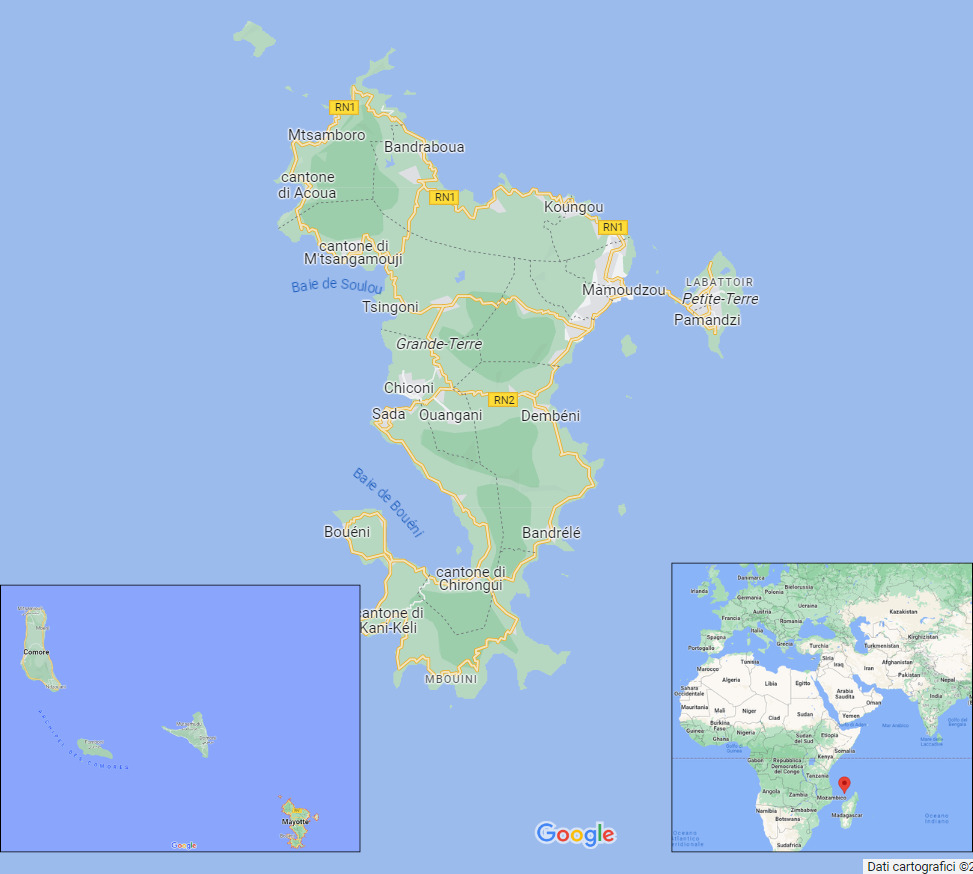
Mayotte, a French Overseas Department in the southwestern Indian Ocean, has been facing a severe drought for years, which has consequences for the social, political, health and environmental life of its inhabitants. This article draws on short- term, situated ethnographic fieldwork, conducted in Mayotte between August and October 2023, during a period of acute water scarcity. In addition to daily fieldnotes, the data collected was drawn from semi-structured interviews and informal conversations with residents, health professionals and stakeholders; continuous participant observation conducted in public spaces, events and neighbourhoods along water distribution points; and extensive work preceding and following the field period to analyse institutional documents and official communications concerning water administration.
This research belongs to a wider project investigating the narratives of women on Mayotte regarding their health and perinatal journeys in the largest maternity hospital in France (Parenton et al, 2020). Broader themes emerged during the fieldwork period, interconnected at various levels: in addition to the issues of departmentalisation – with its profound socio-cultural consequences on the island – and the migration policies adopted by France in its overseas territories, one recurring topic in collected interviews was on the effects of the water and ecological crisis. Local discourses are much more complex and ambivalent than are national and official narratives concerning islandness, such as smallness, peripherality, boundedness and remoteness (Baldacchino, 2004; Chen, 2025). Rather than aiming for a technical and comprehensive ethnography of water governance, this paper focuses on a moment of infrastructural crisis, with the purpose of comprehending how the administration of water resources in the specific context of Mayotte produces specific forms and discourses of islandness, when administrative arrangements, everyday practices and political claims become particularly visible.
In a position, therefore, simultaneously peripheral – in relation to its Metropole – and central – in relation to the migratory networks affecting the region – Mayotte acts out its condition of islandness in the administration of water; a theme adopted in this paper as “a useful entry point to understand debates around islandness” (Chen, 2025, p. 2). This article’s contribution lies not in uncovering previously unknown practices, but in situating well-known coping strategies within a broader analytical framework of islandness and governance.
Theoretical framework: anthropology of overseas Europe, islandness and water relations
This article is based on the theoretical interconnection between island studies, the anthropology of overseas Europe and postcolonial studies. Starting from the consideration of island territories as places deeply marked by political and historical relationships, both colonial and post-colonial, this text explores and analyses how water administration can be read as a tool to understand the social and environmental strategies enacted in Mayotte, specifically as a French Overseas Department intertwined in regional and archipelagic ties. In particular, the analytical framework provided by the anthropology of overseas Europe enables us to comprehend – in the words of the inhabitants of Mayotte – legislative and health inequalities, as well as the active strategies employed by the local population in response to the climate and water crisis.
Concurrently, the concept of ‘islandness’ is an extremely useful theoretical and analytical tool for understanding the dynamics of interconnection, belonging and marginalisation within Mayotte. The term refers not only to a geographical condition of isolation and boundedness, but also to a socio-political, symbolic and economic dimensions that characterise island territories (Baldacchino, 2004). Recent studies conceptualise islandness as a relational and situational process (Foley et al., 2023), moving away from considering it as a set of given geographical characteristics. From these perspectives, islandness emerges through discourses, practices, power relations and infrastructures, and is differently shaped by institutions, states and local agents.
Mahoran islandness can be approached not simply as a physical insularity, but as a matter of administrative arrangements, infrastructural decisions, and everyday experiences of scarcity, producing a dual tension: on the one hand, a strong institutional integration with the French Republic (through laws, administrations, infrastructures); on the other hand, a persistent condition of environmental, social and economic marginality. In the context of the recurrent water crisis impacting the island, islandness is evident in the logistical fragility and, secondly, in the intermittent nature of the French state’s intervention. The scarcity of water resources, the inefficiency of infrastructure and the dependence on external supplies are not merely the result of environmental constraints; they are also a consequence of administrative management that reflects the paradoxes of postcolonial sovereignty (Roinsard, 2022; Goreau-Ponceaud, 2024). Adopting the concept of ‘islandness’ as an analytical framework therefore allows us to recognise that the water crisis is not only a climatic or administrative issue, but also a phenomenon that helps situate the unequal distribution of resources and environmental rights between ‘first-class’ French citizens – those living in mainland France – and ‘second-class’ French citizens – those living on the islands (Roinsard, 2022). The concept of Mahoran islandness is exemplified by the tension between the state’s tangible presence and its operational absence, and between environmental sovereignty claims and the precarious nature of water services.
Following Grydehøj et al. (2025), islandness should be understood as a divergent and competing ascription, rather than a stable and coherent condition. In Mayotte, state institutions, local inhabitants and migrants ascribe different meanings to islandness: for the French state, Mayotte is administratively integrated yet infrastructurally exceptional; for locals, islandness is experienced through intermittent water supply, rationing and health risks; for migrants, it is lived as enforced containment and exclusion from basic services. Islandness has to be treated as a situated political effect produced through infrastructures, administrative decisions, and everyday practices surrounding water access (Zhu & Grydehøj, 2023).
Historical islandness: the paradoxical case of Mayotte
In order to understand the local narratives concerning the Mayotte water situation and to analyse water infrastructure management itself, it is useful to present an overview of the socio-historical dynamics that led Mayotte to become a French Overseas Department and a European Outermost Region.
Mayotte: a French Overseas Department
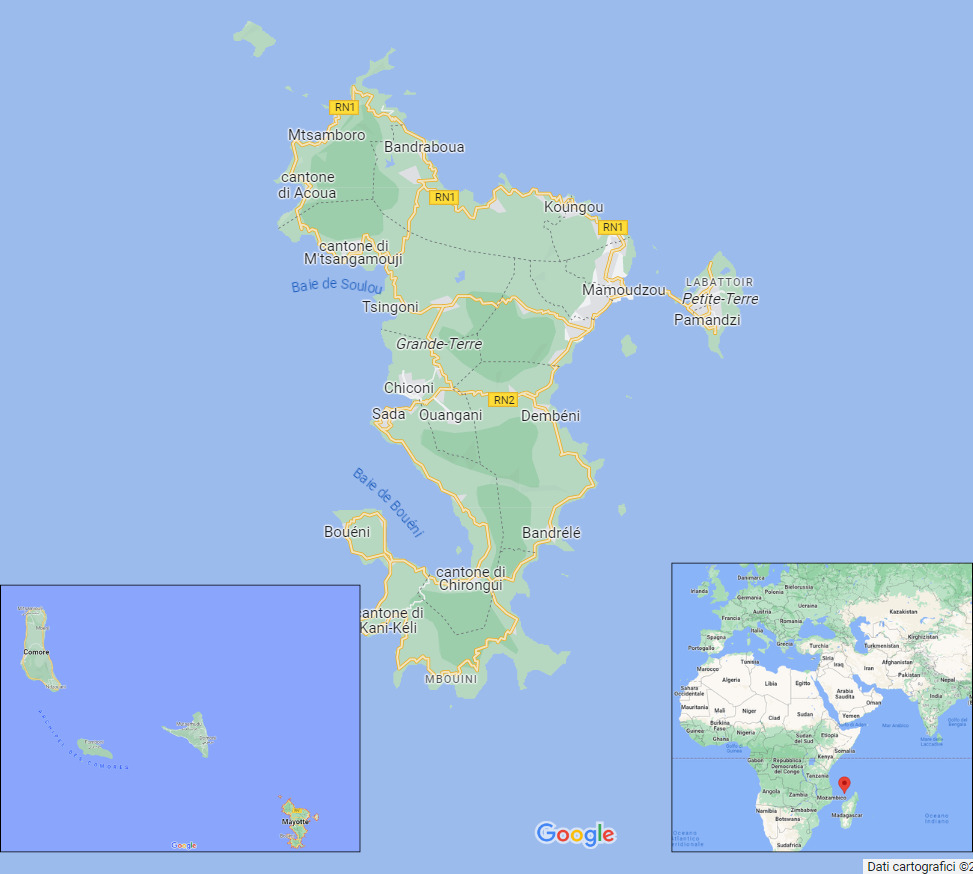
Mayotte is a French island – a “mini-archipelago” (Giraudeau & Maisonneuve, 2021) of volcanic origin – located in the Indian Ocean, precisely in the Mozambique Channel, northwest of Madagascar and geographically part of the Comoros archipelago (Nourault & Perrin, 2017). Consisting of two inhabited islands – the main Grande Terre and the smaller Petite Terre – plus some 30 uninhabited islets, it has been characterised for centuries by a series of incoming and outgoing migrations that have allowed for the encounter and clash of different populations, cultures, languages and societies, creating a historical and political complexity that still characterises Mahoran reality today (Schierano, 2020a).
By virtue of its strategically important geographic position between the great African continent and several important islands in the Indian Ocean, Mayotte has always been immersed in migratory flows. In 1841, the Malagasy sultan Andriantsouli sold the island to France, which officially took possession of Mayotte two years later, in June 1843 (Roinsard, 2022). The Comoros archipelago became a French Overseas Territory in 1946. Subsequent political and administrative tensions between Mayotte and the other Comorian islands led to a period of severe poverty on Mayotte (Schierano, 2020a), fostering a strong sense of local cohesion and a growing identification with France rather than with the Comoros, from which Mayotte increasingly felt politically, socially, and culturally distant.
Between 1974 and 1976, the French Republic organised several referendums for independence in all its islands in the Mozambique Channel: the island of Mayotte voted to remain part of metropolitan France, as opposed to the other surrounding territories, which broke away from it. From this moment, Mayotte assumed a sui generis status (Roinsard, 2022) of Territorial Collectivity of the French Republic, with a legal-institutional power somewhere between that of a colony and a French Overseas Territory. This intermediate political-administrative situation facilitated the spread and reinforcement of a series of adverse social and economic situations that still plague the Mahoran territory today: a low level of schooling, a precarious water-sanitary situation and a widespread state of social insecurity. This statute, initially in force for only three years, was extended for another 25 years until 2001, when the island took on a further special status as a Departmental Collectivity, characterised by a “French-style autonomy regime” (Michalon, 2012, p. 35), with destabilising socio-cultural consequences for the island’s population. The title of ‘Collectivité Départementale’ was valid until the 2009 referendum, the year in which the Mahoran population was finally called upon to vote for a total and complete departmentalisation that saw YES win with 95% of the votes, an outcome officially implemented in March 2011, and that has made Mayotte the 101st French Department, after decades of struggles and clashes between pro-independence and pro-departmentalists (Attoumani, 2021). Departmentalisation refers to the legal and political process through which a territory is transformed into a French overseas department, implying the extension of metropolitan law and its integration into the administrative, institutional and legal framework of the French Republic, while often maintaining specific adaptations linked to local conditions (Maisonneuve & Giraudeau, 2021). This process and its consequences are central to understanding the island’s current condition, shaping administrative arrangements, infrastructure development, and access to basic services such as water.
Mayotte: a European Outermost Region
At the European level, Mayotte became a European Union Outermost Region (OR) in 2014, with a relationship of integration with the European Union, i.e. inclusion in any European treaty or fund. However, Mayotte represents a singularity within this historical-political framework. As previously stated, the island figures as a colony not fully integrated into the European power, perhaps because its predominantly Muslim population (Schierano, 2020c) meant that continental France tended to show a detached and almost disinterested attitude towards the independence or otherwise of the Mahoran territory from the République (Schierano, 2020a). Moreover, as a result of this late departmentalisation, Mayotte is still today the only French department to “exercise, within the same territory, the powers of both the department and the region” (Giraudeau & Maisonneuve, 2021, p. 346), again making it a singular case in the French legal and institutional landscape. These events have had important consequences for the territory’s current socio-economic and political situation, characterised by an instability and financial insecurity that make it one of the poorest areas in France, yet simultaneously the richest among its surrounding islands (Schierano, 2020b). The lateness of the departmentalisation and its inherent policy of cultural and economic assimilation led to a downsizing of Mayotte’s daily lifestyles, adapted to the consumption and costs of continental France, with a consequent increase in the cost of living – “la vie chère” (Schierano, 2020a) – also decisive in access to water resources, as will be discussed below.
The whole history leading up to departmentalisation must be considered in its entirety as a process still in the making, central to this analysis, since not exploring it would result in failure to understand Mayotte’s water, environmental and sanitary situation. Mayotte remains afflicted by the fact that, despite legislative assimilation and equality on paper, the French overseas territories still suffer inequality in practice, relegated to a “paradoxical citizenship” (Roinsard, 2022, p. 37) that makes the inhabitants of these territories unequal citizens relative to those of continental France, but subordinate, distant and peripheral subjects. The islandness of the France-Mayotte relationship is also deeply anchored and evident in the daily claims of the population of Mayotte: on the one hand, the desire to be “French at any cost” (Blanchy, 2002), on the other hand, a strong desire to maintain their own values and differences from the Metropole, including through a multiplicity of narratives and discourses concerning the island’s water resources. It is a territory, then, that in effect acts out its islandness, if we consider that “islands are not rejecting change: they are rather active in changing that relationship [with the colonial metropole] and they are quite successful in doing so on their own terms” (Prinsen & Blaise, 2017, p. 57).
The Mahoran water emergency: a peripheral administration
Water resources and political challenges
This legal-administrative islandness is also evident in the management of the island’s ecological and water resources. As has been amply demonstrated by other studies (Belmar et al., 2016; Chen, 2025; Werner et al., 2017), islands incur various political-environmental difficulties about access to water resources. The environmental changes that characterise our geological age, labelled ‘the Anthropocene’ by Paul Crutzen (Crutzen in Borgnino, 2022), also affect Mayotte, with consequences on the rise of ocean waters but especially on meteorological phenomena: the rainy season, for example, has been affected in terms of the intensity of rains, causing a hardening of the dry season and a lengthening of periods of water shortage.
Due to its limited land area, no watercourse on the island is plentiful enough to be navigable; some reach abundant flow during the rainy season (November to April), while most disappear during the dry season (May to October) (Nourault & Perrin, 2017) . As stated on the Société Mahoraise des Eaux (SMAE) website, Mahoran drinking water resources are divided into two macrogroups: those found deep down, which include aquifers, exploited through drilling; and surface water, including rivers, hill basins, and marine waters. The latter are directed through pumping systems to the appropriate supply chains to be made potable (SMAE - Mahoraise des Eaux, n.d.). Surface water resources from the rivers and hillside basins of Combani and Dzoumogné make up 80% of production, deep resources account for 18% of production, and the seawater desalination unit based in Pamandzi accounts for 2% of production (SMAE - Mahoraise des Eaux, n.d.). Of the two lakes on the island, the waters of Lake Dziani are found to be non-potable because they are saturated with minerals and volcanic marine phytoplankton, which give it a distinctive greenish colour. Lake Karihani in Tsingoni, on the other hand, reduces its surface area by 90% during the dry season. Due to an extraordinarily dry rainy season, the lake dried completely in September 2023 (Youssouffa, 2023). For water treatment, there are six purification units on the island (five treatment units on Grande Terre; one desalination unit on Petite Terre). The distribution is provided by a network with an extension of more than 760 km and by 60 reserves (such as cisterns) of water that supply the various urban agglomerations. However, the infrastructure is insufficient to meet the demand of the entire Mahoran territory: several works are therefore planned, in particular a third basin that should have seen the light by 2022 in Ourovéni, the completion of which has been postponed to 2026 (Fevrier, 2022).
The case of Ourovéni, in the municipality of Tsingoni, is central to this analysis as it is exemplary for understanding the bureaucratic and political dynamics at play in Mayotte. A hillside basin under construction since the early 2000s, it became even more necessary after the severe drought of 2017 (Luneau, 2017) to preserve water resources in anticipation of the rainy season. However, the work has never been completed and the facilities to increase its water storage capacity are lacking to date. Meanwhile, the population density of the main urban centres is increasing exponentially: according to INSEE, Mayotte had 131,000 inhabitants in 1997 compared to the 300,000 people estimated by INSEE as of January 1st 2022 (Grangé, 2022). A further constraint on the basin’s work concerns ownership of the land on which it stands: of the 70 hectares of land on which the basin will be built, 40 currently belong to private individuals and are divided into ten different land units—units of land based on co-ownership and which the Mahoran water union would have to purchase in order to carry out the work. The complication in the purchase lies in the fact that, among these owners, there are also different political figures who oppose the basin’s construction. Mayotte is the only French Overseas Department that does not have a Water Bureau, but it does have a Basin Committee, the president of which was indicted for alleged misappropriation of public funds in 2017 (Luneau, 2017), the year of the serious water crisis. Also in 2017, the president of the Syndicat Intercommunal d’Eau et d’Assainissement de Mayotte (SIEAM) had signed with the Minister of Overseas the ‘Plan eau Mayotte’, an emergency measure to cope with a prolonged shortage of drinking water, the cause of which cannot be considered only the unforeseen drought, but above all the failure of the French state to provide suitable facilities in its Overseas Department (Luneau, 2017).
Economic, social and health inequalities in water access
To date, the island’s situation does not seem to have improved: the scarcity of drinking water is among the main causes of daily discomfort cited by various people in the territory interviewed during this research. Since 1977, the management of drinking water has been handled by SOGEA Mayotte, which became SMAE in 2014, and which is also in charge of the various water cuts carried out periodically on the island with the aim of rationing its resources (SMAE - Mahoraise des Eaux, s.d.-b). By shutting off running water to homes at different times according to municipal sector, at the beginning of this research, in the Mamoudzou sector, the shutdown occurred from 16:00 to 20:00; not even a month later, the cuts began at 16:00 on one day and lasted for 48 hours. In addition to the varying hourly openings based on housing sector, the different accessibility to the little remaining water on the island is based first and foremost on each person’s economic possibilities. Today, among the 63,100 dwellings in Mayotte, four out of ten are constructed from sheet metal (INSEE, 2023). These are mainly concentrated in the urban centres of Mamoudzou, Koungou and on Petite Terre (Balicchi et al., 2014).
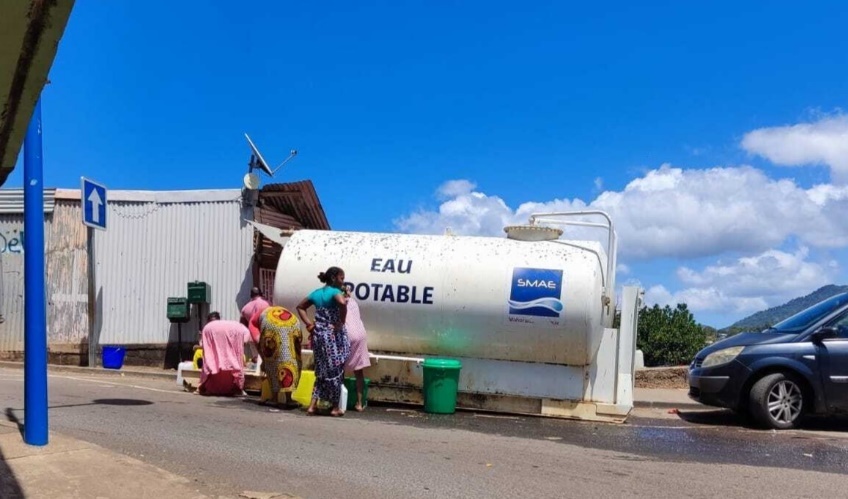
Of these homes, only one in three has indoor running water access and 95% lack basic sanitary amenities (running water, toilets and showers) (Chaussy et al., 2019). Importantly, these houses are inhabited mainly by foreign populations (65%), at triple the rate of those inhabited by Mayotte natives (Schierano, 2020a), meaning that foreigners often live disconnected from sewer systems. Where possible, tanks are then placed with potable water, which the population can access if needed. One consequences of this system is that – given the high population density of neighbourhoods with few services – the queues of people in front of these tanks can stretch for kilometres, and the water resources they contain are often insufficient to meet everyone’s needs.
.jpeg)
Moreover, in the face of this water crisis, prices of water bottles in supermarkets and grocery stores have increased, which are already more expensive than the same products sold in the Metropole. Reaching as much as a dozen euros per case in local stores, the French state decided to freeze the price per bottle at €0.69 in July 2023 (Décret du 18 juillet 2023, 2023). Since it did not seem to be respected outside of large retailers, in September 2023 the price was further increased and locked in at €0.75 for 0.5-liter bottles and €1.40 for 1.5-liter bottles (Décret du 29 septembre 2023, 2023). In addition, since the end of August 2023, many of the large supermarkets have imposed purchase limits on drinking water bottles per customer.
Beyond the economic difficulties, the health risks associated with this prolonged absence of potable water have increased: even when running water is present in the kitchens and bathrooms of Mayotte’s homes, it is still undrinkable following such prolonged closures. The various health agencies in the territory say they are concerned about the critical situation in Mayotte, where diseases are spreading rapidly because of challenging water conditions: acute cases of gastroenteritis, cholera, hepatitis A, typhoid fever and polio are on the rise (Bouhet, 2023). The Agence Régional de Santé, in collaboration with the Prefect of Mayotte, has therefore created a series of panels visible on the streets of the main urban centres, briefly listing health recommendations for reducing risk of disease: wash or disinfect hands regularly; boil water before using it; and store water inside jerry cans for up to 48 hours.
Periods of infrastructural crisis constitute privileged ethnographic moments, as they condense and intensify otherwise dispersed relations between the state, infrastructure and everyday practices. In Mayotte, acute water scarcity temporarily reconfigured daily routines, public discourse and political mobilisation, making islandness empirically observable. Living in such environment is especially problematic for mothers who want to or must – in the absence of expatriation documents – raise their children in Mayotte:
I have two children, both with health problems since they were born. Since they are already fragile, living here without water and with the diseases that come with it is becoming more and more difficult for me and my family. [Margot, métropolitaine, fieldnotes, August 29, 2023].
With the water cuts, it is becoming increasingly complicated for new mothers to raise their babies. Having good personal hygiene becomes complex without running water, breastfeeding as well: the water is not safe to drink, there has been a resurgence of typhoid fever, and of course pregnant women and babies at least up to three months of age can’t drink it because they risk serious illness. In the stores it is getting harder and harder to get the bottles, they are getting more expensive, and you can only get a limited number per person. [Manon, métropolitaine, fieldnotes, September 13, 2023].
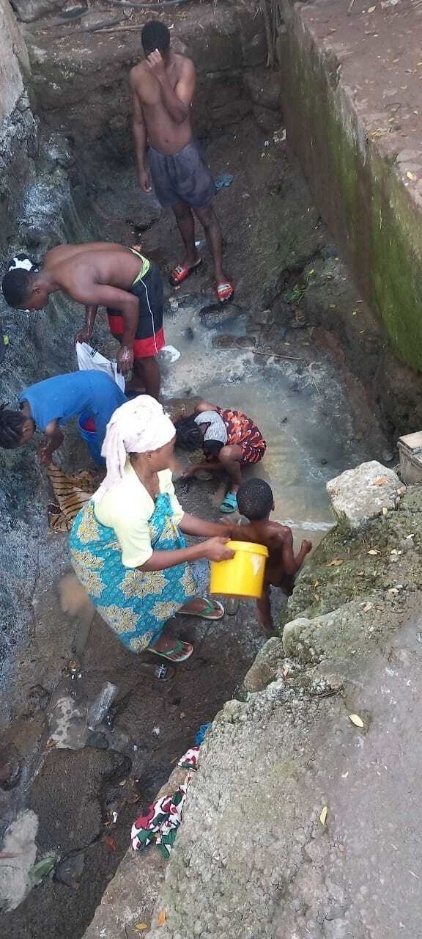
These risks increase for the refugee population coming mainly from the African Great Lakes area (Democratic Republic of Congo, Rwanda, and Burundi) due to the difficult and unsanitary living conditions in which they are forced to live and the almost total absence of the state in the facilities for the reception of migrants. The absence of equipped domestic spaces is associated with poor hygiene for this part of the island’s population: a lack of running and potable water, of shelter from the scorching sun in the dry season and torrential downpours in the rainy season, and of toilets and showers. This further aggravates the psycho-physical health of the refugee people based in Mayotte.
.jpeg)
Moreover, access to water seems to be one of the reasons by which a feeling of hatred and exclusion is justified on the island toward these people, perceived as invaders and thieves of resources too scarce even for the Mahoran population alone. As Ivonne, a Congolese woman, recounts, in the neighbourhood where she lives with her family, she senses with discomfort the relationship of competition that has arisen between Congolese women and Mahoran and Comorian women for water: the few times that it flows from the only fountain present, the refugees are pushed away abruptly by the others, who are present in greater numbers; or the latter share useful information with each other regarding water cuts by communicating exclusively in the Shimaore language, so as not to be possibly understood by the ‘africaines’ (a term by which all migrants not from neighbouring Comoros are indifferently referred to).
Islandness thus has consequences for the territory’s interpersonal and intercommunal relations (Chen, 2025): the peripherality and isolation to which Mayotte is relegated by its Metropole is reflected in the different interactions among the various belongings on the island.
Water supply: insular strategies for dealing with crisis
A dual relation with the Metropole
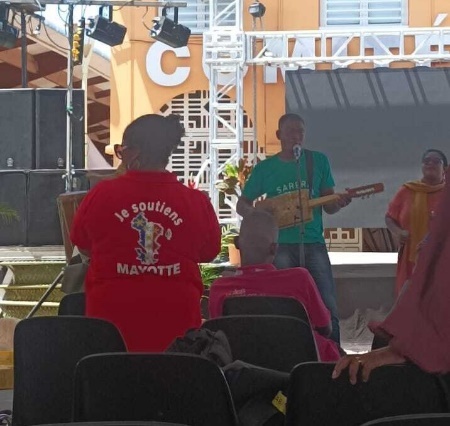
The common water insecurity is not only perceived as contributing to disagreements and contrasts in the Mahoran reality; it also brings out moments of cooperation and collective mobilization among the multiple island belongings, notwithstanding the aforementioned conflicts. During the fieldwork, two demonstrations took place under the slogan ‘Mayotte a soif’ (‘Mayotte is thirsty’), the first held on September 9, 2023 and the second on September 29, 2023: highly attended by the Mahoran population, an important component of refugee and asylum-seeking mothers also took part in the two days, as they were concerned about the future of their children on the island.
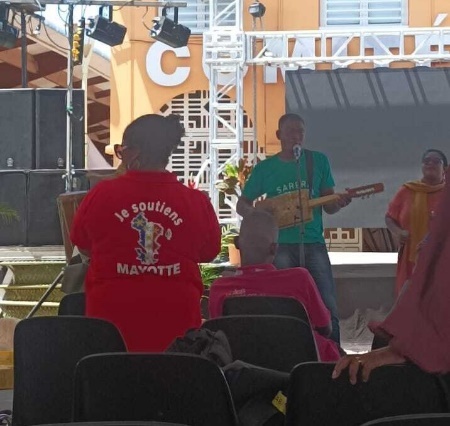
Interestingly, the representations and symbols present during these two-day demonstrations bore witness to the apparent contradictory nature of insular discourses in water resource management. Indeed, many participants, while demonstrating lamenting the inadequacy of state water facilities, proudly displayed French flags and T-shirts depicting the island of Mayotte in the colours of the République.
Rather than constituting a contradiction, the mobilisation of French republican symbols during water protests reflects what Zhu and Grydehøj (2023) describe as the situated and relational politics of islandness. In this sense, islandness is enacted through strategic positioning vis-à-vis the state, allowing the populations living in Mayotte to simultaneously claim inclusion and expose material abandonment.
Water infrastructure thus becomes a key arena through which these relational claims are articulated, making visible how islandness is negotiated through demands for recognition, resources and accountability. Beyond the direct health risks, lack of access to water in everyday spaces made classes impossible in many high schools and classrooms, worsening already negative perceptions of the Mahoran educative system (Prudent, 2023):
In the first few weeks after returning to school, we have had problems with water: where I teach, we do not have private water supplies specifically for the school and it has already happened several times that we have had to call an ambulance for some kid in a state of severe dehydration. Because of the water crisis, many high schools are closing and teachers are being sent directly back to the Metropole. Many parents have confided in me that they don’t know if they will stay here much longer; those who have the proper papers and the financial ability are already thinking of leaving. [Rémi, teacher in Kawéni, fieldnotes, September 10, 2023].
The critical issue of water resources in Mayotte is widely and deeply discussed due to the size and complexity of the environmental and climatic issues involved. It represents a crucial analytical space for understanding the multiple ecological strategies at play in Mayotte and the various meanings that the concept of ‘islandness’ comes to assume in this department. A recurring element in local claims both during environmental demonstrations and in the narratives of individuals is the constant reminder of the theme of departmentalisation: Mayotte’s desire to remain French is accompanied by the explicit and related demand for France to take seriously the critical water and social issues of its overseas department.
Daily strategies: proximity networks, ‘relatedness’ and mutual support beyond the island
Several grassroot strategies are being implemented to address Mayotte’s water crisis. Certainly, those who are financially able have found ways to stock up more on bottles of drinking water, bought from local stores and supermarkets. Often in shared apartments, roommates share expenses to buy as many crates of water as possible, to be rationed on days when pipes are closed. Non-drinking water is stored separately from drinking water, so that it can be used not for food but exclusively for hygienic reasons, such as showering, flushing toilets, washing dishes, domestic spaces, and clothes. During the hours when the waterworks are open, since it is not recommended to drink directly from the taps anyway, the water is filtered or boiled before use.
On the other hand, for those who lack the necessary finances or housing, family and neighbourhood networks are reactivated to stock up on as much water as possible:
With my neighbours and relatives, we arrange to line up in front of the tanks, with as many bottles and cans as we can, so that we can secure some supplies for the week. They often fill containers for me too, because being at work all day I wouldn’t be able to do it myself. For undrinkable water I usually use tap water when it is there, even then stocking up for the closed days. The problem, however, is that in my neighbourhood even during the defined institutional opening hours no water comes out anyway, so it is becoming increasingly difficult to be able to predict how long you will need the supplies you have set aside. [Zaied, Mahoran, fieldnotes, August 23, 2023].
For the refugee population, which must cope with both the general water crisis and their specific housing difficulties, some associations provide bottles of water to families, pregnant women and children. Networks of cooperation and ‘relatedness’ also come into being in these circumstances, allowing refugees to make up for the lack of state water services: a relatedness expressed in terms of kinship, based not on genealogy, but on the sharing of an everyday life, mutual care, intimacy and collaboration between people (Carsten, 2000). These practices resonate with approaches that conceptualise water as a medium through which social relations are produced and maintained (Krause & Strang, 2016).
I live in a poor neighbourhood in Kawéni, along with other African and Comorian women, also with children. Often ‘les frères’ of the neighbourhood help me with the child, especially with money and water supplies. [Benedicte, Congolese, fieldnotes, September 12, 2023].
To date, the Mahoran water situation does not appear to have stabilized, indeed in certain aspects it has worsened, especially since the passage of Cyclone Chido in December 2024. Winds of 220 km per hour and torrential rains devastated the island, causing deaths and irreparable damage to houses, to the electrical system, and to urban centres (Cassidy, 2024). The drama of the situation immediately following the cyclone emerges in the words of Pauline, a French woman with whom I maintained contact:
Currently I am back in Paris, my husband has remained in Sada. I did not hear from him for more than ten hours, the telephone network was completely down. When he contacted me again, he let me know that the supermarkets are completely empty, there is not even water left. [Pauline, métropolitaine, fieldnotes, December 16, 2024].
On December 30, 2024, French Prime Minister François Bayrou issued the ‘Mayotte Debout’ plan to respond to the socio-ecological emergency and restart the reconstruction of the island’s main services (Cann, 2024). Divided into several paragraphs comprising nine main issues (electricity, water, telecommunications, housing, schools, security, health, transportation, and economy), it summarizes the actions planned by the state to cope with the consequences of Chido. About the water issue, the plan includes:
Military intervention, units from the 13th and 19th Engineer Regiments, specialised in emergency operations, along with their equipment, from next week onwards, to assist local teams with the water distribution network, the repair of the road network and damaged buildings; by the end of the week (January 6, 2025), the volume of drinking water produced prior to Chido will be reached (38,000 m³ per day). However, distribution was already insufficient (water crisis). With Mayotte Debout, we will reach a production level of 40,000 m³ per day by June 30, 2025 and, within the year, upgrade the distribution networks across the entire territory. The Mayotte Water Plan provided for €60 million in investment in 2025. The government is prepared to increase funding as required; a second desalination plant; and the accelerated construction of the third hill reservoir. (Plan Mayotte Debout, 2024, trans. mine).
Despite this program, the water crisis in Mayotte does not seem to be improving (Cann, 2025a): for example, although some bureaucratic paperwork has been moved forward for the construction and start-up of the Ourovéni basin, it is not in continuous and efficient operation due to the turbidity of the water – caused by the heavy rains – that makes water distribution impossible in much of the island (Cann, 2025b). In the face of the drama of climate destruction, networks of neighbourliness and mutual support resurface again:
The island is destroyed, we have no water and electricity. Many people have lost everything, but there is strong mobilization and solidarity. [Claire, métropolitaine, fieldnotes, December 23, 2024].
This solidarity transcends the island of Mayotte alone, going on to reactivate relationships of connection, exchange, and migration among the islands of the southwestern Indian Ocean: in particular, Reunion Island and the Comoros archipelago played a key role in Mayotte’s recovery. Both countries collected donations of food, water and basic necessities to send to the people of Mayotte in the weeks immediately following Cyclone Chido (Bouchou, 2024; Madi, 2024). Out of these dynamics emerge the relationality among islands and a detachment from the continental view of islands as isolated, peripheral and uniquely vulnerable (Baldacchino, 2004). Thus, old and new oceanic networks (Hau’ofa, 1994) re-emerge in this particular geographical area and the concept of Indianoceania resurfaces. ‘Indianoceania’ first emerged in the literary sphere, only to find practical action in the political sphere when in the 1950s the idea of a federative community united by cultural, social and historical specificities (Schierano, 2020b) arose among the islands of the southwestern Indian Ocean: Madagascar, Comoros archipelago, Seychelles, Mauritius, Reunion Island and Mayotte. The concept of Indianoceanism has developed precisely with the intention of emphasising those networks of connections, exchange relationships, migrations of people, goods, and cultures that unite these oceanic islands (Favole & Giordana, 2018) and allow them to overcome these water and ecological difficulties in alternative and relational ways.
Conclusions
This article has examined water scarcity in Mayotte as a situated empirical lens through which to approach islandness as a relational and processual phenomenon. Rather than treating islandness as a fixed geographical or cultural condition, the analysis has focused on how it is enacted through everyday interactions with infrastructure, administrative arrangements and political claims during a period of acute crisis. By concentrating on a temporally bounded moment of disruption, the paper has illustrated how water infrastructure has become a key interface between the state and the population, rendering relations of governance, inequality and belonging unusually visible. The water emergency did not create these dynamics, but intensified and condensed them, allowing for an ethnographic observation of how islandness is negotiated in practice.
Starting from an analysis of the management and administration of water resources in Mayotte, it is possible to comprehend how the concept of ‘islandness’ (that is, insularity understood not only as a geological condition, but also as a social, political, and ecological construct) is strongly contextual and situated (Zhu & Grydehøj, 2023). Understanding islandness in these terms requires attention to specific moments in which relations between infrastructure, administration and everyday life become unusually visible. Periods of crisis constitute such moments, as they condense and intensify dynamics that are otherwise dispersed over longer temporalities. In the case of Mayotte, the water emergency temporarily reconfigured daily routines, public discourse and political mobilisation, allowing islandness to be observed as it was actively enacted, negotiated and contested in practice. The Mahoran experience regarding the water issue, in fact, is not only a peculiar case within the broader debate on the relations between centre and periphery (Favole & Giordana, 2018); it also takes shape as a privileged lens through which to observe the dynamics of adaptation, resistance and innovation that characterize many island realities. The various strategies implemented locally to cope with challenges related to scarcity or uneven distribution of water resources reflect a capacity for agency that adaptively redefines parameters commonly associated with islands (smallness, peripherality, boundedness and remoteness) (Baldacchino, 2004; Chen, 2025). Instead, these elements, often conceived only as structural limitations, are strategically and consciously reworked and re-signified to negotiate positions of power, access to resources, and visibility in French and European geopolitical and administrative contexts. In this sense, islandness in Mayotte is not simply a condition, but rather becomes a reality in constant redefinition (Foley et al., 2023), shaped by the interplay between environmental phenomena, governance practices, and claims of belonging.
Funding
I benefited from an International Mobility Grant for conducting thesis research abroad for students enrolled in Master’s degree programs in the Department of Cultures, Politics and Society (Academic year 2022/23), provided by the Italian University of Turin.