
Introduction: Rethinking Island Sustainability
Islands are not merely geographically isolated spatial units; they are also among the most frontier and sensitive arenas for global sustainable development practice (Bass & Dalal-Clayton, 1995; United Nations, 1993). On the one hand, islands are highly constrained in terms of spatial scale, resource endowment, and ecosystem capacity. On the other hand, they carry strong aspirations for economic growth, social prosperity, and improved quality of life. This inherent tension means that construction and development can no longer be understood as purely technical or economic decisions; rather, they constitute sustainability governance issues in which social, economic, and environmental dimensions are deeply intertwined (Cuka, 2025). Accordingly, sustainable island construction and development warrant greater scholarly attention and international support (Crossley & Sprague, 2014).
Compared with mainland regions, island construction typically faces multiple structural constraints, including limited land and resource supply (Deschenes & Chertow, 2004), relative geographical isolation (Lessy et al., 2025), and highly fragile ecosystems with restricted resilience (Bass & Dalal-Clayton, 1995; McIntyre, 2004). These constraints imply that construction and development activities on islands often carry stronger elements of irreversibility, and their cumulative impacts tend to manifest more rapidly. Changes in building forms, infrastructure layouts, and the use of terrestrial and marine spaces can exert direct and far-reaching effects on island ecosystems, while also reshaping social organization and residents’ everyday practices (Chi et al., 2026; Z. Y. Yu & Chen, 2015). Construction and development should therefore be understood as critical mediating processes of island sustainability, rather than as mere instruments of growth or external interventions.
In contemporary island development, tourism frequently serves as a central economic pillar. While tourism generates employment opportunities, fiscal revenue, and infrastructure investment, it is also a major driver of land-intensive development, resource overexploitation, and ecosystem degradation (Z. Y. Yu & Chen, 2015). Tourism-related construction activities—such as guesthouse expansion, road network upgrading, and scenic site development—simultaneously promote economic growth and intensify conflicts between human activity and ecological carrying capacity. Some small islands even face the risk of closure due to environmental standard violations, overcrowding, and inadequate infrastructure (Fernandez-Abila et al., 2024).
For this reason, discussions of sustainable island development cannot avoid the core issue of construction and development. How to meet socio-economic development needs while safeguarding ecosystem integrity and resilience remains a long-standing yet insufficiently integrated challenge in island studies. Conventional development models and planning paradigms are often derived from mainland-scale experiences. When directly transplanted into island contexts, they frequently prove ill-suited and overlook the distinctive resource constraints, ecological fragility, and institutional capacities of islands (Baldacchino, 2006; van der Velde et al., 2007). Against this backdrop, this paper takes sustainable island construction and development as its central analytical entry point. It seeks to move beyond the simplistic opposition between development and protection, to reconsider the role of construction in island sustainability, and to provide a more context-sensitive and theoretically grounded perspective for understanding future island development pathways.
Construction and Development from Fragmented Disciplinary Perspectives
Research on sustainable island development has long exhibited a strongly interdisciplinary character, with discussions spanning island studies, regional development, environmental science, tourism studies, and public policy (Baldacchino, 2006). However, despite the expanding scope of research topics, ‘construction and development’ have rarely emerged as integrated analytical objects in their own right. Instead, they have been dispersed across several interconnected yet largely separate research trajectories.
First, within the tradition oriented toward economic development, islands are frequently conceptualized as structurally constrained economic units, whose development is limited by factors such as population size, resource endowment, and market accessibility (Du, 2015; Kakazu, 1994; Reynolds et al., 2022). This body of literature examines how islands achieve economic survival and growth through tourism expansion, external transfers, or institutional advantages, generating frameworks such as tourism-led development, small island economic dependency, and diversified income structures (Benzaken et al., 2024; Clark, 2013). In recent years, the ‘blue economy’ has emerged as a new maritime development paradigm, emphasizing synergies between economic growth and ecological protection through resource use (Roy & Akbar, 2026). Yet within this economically oriented tradition, construction and infrastructure investment are typically treated as necessary instruments for growth, while their spatial consequences and institutional implications remain insufficiently theorized.
Second, governance- and institution-oriented research places greater emphasis on policy instruments, governance models, and community participation in advancing island sustainability (Ozgit, 2022; H. Yu et al., 2025). This line of inquiry highlights the role of institutional design and stakeholder negotiation in mediating tensions between economic growth and ecological protection. Particularly in small island contexts characterized by tourism expansion and increasing resource pressure, governance systems often evolve from informal network-based cooperation toward more formalized institutional arrangements (Partelow & Nelson, 2020). Although some studies address land-use regulation and environmental controls, construction activities themselves are generally treated as objects of governance or policy outcomes, rather than as social–spatial processes with intrinsic dynamics and feedback mechanisms.
Third, research centered on ecological protection and environmental vulnerability reveals the high sensitivity of island ecosystems to external disturbances (H. Zhang et al., 2021). This body of work emphasizes biodiversity conservation, ecosystem services, and climate change impacts, thereby providing essential foundations for understanding the ecological basis of island sustainability. However, human construction activities are often generalized as exogenous pressure sources (Chi et al., 2026). Their specific forms, spatial distributions, and interactive feedback mechanisms with socio-economic processes remain in need of more detailed investigation.
Furthermore, with the deepening of the concept of ‘islandness’, island studies has gradually shifted from an emphasis on insularity toward a relational perspective, highlighting the co-constitution of land–island, island–island, and island–sea relationships (Foley et al., 2023; Grydehøj et al., 2025; Yang et al., 2025). Yet even within this theoretical trajectory, construction and development frequently appear as background conditions rather than as systematically incorporated elements of analytical frameworks.
Overall, existing research has generated substantial insights into economic growth, governance instruments, and ecological vulnerability. Nevertheless, construction and development continue to be treated primarily as external means or regulatory objects, rather than as processual spatial practices that actively shape island social–ecological systems. As a result, island sustainability is often reduced to a narrative of balancing ‘development and protection’, operationalized across different dimensions as a set of opposing structural tensions (see Table 1). Within this framework, development and protection are commonly understood as competing goal variables to be weighed against one another, while construction is positioned as an instrumental mediator. The cumulative, irreversible, and path-locking effects of construction decisions have yet to receive adequate theoretical attention (Cuka, 2025; Grydehøj & Su, 2025; Su & Grydehøj, 2022).
Contributions to This Special section
It is precisely in response to the research gaps outlined above that the five papers included in this special section approach the question of construction from different analytical angles. Together, they advance the integration and deepening of construction-related debates within island sustainability research, offering new empirical evidence and theoretical perspectives for understanding how construction becomes embedded in the evolutionary trajectories of island social–ecological systems.
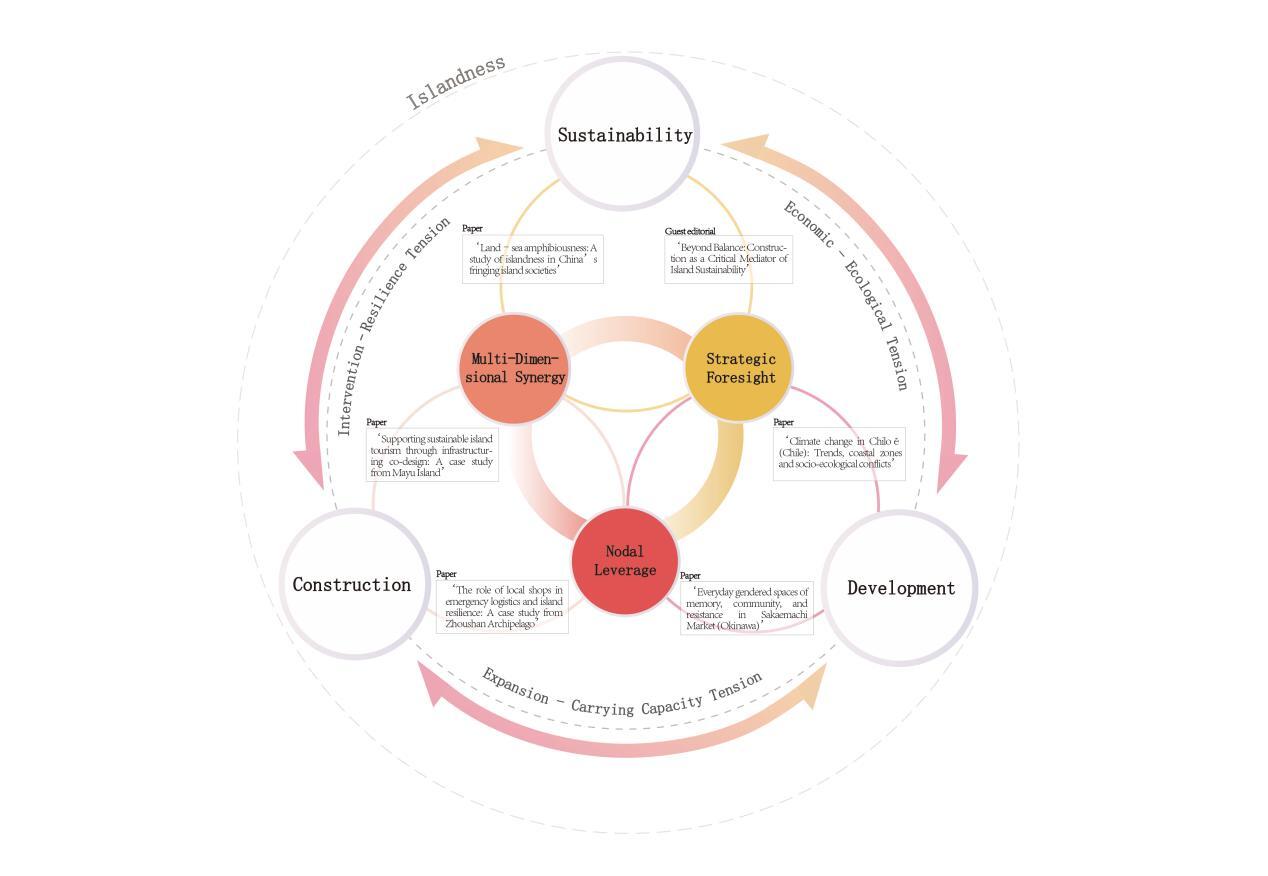
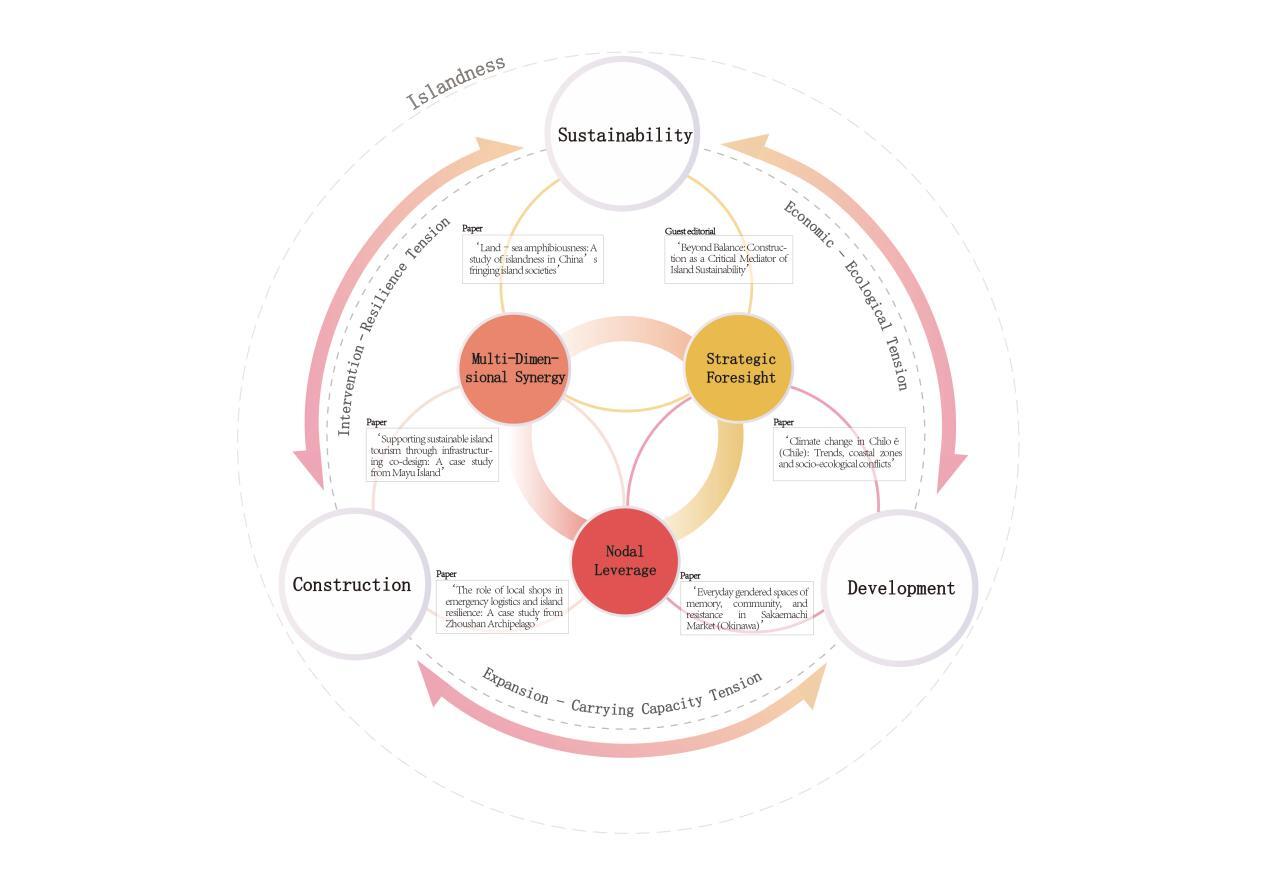
Vázquez Pinillos et al.'s (2026) paper ‘Climate change in Chiloé (Chile): Trends, coastal zones and socio-ecological conflicts’ takes the Chiloé Archipelago in Chile as its case study and demonstrates how climate change amplifies existing island vulnerabilities through the compounded effects of sea-level risks, freshwater stress, and conflicts among coastal industries. The study shows that such risk accumulation is not merely an environmental transformation; rather, it translates climatic pressures into systemic social–ecological governance challenges. It highlights the necessity of adaptive planning instruments tailored to the specific geographical characteristics of islands. More importantly, the paper establishes a mechanism linking environmental risk exposure to the emergence of social–ecological conflicts, thereby extending the analysis to the level of spatial governance and construction decision-making. In doing so, it provides critical empirical grounding for understanding the long-term structural consequences that construction under climate pressure may generate.
Wu and Yao’s (2025) paper ‘Supporting sustainable island tourism through infrastructuring co-design: A case study from Mayu Island’ situates its analysis within the context of tourism development on Mayu Island, China, and explores the role of participatory infrastructuring practices in promoting sustainable island tourism. In contrast to macro-level governance studies centered on policy instruments and institutional frameworks, this research introduces ‘infrastructuring co-design’ as an operational collaborative mechanism. It emphasizes how sustained participation and negotiation processes facilitate the formation of local consensus and the reframing of public issues. This approach underscores that construction is not a one-off project intervention, but rather an ongoing practice embedded within governance processes. As such, it provides important practical insights into construction as a key process in island sustainability.
Ma and Shao’s (2026) paper ‘Land–sea amphibiousness: A study of islandness in China’s fringing island societies’ advances islandness research at the theoretical level by deepening the relational turn. Through the concept of ‘land–sea amphibiousness’, the study reveals the spatial practices and institutional logics of nearshore island societies within coupled land–sea structures. It moves beyond traditional frameworks that interpret islandness solely as geographical constraint or maritime attribute, emphasizing instead that island development is always embedded within the co-construction of land–island–sea relational networks. From this relational perspective, the paper offers a new conceptual tool for analyzing how construction decisions produce long-term structural effects within interwoven land–sea spatial systems.
Zhang et al.‘s (2026) paper ‘The role of local shops in emergency logistics and island resilience: A case study from Zhoushan Archipelago’ examines the Tian’ao–Huangsha community in Zhoushan, Zhejiang Province, China, and investigates how small-scale retail infrastructure can be integrated into island emergency logistics systems to enhance resilience. Drawing on questionnaire surveys, Analytic Hierarchy Process (AHP) weighting analysis, and focus group discussions, the study demonstrates that the number, distribution, and accessibility of local shops are crucial for improving emergency response efficiency. However, their institutional integration remains constrained by insufficient incentive mechanisms and underdeveloped public–private collaboration frameworks. By operationalizing island resilience at the level of infrastructure configuration and institutional design, this research provides robust empirical evidence of how construction, when institutionally embedded, can strengthen islands’ emergency capacities and long-term adaptive potential.
Ginoza and Fusté-Forné’s (2026) paper ‘Everyday gendered spaces of memory, community, and resistance in Sakaemachi Market (Okinawa)’ shifts attention to the role of everyday social infrastructures in sustaining island resilience and cultural continuity. Through an ethnographically informed case study of Sakaemachi Market in Naha, Okinawa, the study examines how gendered labor, local food systems, and community networks operate as embedded infrastructures that sustain place-based economies and collective memory. Rather than focusing on large-scale physical infrastructure construction, the paper emphasizes the construction of everyday market spaces as a key carrier of island sustainability. These nodal, small-scale spatial practices play a crucial role in continuously sustaining community life and island development.
Overall, the five contributions in this special section address climate vulnerability and conflict mechanisms, participatory infrastructural governance practices, theoretical refinement of islandness, and resilience-oriented infrastructural embedding from four complementary dimensions. Collectively, they respond to the lack of mechanistic explanation of construction and development in existing research. More importantly, they shift island sustainability studies from an abstract narrative of balancing ‘development and protection’ toward a more process-oriented understanding of construction, spatial structure, and institutional conditions. In doing so, they lay a stronger theoretical and practical foundation for rethinking the relationship between construction and sustainability within island contexts.
New Directions
The studies discussed above deepen our understanding of island sustainability from multiple dimensions. More fundamentally, however, they collectively point to a critical insight: as risk pressures, governance practices, and spatial relations become increasingly complex, island sustainability can no longer be adequately explained through the simple framework of ‘balancing development and protection’. Whether in the formation of climate-related conflicts, the collaborative practices of participatory infrastructuring, or the institutional embedding of land–sea relations and emergency infrastructure provision, construction and development emerge not as external or instrumental tools of sustainability, but as key processes that continuously shape the structure and trajectories of island social–ecological systems. Incorporating construction into the core of sustainability analysis is therefore not a conceptual addition, but a necessary reconstruction of the analytical framework.
Existing research on sustainable island development is often structured around the dominant narrative of balancing economic growth and ecological protection (Cuka, 2025; Ozgit, 2022). While this framework is valuable for revealing development tensions and policy trade-offs, its explanatory and operational capacity becomes increasingly limited when applied to concrete construction and spatial interventions. In many island practices, sustainability is positioned after construction, or invoked as a constraint on development, leading to a binary logic of ‘build first, repair later’ or ‘substitute protection for development’ (Cuka, 2025). Such approaches overlook a structural reality: construction is not the outcome of a single decision, but a cumulative process characterized by path dependence and spatial lock-in effects, whose consequences permeate the long-term evolution of island social–ecological systems (Su & Grydehøj, 2022).
Against this backdrop, this paper conceptualizes sustainable island construction and development as a spatial–social–ecological coordination process premised on islandness. Here, islandness refers not only to natural constraints such as limited area, spatial isolation, and ecological fragility, but also to a structural condition shaped by modes of resource provision, infrastructural path dependence, property regimes, and governance capacities. From this perspective, construction is no longer merely a technical instrument for achieving development objectives. Rather, it functions as a critical mediator embedded within institutional arrangements and social practices. By reorganizing spatial structures, resource flows, and ecological connectivity, construction directly influences island resilience and long-term sustainability pathways.
Furthermore, island construction and development exhibit pronounced multi-scalar nested characteristics, requiring analysis beyond single projects or sectoral perspectives toward interaction mechanisms among ‘local and systemic,’ ‘short-term and long-term,’ and ‘land and sea’ dynamics (Y. Zhang et al., 2023). Local construction decisions often reshape the broader system through spatial chain effects. Adjustments to transportation infrastructure, shoreline engineering, tourism development, and residential layouts can alter accessibility patterns, demographic and industrial distributions, and ecological corridor structures, thereby influencing resource pressures and environmental risks. At the same time, overarching island development strategies and institutional arrangements constrain the scope of specific construction practices. Fiscal capacity, industrial positioning, and planning systems significantly shape the direction and tempo of construction activities. This multi-scalar nested structure reinforces the irreversibility of island construction and amplifies the path-locking effects of short-term decisions on long-term sustainability trajectories.
In this sense, defining construction as a critical mediator of island sustainability does not imply the proposal of a universal planning model. Rather, it seeks to distill generalizable construction logics and principles of spatial intervention that can transform the structural tensions among sustainability, construction, and development into analytically coherent and governance-relevant action logics (Figure 1).
1. Strategic Foresight: The Logic of Holistic Embedding in Construction Decision-Making
In island contexts, construction must be embedded within an overarching development vision and spatial governance framework. This requires integrated consideration of economic feasibility, social equity, and ecological carrying capacity. Construction should therefore not be treated as an isolated project, but as an integral component of an island’s broader development trajectory. Given its significant long-term lock-in effects, the sustainability implications of construction cannot be evaluated solely in terms of short-term returns or single-sector growth.
2. Nodal Leverage: The Logic of Targeted Intervention in Spatial Networks
Compared to large-scale, comprehensive transformations, island construction is better suited to optimizing spatial networks through precise interventions at critical nodes. Small-scale interventions at transportation hubs, public service facilities, ecological restoration sites, and cultural landscape systems can trigger coordinated adjustments across the wider spatial structure. In this sense, construction is not simply an additive expansion of spatial elements; it may also involve functional reconfiguration, risk mitigation, and, where necessary, strategic reduction or de-intensification.
3. Multi-Dimensional Synergy: The Logic of Composite Value Integration
Island construction typically carries multiple objectives, with a single intervention often simultaneously serving public service provision, cultural continuity, and ecological restoration functions. For example, the design of green infrastructure, coastal ecological engineering, and wildlife migration corridors can integrate use value with ecological value. Such practices enable the enhancement of residents’ quality of life and industrial development conditions while maintaining spatial coherence and biodiversity. Through this multi-dimensional synergy, construction becomes a platform for value integration rather than a site of value conflict.
Conclusion
Sustainable island construction and development are not merely technical or policy issues confined to a single dimension. Rather, they constitute a comprehensive agenda deeply embedded within island spatial structures, ecological systems, and social practices. By situating construction and development within the analytical framework of islandness, the contributions presented in this special section move beyond a simplistic opposition between development and protection. They foster a more context-sensitive and multi-scalar understanding of sustainable island construction and development.
Future research should further strengthen interdisciplinary dialogue and comparative island studies, while advancing a shift in perspective from islands as isolated territorial units toward integrated archipelagic and land–sea assemblages. Such a reconceptualization will be essential for supporting a new research agenda on sustainable island construction—one that is capable of addressing the structural, spatial, and institutional complexities of island futures.
Funding
This work was funded by:1. National Natural Science Foundation of China (Grant No. 52378042); 2. The 2024 Pilot Project of Zhejiang University’s Balance Architecture Research Center, Sustainable Construction Technology and Demonstration of “Ecological-Human Settlement” Environment in Waterfront Villages and Towns; 3. Key Project of the Annual Regular Topics of Zhejiang Provincial Philosophy and Social Sciences Planning in 2026: Research and application of the evaluation system for the construction of “Maritime Garden” in Dongtou District; 4. Research results of “Social Sciences Empowering High-quality Development Action in Mountainous Island Counties”.