
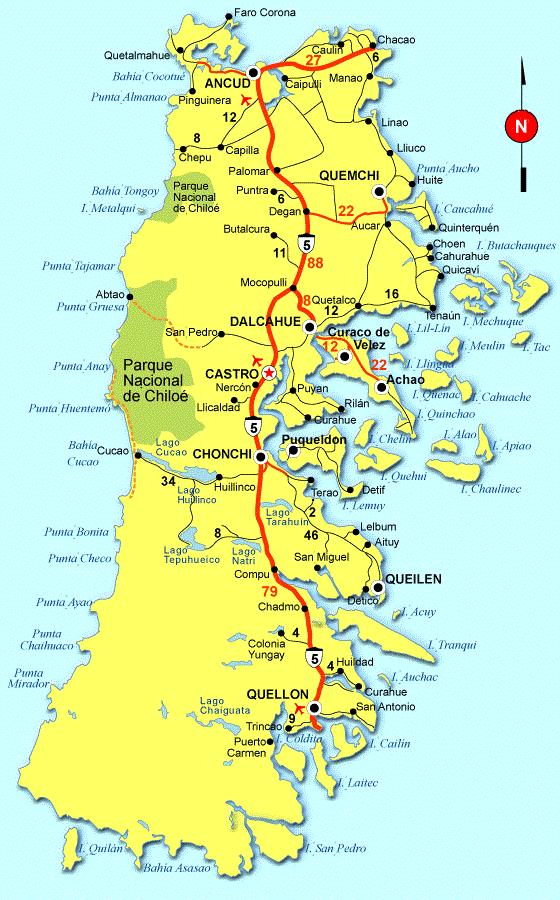
1.0. Introduction
For decades, island studies has emphasized that islands and archipelagos should express and shape themselves (their interests, ways of life, and futures) in their own terms. This principle, also resonant in the Chiloé Archipelago (Los Lagos Region, Chile), contrasts with continental approaches (imperial, national, global) that have sought to define them externally (Baldacchino, 2008; Hay, 2006; McCall, 1994). It has also given rise to the epistemological notions of “thinking with” and “thinking from” archipelagos: with the historical and geopolitical relations that constitute them, and from the ideas and theories that express their own archipelagic thinking and transdisciplinary knowledge production (Stratford, 2020, p. 59; Thompson, 2017, p. 68). This framework is often linked to the ‘decolonial’: the view that correlational archipelagic thinking seeks to geographically and epistemologically “shift” or “decenter” modern reason (Chandler & Pugh, 2021, p. 211; Thompson, 2017, p. 68). Here, the insular condition is presupposed as an imposed, imperial construction (Pugh, 2013; Roberts & Stephens, 2017; Stephens, 2013; Stratford et al., 2011; Thompson, 2017). This article engages that form of decoloniality which Chandler and Pugh (2021) have critiqued, especially the connection between “thinking with” archipelagos and “correlational epistemologies” (p. 210). The authors argue that framing islands as producing correlational knowledge, where co-constitutive relations take precedence over discrete entities, can obscure island politics. In this form of decoloniality, insularity is treated as a modern continental projection that renders correlational ontologies invisible.
When taking up the notions of thinking with and thinking from, I focus on the Chiloé Archipelago, a sea-land space onto which insularity has long been projected. My hypothesis is that in Chiloé (and perhaps other archipelagos as well), the possibility of an archipelagic ‘from’ is still emerging, and that insularity cannot be discarded from the process, as it plays a constitutive role. To frame this argument, I develop the notion of “epistemological responsibility,” emphasizing accountability when thinking with and from archipelagos. In Chiloé, insularity is not merely a residue or imposed notion, nor simply the subordinated pole in the binary between ‘closed island’ and ‘open archipelago’: it is part of the Archipelago’s history and lived experience. To advance this thinking with and from Chiloé, I draw on different vignettes: historical research, ethnography (from Apiao and Coldita islands), literary essay (Nicasio Tangol’s ‘magical Chiloé’), and cultural narrative (a myth of the Archipelago’s origins). These vignettes are distributed across two sections: one on ‘thinking with’ Chiloé, and the other on ‘thinking from’ it, which I explain in the next section.
As noted above, it remains unclear how thinking situated in Chiloé should be understood, a Chilote version of the ‘in its own terms’ principle. I suggest the issue turns on the relation between the insular and the archipelagic, and on the long process of ‘insularization’ (the framing of Chiloé as insular) that continues today. This process involves both external actors (the Chilean state, companies, NGOs, universities, the academy) and Chiloé’s inhabitants. To think from an archipelago is to recognize our collective participation in the epistemological production of what an archipelago is: a place shaped by symbolic, historical, and relational specificities such as ‘insularity.’ As Stratford (2020) notes, such thinking must not only react to imposed imaginaries but also critically engage with how an archipelago comes to be. Zhu and Grydehøj (2023) likewise remind us that researchers’ relational narratives and tropes are partial and politically motivated. Grydehøj et al. (2025) point to the myriad ways that islandness is understood in different archipelagos, calling for a closer assessment of these local ideas. I extend these calls through the notion of epistemological responsibility: a situated imperative to remain accountable to the ideas, tensions, and symbolic projections shaping Chiloé. Even a perspective ‘from’ archipelagos must be accountable for the relations it evokes.
My proposal builds on contemporary scholarship on the Chiloé Archipelago. In recent years, several scholars have approached it from an island studies perspective, or through critical engagements with ‘archipelago’ and ‘islandness.’ Lazo and Carvajal (Lazo 2026; 2017, 2018) propose that archipelagic constellations of meaning and experience emerge between Chiloé’s islands through practices of mobility, unsettling continentalized approaches. Catepillán (2020) argues that Chiloé has been imagined as “entirely insular” by central Chile (the nation’s representational core) (p. 123), while Ther (2026) calls for subverting centralized frameworks to enable more autonomous ways of strategizing the archipelago’s future. In previous work, we introduced the concept of ‘layers of isolation’ to understand Chiloé’s archipelagic condition (Bacchiddu & Saavedra Gómez, 2025). Yet these contributions have not fully foregrounded Chiloé as a place capable of epistemological production, as a possible ‘from’: a situated and autonomous locus from which thinking might emerge in response to the Archipelago’s demands and imagined futures. This locus remains to be constituted, its contours not predetermined but elicited from Chiloé itself. What follows is a step toward constituting that locus from an academic standpoint–one perspective among many on Chiloé.
I begin by considering Chiloé as a “constituted place” (Thompson, 2017, pp. 66–67) where the figure of insularity is essential for understanding local archipelagic experience. I treat archipelagos as spatiotemporal configurations, shaped by how islands are inhabited, experienced, and imagined, and set aside more metaphorical or expansive uses of the concept (see Roberts & Stephens, 2017). Archipelagos are both natural and geological, defined by land and sea, and historical webs of relations, including those of power: they are configured by representations that attempt to capture their geography. This reveals a paradox: archipelagos are constituted both by representations tied to the relational (islands as open “nodes,” connected to one another and to continents) (Thompson, 2017, p. 67), and by representations tied to the insular or closed (bounded islands, often defined by an “edge”) (Hay, 2006, p. 20). This paradox has shaped island studies debates, framing it as an opposition between insularity and the archipelagic–an opposition I return to later.
This paradox suggests that approaching archipelagos as constituted places also entails understanding them as symbolic mediations, since the tension between insularity and the archipelagic unfolds through the interplay of abstract forms and concrete geographies. Following Roberts and Stephens (2017), I understand archipelagos as mediations between human experience (unfolding through symbols) and a sea-land materiality: a persistent “push and pull” between the abstract and the concrete (p. 7). With Wagner (1981), I take abstract and concrete as elements of a mediated reality that is symbolic per se. No archipelago simply is: it comes to be, not as an immanent entity, but through human interpretation and resignification (Martínez-San Miguel & Stephens, 2020). As mediations, archipelagos are fixed by “figures of speech” or “figures of thought” (Stratford, 2020, p. 62), emerging at the intersection of figurative tropes (metaphor, metonym, allegory, analogy, personification, catachresis) and geography. These figures mediate between subject and world, enabling or constraining action and shaping experience (Ogden, 2021). In Chiloé, they include the “magical archipelago” (Mansilla Torres, 2009; Saavedra Gómez & Cortés-Ortuño, 2026), exotic islands (Catepillan, 2020), marginality to national economic intervention (Carrasco-Bahamonde, 2024), a biodiverse landscape for conservation projected by state agencies and NGOs (Ministerio del Medio Ambiente, 2013), or a distant “paradise,” as marketed by Inmobiliaria Costa Terao (n.d.) and other real-estate companies.
These examples from Chiloé point to a broader dynamic: projection. Figures, including insularity, are often projected onto islands and archipelagos through continental imaginaries (Gillis, 2004; Glissant, 2002; Stephens, 2013). I understand “projection” as the subject enacting in its world the form through which it “understands” itself (Heidegger, 2009, pp. 163–164). This logic is tied to modernity, conceived as an epoch where the world-as-image and the subject-object relation are fundamental to experience (Heidegger, 1958). Islands and archipelagos have been privileged sites of continental projection, which conceives insularity through imperial, colonial, national, postcolonial, and global frames (Roberts & Stephens, 2017; Thompson, 2017). These projections emphasize images of islandness as “vulnerable,” “fragile”, “dependent,” “homogeneous,” “isolated,” “peripheral,” “exotic,” “utopic,” or “backwards” (Grydehøj et al., 2025, p. 7; Hay, 2006, p. 30; Pugh, 2013, p. 11; Stephens, 2013, pp. 14–15; Stratford et al., 2011, p. 116). Insularity is thereby reproduced as distant, bounded, and inward-turning, constructing the insular other as an object, stripped of agency.
Yet projection does not operate only through imposed imaginaries of conquest, extraction, or integration; it also manifests in practices of decolonization, autonomy, and identity enacted from islands and archipelagos themselves. Representations, including insularity, both “influence” life on islands (Hay, 2006, p. 30) and emerge from them, inseparable from concrete experience. As a figure (a contested, situated trope), insularity can be appropriated, embodied, denied, resisted, reinvented, or placed in tension (Baldacchino, 2008). This connects to my claim here: in Chiloé, insularity and the archipelagic coexist as figures. Their interaction, imposed and appropriated, is crucial for articulating an epistemology from Chiloé that is grounded and responsible. By suggesting insularity is central to thinking with and thinking from the Archipelago, I depart from Hay’s (2013) claim that insularity cannot be recovered due to its associations with isolation and inwardness. The Chiloé experience suggests otherwise: insularity, far from discarded, can be reclaimed as a world-constitutive figure, even with its self-containment undertones.
Before turning to the Chilote vignettes, let’s recall that in island studies the tension between insularity and the archipelagic is often framed as an opposition: insularity, associated with isolation, dependency, exoticism, and coloniality, versus the archipelagic, framed as correlational and decolonial (Pugh, 2013; Stephens, 2013; Stratford et al., 2011; Thompson, 2017). Within this framing (which I revise later), thinking from archipelagos is imagined possible only once insularity is overcome, as if archipelagic thinking could emerge only by leaving insularity behind. My suggestion, however, is that in Chiloé insularity cannot be set aside: it is constitutive of archipelagic experience and must be considered in any attempt to think from the Archipelago. This is the tension the following vignettes explore.
2.0. On Vignettes: Thinking With and From Chiloé
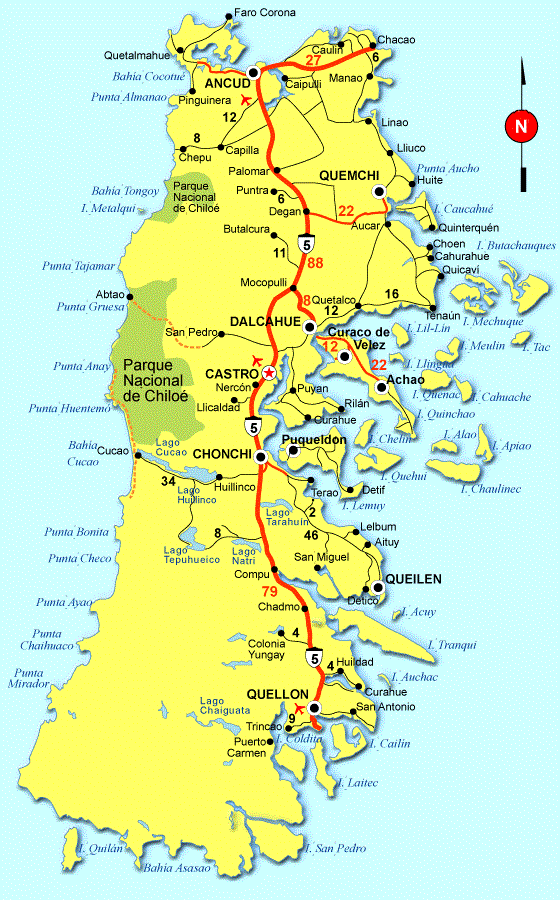
Here, I present general features of Chiloé that frame the vignettes on insularization, clarifying why they are distributed as ‘thinking with’ and ‘thinking from’.
The Chiloé Archipelago, in southern Chile, comprises a main island (“Isla Grande de Chiloé”) and dozens of smaller ones scattered across an inland sea. Historically, coastal communities of Spanish, Mapuche, and Chono descent lived dispersed between the forest and the sea. In recent decades, this orientation has shifted: roads and highways have been expanded, interior lands cleared, and forests exploited for timber, peatbogs, and wind parks. Population growth has concentrated in communes such as Ancud, Castro, and Quellón, while some smaller and more insular communes have stagnated or declined, reshaping the archipelago’s spatial and social landscape (INE, 2002–2017).
From the outside, Chiloé has long been imagined as mythological, traditional, timeless, a land of legends, wooden churches, and hospitable people. Today, tourists and affluent urban families purchase rural plots (parcelas de agrado) to build second homes, seeking healing, authenticity, and reconnection with nature, as promoted by Refugia Chiloé (n.d.), Properstar (2025), or Inmobiliaria Costa Terao Spa (n.d.). Media and tourism reinforce this image, highlighting ‘ancient’ practices, mythology, gastronomy, religious devotion, and biodiversity. Yet this contrasts sharply with a current Chiloé: ecologically and socially transformed by salmon aquaculture (Barton & Román, 2016), hydric crises, land parceling, and energy projects like Transelec and the Coloane wind farm (Fundación Senda Darwin, 2025; Valdés Bize, 2024). Cabaña Alvear (2024) notes that such initiatives are justified as national sacrifices, positioning Chiloé as an energy reservoir. The 2016 “Mayo Chilote” mobilizations (triggered by a red tide bloom and the dumping of dead salmon into the sea) exposed tensions between these representations and lived realities, as poisoned waters and devastated ecosystems gave rise to collective outcry (Araos et al., 2019).
These descriptions reveal a longer trajectory I call ‘insularization’: the projection and appropriation of the insular figure onto the Chiloé Archipelago. Through this process, Chiloé becomes a constituted place, shaped by persistent symbolic mediation in lived experience. Here, ‘thinking with’ becomes relevant. It refers to the historical and symbolic constitution of an archipelago through relations that exceed geography, both imposed and endogenous, while ‘thinking from’ highlights local epistemologies embedded in those relations. In Chiloé, insularization connects both: it projects historico-political figures of insularity while entangling them with archipelagic experience. Because the following vignettes pertain to insularization, their distribution between two sections (one on historical insularization and one on creative ‘thinking from’) is analytical: most vignettes elicit potential for both.
I now proceed with the ‘thinking with’ vignettes, seeking to highlight moments in the history of Chiloé where insularity plays a significant role in relation to an outside.
2.1. Thinking With Chiloé: Historical Vignettes
Chiloé can be considered an archipelago in geographic, historical, social, and cultural senses: its present geography, which emerged through postglacial retreat (Moreno et al., 2022); the island-to-island evangelization of the circular mission during colonial times (Saavedra Gómez, 2015); inter-island exchanges and religious voyages like those to the Caguach island; and ongoing mobility between small rural islands and larger urbanized ones (Bacchiddu, 2026; Lazo Corvalán & Carvajal Hicks, 2017, 2018; Saavedra Gómez, 2023).
Yet the weight of insularity is strongly felt. The Isla Grande, at 8,394 km2, is fifty times larger than Quinchao, the next biggest island. In some contexts, this symbolic weight transfers: Achao, Quinchao’s main town, can reproduce the same logic of insularity, casting others as the real islanders (Bacchiddu & Saavedra Gómez, 2025). The Isla Grande can appear almost continental from smaller islands, complicating what it means to be an islander. Residents often identify as such when facing the “outside world,” but within the archipelago the matter shifts: who counts as an islander varies across internal relations, shaped by the Isla Grande’s historical and symbolic gravity. Is this “main island” truly an island, and in what ways?
This dynamic emerges early. In 1609, Father Diego de Torres Bollo, citing missionary Juan Bautista Ferrufino, wrote: “There is among those islands one large one where the Spanish settlement is located, to which the others come to serve.” (Leonhardt, 1927, p. 23) (All translations from Spanish are the author’s unless noted). The notion of a “great island,” distinct for its size, was already circulating. Torres also described Chiloé as “like an archipelago” (p. 22), a phrasing he did not use for other island groups such as the Chonos. Why “like” and not simply “an archipelago?” This “great island,” so unlike the others, already carried the symbolic weight of a continent.
Another colonial vignette: In 1743, the cabildo (town council) of Castro, of Spanish descendants, wrote to Bishop Pedro Felipe de Azúa e Iturogoyen to protest the abolition of the encomienda, the forced labor system through which indios paid tribute. Azúa had recommended it after visiting the province two years earlier. Their letter, preserved in the Colección de Documentos Inéditos para la Historia de Chile José Toribio Medina, describes an unproductive, impenetrable, impoverished province, abandoned by the Indies administrative centers. Encomenderos, the holders of encomiendas, dispersed among “uncultivated and dense mountains,” lament their isolation and neglect. They complain of “looking only at one another, the husband at his wife and children, and they at him.” Unable to gather, attend mass, or confess in grave sickness, they no longer relied on the indios to row their piraguas (CDIHC, tomo 185, f. 294).
Yet in the same letter, the indios appear embracing the archipelago: moving in their vessels, living “apart in their islands” (CDIHC, tomo 185, f. 297), resisting concentration into estancias or towns, and choosing when and where to work–a freedom won in the uprising of 1712, after which Azúa undertook his visita (Saavedra Gómez, 2015). This archipelagic mobility contrasts with Spaniards’ sense of isolation and inwardness, which are tropes of insularity. In eighteenth-century Chiloé, two figures coexisted: insularity as confinement and the archipelagic as mobility. The letter itself stages the paradox: those claiming dominion felt trapped, while those they sought to dominate moved fluidly across the waters. These conditions were not separate but persistently mediated; in these islands, indios and Spanish descendants lived together.
An early republican vignette: In May 1826, months after Chiloé’s annexation to Chile, part of the Chilote elite threatened an uprising against the emerging republic. They advocated the return of Bernardo O’Higgins, Chile’s former Supreme Director between 1817 and 1823, whose centralized style suggested authoritarian rule, and who had recognized Chiloé’s strategic importance (Aravena, 2024). This appeal drew on memories of the archipelago’s eighteenth-century relevance: its proximity to the Estrecho de Magallanes, relative autonomy, and modernizing streak under Bourbon rule, when roads were built, San Carlos de Ancud was founded, and Chiloé was made directly dependent on the Viceroyalty of Peru (Urbina Burgos, 1998). It also recalled the province’s loyalty to the Crown during the Independence Wars, reinforcing the elite’s sense that Chiloé had mattered, and could still matter, in the unsettled republican order (Aravena, 2024).
This vision may have drawn on the figure of Chiloé as both “imperial archipelago” (Thompson, 2010, p. 1) and “continental archipelago” (Thompson, 2017, p. 62): a province of islands and nations stretching from Maullín beyond the Corcovado Gulf, including continental territories in the Spanish Empire. In colonial times, Chiloé encompassed far more than its core islands. In the seventeenth century, the “Corregimiento de Chiloé” was described as extending “from 41° south latitude to the South Pole, and from the Pacific Ocean to the Atlantic” (Catepillán, 2017, p. 53). Yet this jurisdiction was largely theoretical: the archipelago’s northeastern coast and continental outposts like Calbuco and Carelmapu formed its true core. Still, the image of a vast, imperially connected archipelago may have kindled the Chilote elite’s republican imagination–even as fears of abandonment and confinement crept in with Chiloé’s new condition as a ‘national archipelago’.
This fear of being too remote, too marginal, too loyal to the old regime, and irrelevant to the republic may have been justified. Following Catepillán (2020), Chiloé became “entirely insular” (p. 123) in Central Chile’s eyes: an exotic “imagined landscape” (p. 115) of islands, harsh weather, and poor, introspective people. As I’ve suggested, this trope of exoticism, backwardness, and inwardness reflects a specific projection of insularity: a figure through which the nation-state imagines itself as continental and modern. This symbolic framing was accompanied by an administrative one, what Catepillán calls a “severing” (2017, p. 54) of Chiloé’s jurisdiction. Over the nineteenth and twentieth centuries, southern and continental territories were annexed to the Llanquihue province, and by the mid-twentieth century Chiloé itself was merged into it. In 1976, it regained provincial status, but without its former colonial territories. Jurisdictionally, it was dramatically reduced: no longer a strategic imperial frontier but a subnational archipelago, refigured in the national imaginary as insular, exotic, marginal.
The trope of inwardness and tradition shaped how late-nineteenth and early-twentieth-century Chilotes wrote about the Archipelago. As Catepillán (2020) notes, they contested insular tropes projected from central Chile yet remained entangled in them, especially those of utopia and innocence: work ethic, frugality, submission, religious fervor, humility, communitarianism, or customs lost to modernity. Darío Cavada, perhaps the most renowned, offers a vivid example. In Chiloé (1896) (signed as “N.N.N.” and “islander”) Cavada describes Chilotes as people “of good customs and education” (p. 71), sometimes “at odds with the modern spirit” (p. 82). He calls them “dreamy” (“soñador”, p. 21), shaped by the sea, with an “idiosyncrasy” that leads them to “speak little and think a lot” (p. 21), while also criticizes their beliefs in witches and other “nonsense” (p. 70).
Cavada portrayed Chiloé and its people as both “islander” (“insulano”) (p. 29) and archipelagic, depicting them as “adventurous” (p. 21) and “roamers by nature” (p. 24). These traits, he argued, meant Chiloé “always deserved the commiseration and even the scorn of their industrious fellow citizens from the north” (p. 24), that is, Santiago. By appropriating the figure of insularity projected from central Chile, Cavada made a case for Chiloé’s archipelagic nuance and its need for greater recognition as subnational territory. He wrote that Chiloé was “the tail of the condor” (p. 81), a position to be dignified through state attention, “experience, and knowledge” (p. 74).
A vignette on Chiloé’s modernization by the Chilean state: In 1950–1962, CORFO (Chile’s economic development agency) published the Geografía Económica de Chile, outlining a national developmental vision based on territorial resources and technological progress. It sought to construct a “single image and the true dimension of the country” (CORFO, 1950–1962, p. IV, 255), forging unity from diversity by defining territories as uniform in customs, climate, and resources. As Thompson (2017) notes, this regional development framework often arbitrarily homogenized islands and archipelagos to fit the national imaginary. The Geografía Económica placed Chiloé in the typological “Región de los Canales,” extending through Aysén and Magallanes, solely because of its insularity: “it is only its insular condition that induces us to put it apart” (CORFO, 1950–1962 I, p. 39). This linked the province to southern archipelagos and Patagonia, reinforcing its exoticization (Catepillan, 2020). Chiloé was described as a distinct “país chilote” (CORFO, 1950–1962, p. IV, 420), included in the nation yet marked apart.
Chiloé received limited attention compared to Patagonia. It was framed as “unmistakable,” “unique,” and difficult to integrate (CORFO, 1950–1962, p. IV, 419–420). Its inclusion raised the Canales region’s population density, and was deemed the “most humanized and alive” sea of the country, its last truly inhabited territory (p. 419). Patagonia, by contrast, was “something like the antithesis of Chile’s roots” (p. 436): uninhabited, unexplored, awaiting conquest. Chiloé was thus part of the country but at its margins–a symbolic frontier bordering a “desolate archipelagic world” and a “great pioneer horizon” (p. 419). As the site where humanization gave way to emptiness, Chiloé became an umbral: both part of the nation and its dilution.
Chiloé only partially conformed to continental expectations. It was dispersed “in little towns of some hundreds of inhabitants,” its people “willing to leave and emigrate” (p. 421-422). CORFO spoke of its two “faces”: temperate inland seas but harsh Pacific coasts (p. 420). Its “old tradition” made it attractive yet hindered development (p. 420). Archaisms, isolation, and smallholding were said to foster poverty and migration, while its timber and shellfish were deemed “of little importance” (p. 421). Its population was considered mestizo, but its “hispanization” slow, with “a numerous Indigenous component” (p. 421) contributing to poverty. In sum, Chiloé’s “island life” meant it did not partake of Chile’s “development spectacularity,” but rather in “inwardness” (p. 421).
Through Geografía Económica, CORFO projected insularity onto Chiloé, reproducing its ambivalence: a utopia of tradition (a respite from modernity) and a site of underdevelopment. Central Chile operated this projection to define its own modern, humanized frontier. By constituting Chiloé as an ambiguous umbral, between canonical Chile and a world beyond, insularity rendered it a national archipelago, with little geopolitical interest beyond serving as a gate to Patagonia.
The Geografía Económica inspired modernization initiatives in Chiloé within the regional development framework. Philippe Grenier’s Chiloé et les Chilotes (1984) offers a critical summary, noting these programs were reactive rather than proactive, mere responses to disasters like the 1950s potato blight and the 1960 Valdivia earthquake. Development plans were underfunded, poorly adapted to Chiloé’s terrain of “tiny, sloped fields” (p. 447), and road construction was “slow and sometimes mediocre” (p. 450). More significant were the efforts after the Valdivia earthquake: the destruction triggered internal rural-urban migrations, which led to expanded road infrastructure. CORFO also promoted a free-port policy to integrate the Archipelago into international trade, but Grenier judged this initiative weak in both infrastructure and impact.
Yet modernization had cultural effects Grenier did not anticipate. The free port is remembered as a moment when Chiloé opened to the world: modern goods and new trading practices reshaped local commerce and material culture. In towns like Castro and Chonchi, ceramic tableware, radios, and toys became markers of modernity. Symbolically, the free port disrupted a deeply rooted insularity, echoing the abandonment felt by the Castro cabildo in an earlier vignette. These cultural shifts complicate Grenier’s account, which, despite acknowledging central Chile’s “distorted vision,” still portrayed Chilotes as dependent, isolated, and trapped in a “mentality of poverty” (p. 128), tied to submission and tradition. This mentality, he argued, turned individuals “into themselves” (p. 121), fostering “individualism” (p. 145) and sustaining a mythology of daily life. For Grenier, myth persisted because Chilotes were unable to “really transform nature” (p. 139). Even as he critiqued national imaginaries, he reproduced an uncritical insular trope, rendering Chiloé passive. This may explain why he overlooked how modernization contributed to a Chilote identity that conceives the Archipelago as a cultural and geographic “totality” (Uribe Muñoz, 2024, p. 233), what Daughters (2026, p. 132) calls a “pan-island” Chilote identity.
A vignette on modernization and identity: in the early 1960s, CORFO commissioned the Universidad de Chile to study Chiloé’s regional development (Munizaga, 1971). The task fell to the Centro de Estudios Antropológicos, later Chile’s first Department of Anthropology. Fieldwork was conducted in 1965–66, shortly before Grenier’s visit. Carlos Munizaga, a foundational figure in Chilean anthropology, led the study, Reconocimiento cultural de Chiloé. ‘Reconocimiento’(‘recognition’) aligns with the idea of projection: the state sought to assess how Chilote culture might fit national development imaginaries. Munizaga noted that Chilote kitchens, with their wood-burning stoves, met World Health Organization standards for warmth, showing Chiloé had something to say about development. Yet despite critiquing “ethnocentrism” (Munizaga, 1971, p. 3), Munizaga reproduced the logic of projection, portraying Chiloé as an imperfect mirror of modernity, as CORFO did. Traditional values, he argued, sustained a mentality resistant to change, akin to Grenier’s ‘mentality of poverty.’
Munizaga also observed cultural agency. Urban Chilotes showed interest in “regional music” (1971, p. 11) and mythology, often accessed through radio programs. Rural migrants sought knowledge of their own myths and legends, which Munizaga believed could be mobilized in handcrafts and tourism. González, Van Meurs and Ulloa (2011) note this valorization was already underway, with fiber handcrafts from Llingua Island sold in Santiago. Local folklorists such as Quintana Mansilla and Cárdenas, and the Institute of Rural Education, fostered these practices. A self-conscious, pan-islander Chilote identity was taking shape.
Uribe (2024) links this identity’s emergence to modernization between the 1950s and 1970s. Until the mid-twentieth century, urban elites claiming “Iberic heritage” (p. 232) discriminated against rural dwellers, calling them “indios”. “Chile’s contempt” (p. 97) was reprojected by Chilote elites (mainly residents of Isla Grande) onto Chilote rurality. This dynamic echoed the imperial archipelago and the anxiety to be continental, reinforcing insularity, as localities deemed backward were often smaller islands or places on the main island accessible only by boat. It recalls the Castro cabildo letter and the ambiguous weight of Isla Grande, at once continental and insular. It also connects with Baldacchino’s observation (2020) that larger islands may act as mainlands toward smaller ones, treating them as more traditional and seeking to integrate them into broader territorial identities.
According to Uribe (2024), modernization, especially after the 1960 earthquake, reshaped this contempt. A new Archipelago intellectuality emerged, invested in preserving rural culture (music, myth) as an endangered “reservoir of traditions” (p. 235). Drawing on categories from central Chile folklorists, Chilote intellectuals reimagined Chiloé as a “distant world,” appropriating insularity as their own. They produced an unprecedented “gaze upon oneself” (p. 235), and worked toward autonomous “cultural continuity” (p. 238). This pan-islander identity, with insularity, tradition, and modernity at its core, remains active today, though transformed by stronger Indigenous content (Daughters, 2026). It reflects how insularization has long shaped Chiloé as a constituted place. Whether the emergence of this pan-islander identity from Isla Grande produced tensions with smaller islands, as Baldacchino (2020) suggests for other archipelagos, remains unclear.
A final vignette on insularization: Uribe (2024) argues that Chilote critical folklore emerged in response to salmon industry consolidation in the 1970s and 1980s, supported by neoliberal deregulation under Pinochet’s dictatorship. Salmon farming reshaped Chilote rurality, driving rural-urban migration, precarious work, women’s labor, and unsettling cooperative practices (Román, 2026). By the 1980s, Uribe suggests, folklore became a mere aestheticization of a vanishing way of life: insularity folded into exoticization, staged and commodified in folklore festivals. In the 1990s and 2000s, Chilote myths and practices were further commodified in tourism through figures like ‘Chiloé Mágico’ (Mansilla Torres, 2009). The 2007 ISA virus crisis caused massive layoffs in aquaculture, but the industry soon recovered (Alvial et al., 2012).
In May 2016, protests erupted in Chiloé after a red tide bloom event, the dumping of dead salmon into the sea, and the death of shellfish and marine life. Beginning with artisanal fishers, mobilizations spread across civil society, blockading roads, closing the Chacao canal, and isolating the Archipelago. The uprising exposed decades of commodification and extractive transformation under what Araos et al. (2019) call a “neo-extractivist model of development” (p. 408). The protests, lasting approximately 18 days, were archipelagic, spanning all ten comunas of the province and smaller islands, as reported by Resumen (2023) and suggested by Neira Flores (2018). A pan-islander identity re-emerged, framing Chiloé as a cultural and geographic totality within a new socioecological figure.
Protesters appropriated the figure of insularity. By forcefully isolating the Archipelago, they reversed the condition long projected onto Chiloé. This reversal was captured in the phrase Chiloé está Priva’o, emblematic of the protests. While ‘priva’o’ echoes ‘privado’ (‘privatized’), aligning with critiques of sea privatization, its deeper meaning is local: a state of anger, sadness, and inwardness that invokes “private” as the enclosed and intimate. As earlier vignettes showed, inwardness is a recurring trope in the projection of insularity. In 2016, it was appropriated as a mental and affective force carrying political agency.
Contrary to Hay (2013), in Chiloé the insular can be recovered as psychological and symbolic form–and has been for a long time, despite its colonial undertones.
2.2. Thinking From Chiloé: Vignettes of Ethnography, Essay, and Myth
The previous vignettes, framed as a form of ‘thinking with,’ traced how Chiloé has been insularized through the projection and appropriation of figures, that is, through symbolic mediations constituting it as an archipelago. As Stephens (2013) notes in her reading of the Caribbean, I attempted a modest “connecting, drawing, and mapping” (p. 25) of how Chiloé has been shaped through insularity. Yet I do not think this reveals, in Chiloé, the insular as simply constitutive of “colonial modernity” (p. 25) in contrast to the archipelagic correlational, decolonial, or non-modern (Chandler & Pugh, 2021). I will return to this opposition later.
From colonial times to May 2016, insularity in Chiloé has carried both negative and positive registers. Tropes of continentalization, isolation, exoticism, tradition, utopia, inwardness and autonomy shifted in meaning as they became embedded in the Archipelago. In colonial times, insularity oscillated between belonging and exclusion, dominance and powerlessness within the imperial archipelago (between being ‘seen’ or not by the Crown) while the ‘indios’ embraced their own archipelagic experience, seizing the abolition of the encomienda. In the republican era, insularity was both a source of marginalization and a claim to national belonging. By the twentieth century, it signified underdevelopment and opacity (the ‘umbral’ condition) in the nation-state’s imagination, downplaying the archipelagic through poverty and ‘desolation.’ Yet it also sustained a specificity later appropriated as identity, giving rise to Chiloé está Priva’o as an archipelagic claim: inwardness, tradition, and isolation as assets for the future. This notion was inseparable from modernization and the projection of the insular–that is, from insularization. Today, the “priva’o” idea coexists with projections that rework exoticization (parcelas de agrado, the spiritual-natural, a respite from modernity) and national development: Chiloé as ecological sacrifice zone and energy reservoir.
My argument is that if ‘thinking with archipelagos’ means attending to their mutable limits, histories, connections, impositions, and appropriations (Thompson, 2017), then thinking with Chiloé requires assuming insularization: insularity as a complex figure within a situated relationality that remains unresolved, not opposed to the insular itself. Following Baldacchino’s (2020) idea of an “archipelagic imagination” (p. 378) beyond island essentialization and inter-island tensions, insularization here is co-constitutive with both the archipelagic and continental projection.
In the vignettes that follow, I extend this ‘thinking with’ (developed in the previous section) through a closer reading of ideas on insularity emerging from the Archipelago. I consider this a step forward in imagining what a ‘thinking from’ Chiloé might entail.
On May 19, 2025, during a session of the Magister in Territorial Governance at the Universidad de Los Lagos, Chilote writer Sergio Mansilla presented the lecture Towards an Island Thinking. Two interventions stood out. Poet Carlos Trujillo reflected on the differences between life on the Isla Grande and the smaller islands. As a child in a town on the former, sixty years ago, he recalled residents greeting and buying produce from those arriving from “the islands.” People saw themselves not as islanders but as “hill folk,” with little sense of Chiloé’s archipelagic nature. Yet today Chilotes living on the continent identify as “from the island,” meaning the Isla Grande. For Trujillo, insularity shifts over time and is expressed differently across the Archipelago: it is heterogeneous, produced through encounters between different people with distinct insular experiences. As in the colonial vignette, the Isla Grande carries continental weight when seen from within, defining others as islanders, but from the outside it becomes the origin island marking the ‘islander’ condition.
The second intervention came from Chilote poet Olga Cárdenas, who noted that Chilotes are often perceived as “one thing that speaks, thinks, and feels the same.” In reality, each island is a “different world”: customs, speech, and legends vary, sometimes subtly, but meaningfully. For Cárdenas, Chiloé is not “a flat thing, like a table,” but diverse. Insularity is experienced heterogeneously, shaped by each island’s geography and history. As I see it, she countered homogenizing projections by multiplying the insular from within, presenting her own version of insularization. We have described this chromatic wheel of insularity, where the insular shifts from one island to the other, as “layers of isolation” (Bacchiddu & Saavedra Gómez, 2025, p. 2). This heterogeneity, persisting despite Isla Grande’s continental weight, remains relationally embedded in Chiloé’s archipelagic nature: paraphrasing Barrow in Baldacchino (2020), it is kept “together together” (p. 378), with variations rather than internal tensions. The archipelagic emerges from the insular, and vice versa.
An ethnographic vignette: Bacchiddu (2026) traces the tension between “island” and “town” as it emerges between Apiao Island and Achao, a town on Quinchao Island (p. 193). For Apiao inhabitants, Achao represents modern life, and they often internalize how Achao residents describe them: backward, poor, distant, Indigenous, tied to tradition, even though Achao itself is also on an island. In Achao, Apiao islanders embrace modern logics of work and consumption. Yet for Bacchiddu this is not simply about accumulating money or objects, but about “resembling the Other” (p. 209), communicating with them, becoming “anonymous” (p. 215), non-islanders. This appropriation of modernity is “inventive” (Bacchiddu & Saavedra Gómez, 2025, p. 18), as Apiao islanders preserve both experiences, the island and the town. In Apiao, insularity is felt as an imposed projection of backwardness and inwardness, marking them as different, but it is also appropriated, bent, and transformed to produce subjectivity. As in previous vignettes, this unfolds in a context shaped by the deferred continental weight of Isla Grande: Quinchao, where Achao is located, becomes continentalized in contrast to Apiao, whose insular condition is thereby intensified. Insularity, as a figure, emerges again as heterogeneous–dependent on perspective, yet always tied to a geographical and political archipelagic reality.
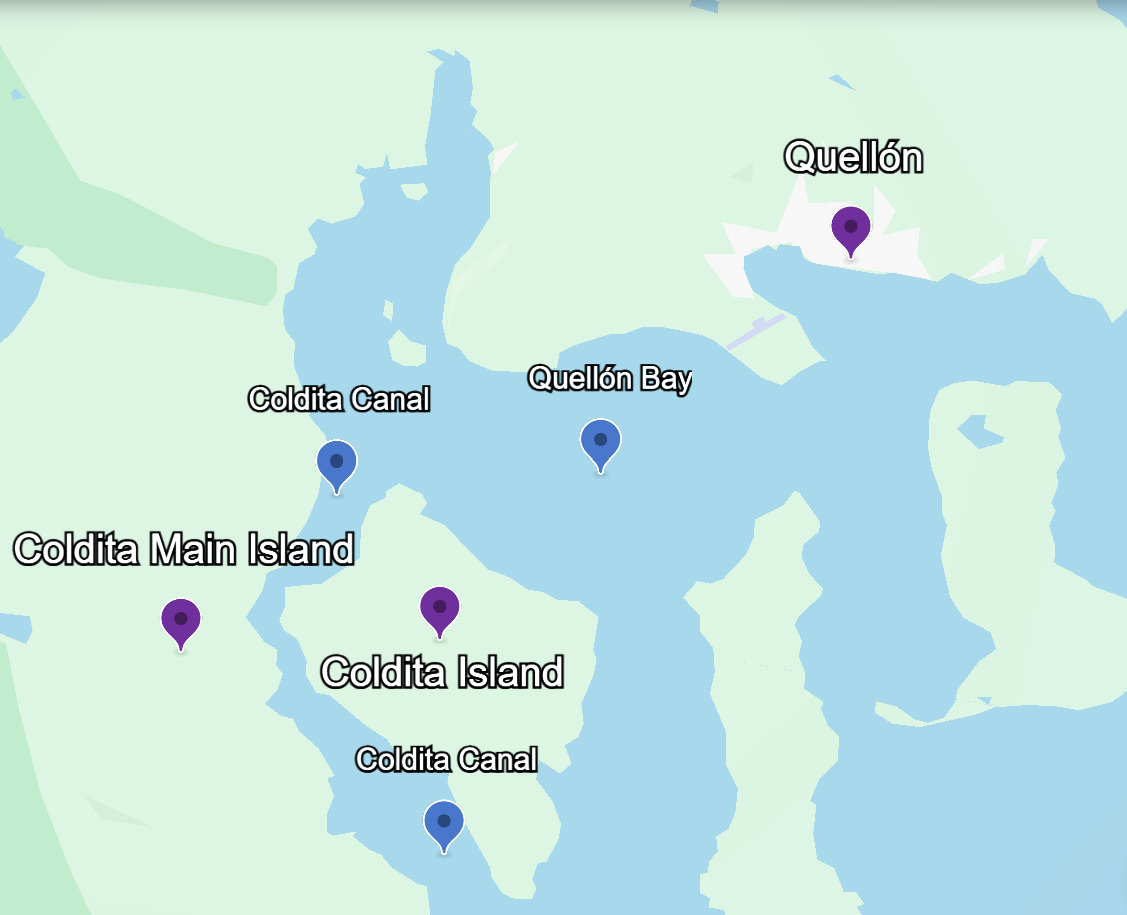
Another ethnographic vignette: a narrow canal separates Coldita Island from the Isla Grande. In its northern section, the canal dries at low tide and can be crossed on foot. Both sides (Coldita Island and what I call Coldita Isla Grande) are linked by historic and kinship ties. With no roads, Coldita is only accessible by sea (Saavedra Gómez, 2023). As a result, even those living on Coldita Isla Grande consider themselves islanders. Many Colditans now reside in Quellón on the Isla Grande, some maintaining a double residency and moving between Coldita and the city by public motorboats or their own vessels.
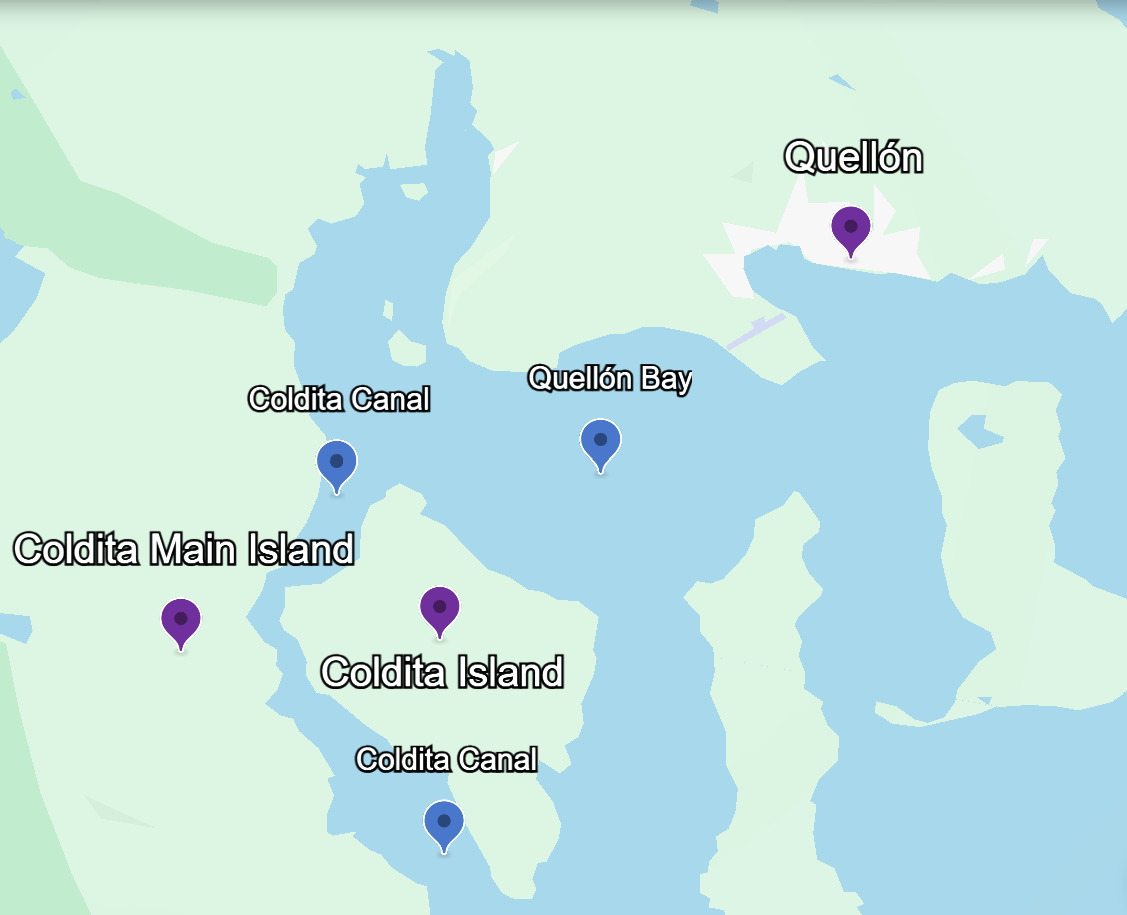
When traveling home, Colditans with residence in Coldita Isla Grande say they are going to “the island,” even though it lies in the same coastal section as the Isla Grande proper. In this usage, the island figure symbolically transforms Coldita Isla Grande into an extension of Coldita Island, the two joined and separated by the tide. Coldita Isla Grande becomes an insular territory, distinct from the Isla Grande to which it geographically belongs. A process of insularization unfolds: the Isla Grande is understood as continental, while one of its sections undergoes a reversed transformation, becoming a kind of prosthesis of Coldita Island. In Coldita, a persistent mediation between insular and continental is enacted: insularity emerges not as fixed, but as a relational figure shaped by geography, movement, and symbolic projection. This mediation differs from Apiao: while Apiao islanders render insularity invisible to resemble the continental Other, Colditans underscore and problematize it, defining their subjectivity as insular through archipelagic movement and symbolic differentiation.
An essay vignette: in 1972, Chilote writer Nicasio Tangol proposed the concept of the ‘magical archipelago.’ He linked the ‘magical’ to Chilote legends and customs, engaging the more identity-oriented and political approach to folklore that emerged around the 1960s. Although the magical is a constitutive trope in the projection of insularity, Tangol treated Chilote beliefs more affirmatively than, for instance, Darío Cavada before him. For Tangol, Chilotes lived in two worlds: an exterior one of Chilean “citizenship” (1972 vol. II, p. 8), and an interior one, “unfathomable” to outsiders (1972 vol. I, p. 77). Within this interior world, the Chilote appears as a “creative god” (1972 vol. II, p. 9), both creating and contemplating his own mythological universe. Tangol recovered inwardness as an asset, much like the 2016 protesters’ use of the priva’o notion.
Unlike Grenier, Tangol portrays Chilotes as inventively appropriating insularization through myth (much like Apiao islanders and Colditans), granting them autonomy and a history of their own. They are no longer defined by dependence on Chile. He connects this unfathomable insularity to archipelagic notions: Chilotes’ origins lie not in mestizaje but in the southern archipelagos, which CORFO’s Geografía Económica had deemed empty and desolate a decade earlier. In Mayachka: cuentos fueguinos, Tangol described these archipelagos and their peoples as having a mythological capacity that constitutes a fractured, self-produced world (Saavedra Gómez & Cortés-Ortuño, 2026). Chiloé as a magical archipelago would therefore have an origin beyond its modern confines. Unlike CORFO, this archipelagic connection involves a world that, because of its opacity, is also expansive and relational, where the insular and the archipelagic coexist symbolically.
A mythological vignette: in 1990, a tale by José Santos Lincoman was published posthumously. Lincoman, a renowned Chilote Williche leader active from the 1930s to the 1980s, entitled it How Chiloé Was Divided (a very ancient Williche tale). It can be read as a socio-geographic origin myth of Chiloé (Saavedra Gómez, 2023). The narrative recounts a great earthquake that submerged valleys, dragging people and animals into the sea or burying them, leaving only a few survivors. One man and his family remained on an island without food; all of their children died except one. The husband asked his wife if she would sacrifice their last son to the waters so that they might return to their original levels. She chose instead to offer herself, and drowned. Afterwards, the son too asked to be given to the sea. Weeping, the father carried the child to the shore, where a wave took him away. Immediately, rivers and estuaries filled with fish and shellfish. Left alone, the man wandered the coasts, calling for his wife and children. He shouted with joy, then cried, asking himself again and again: why did I kill my family?
As implied by the tale’s name, catastrophe gives birth to Chiloé as an archipelago: the island where the family is stranded is one among many, with other families also isolated. Only when the husband is left alone, when insularity becomes radical, does marine sustenance appear in abundance. But the lonely man has gone mad. The myth portrays radical insularity as a social impossibility: paraphrasing Hay (2013), he is trapped within an insular state of mind, and cannot reproduce the world of valleys and kinship that existed before the catastrophe, despite abundant food. Lincoman’s myth suggests insularity is asocial: recovering society would require crossing the sea, meeting with others, resuming kinship and exchange. At first glance, archipelagic relationality is framed as breaking insularity, potentially opening islands (and minds) to each other. Yet comparison to other versions, such as the Treng-Treng and Kay-Kay Vilú myth (Saavedra Gómez, 2023), shows catastrophe recurs, caused by misbehavior, especially resource hoarding and witchcraft. Because misbehavior is inherent to social life, resuming sociality brings catastrophe again, this time within and between islands: insular catastrophe is inevitable.
In Lincoman’s myth, insularity appears as a mental state akin to madness (a trope of inwardness) but also as a danger embedded in archipelagic relationality. Insularity is inescapable, absorbing and constraining whatever the archipelagic might become: the insular and the archipelagic coexist within Chiloé’s mythical cycle. Like Tangol, Lincoman drew on projected figures of insularity and embedded them creatively within the archipelago’s complex relationality.
3.0. The Insular and the Archipelagic
With the insularization vignettes, insularity emerges as embedded in Chiloé, symbolically and politically mediating with the archipelagic and contributing to the Archipelago’s condition as a constituted place. It appears both projected and appropriated, especially in identity, and remains under tension from colonial times through the May 2016 protests. A ‘thinking with’ the Archipelago that engages its constitutive relationality cannot escape insularity; the figure cannot be discarded as merely external or colonial.
The vignettes on ethnography, essay, and myth offered resources for a ‘thinking from’ Chiloé that enacts its own epistemological forms of understanding the archipelagic. Trujillo and Cárdenas’ interventions on island thinking show insularity as relational and contingent, refracted through the Isla Grande’s ambiguous continental/insular weight and through archipelagic relations shaped geographically and historically. This refraction is heterogeneous, shifting with specific insular experiences and perspectives, as expressed in ethnographic vignettes from Apiao and Coldita. Because Chilote insularity is not fixed but relationally activated, it constitutes subjectivity through divergent symbolic mediations, ranging from invisibilization to radical assertion. These mediations bend geographical categories such as ‘continent’ and ‘island’.
Here, the archipelagic ‘push and pull’ between the abstract and the concrete (Roberts & Stephens, 2017) is tied to insularity. Tangol’s vignette shows Chilote belief and myth as world-generative, turning insularity into a mode of archipelagic inwardness and confinement that no longer signals national marginality or backwardness but creative autonomy. Lincoman complicates this intertwinement: even though insularity and the archipelagic lie at the Archipelago’s mythological origin, the cyclical inevitability of catastrophe (the breakdown of the archipelagic world) is tied to the insular as both generative and destructive of geography and sociality. His myth suggests that Chiloé becomes a constituted place through the persistent mediation of insularity within the archipelagic, a mediation that places relationality at ongoing risk of collapsing into unbearable inwardness.
The relation between the insular and the archipelagic, between inwardness and relationality, has been important to island studies, often framed as an opposition. Stratford et al.'s Envisioning the archipelago (2011) advanced an archipelagic perspective privileging both island-to-island and island-to-continent relations. These are conceived not as unidirectional and passive but as multiplied, agentive “assemblages” (p. 122), as ontogenic correlational compounds articulating diverse entities and practices. The archipelagic was also defined as a thinking “model” (Martínez-San Miguel & Stephens, 2020, p. 6; Stratford, 2020, p. 53; Stratford et al., 2011, p. 121), one that conceives the planet as a fluid archipelago in process (Pugh, 2013; Stephens, 2013). This approach responded to modern reason’s view of islands as isolated and bounded, giving rise to the idea of ‘thinking with’ archipelagos (Pugh, 2013).
This ‘thinking with’, which Thompson (2017) connected to a ‘thinking from’, is conceived as decolonial, as “shifting the geography of reason” (p. 68). Chandler & Pugh (2021) describe this as “correlational thought” (p. 211), and critique it for diluting island politics and autonomy. Stephens (2013) argued that Caribe archipelagic relations are fractal, of “self-similarity” (p. 16), the “antithesis” (p. 11) to imperial insularity imposed by “colonial modernity” (p. 25). The Caribe thus reveals the archipelagic as movement, as decolonial correlationality unsettling continental reason. In sum, the opposition between connected and isolated, open and closed, has often been recast as one between the insular (representational, imposed, colonial, or ‘unreal’) and the archipelagic as ‘real’, preexisting insularity. Other examples include Pugh (2013), who suggested archipelagos operate by an ontology of “metamorphosis” (p. 9), a “transfigurative originality” exceeding static island tropes of “singularity, isolation, dependency and peripherality” (p. 11). Thompson (2017), meanwhile, argued that the “flawed” island trope “confounds and confuses” (p. 61) the idea of correlational archipelagic spaces.
As Santos Perez notes, quoting DeLoughrey (2017), many authors advancing a decolonial and correlational ‘thinking with archipelagos’ in island studies (conceiving insularity as colonial or modern) draw inspiration from Caribbean and Pacific archipelagic experience, and from intellectuals such as Glissant (see Saavedra Gómez, 2026), Walcott, Brathwaite, and Hau’ofa. Yet a question arises about other ways of experiencing and understanding insularity and the archipelagic, from other archipelagos that emerge as constituted places, such as Chiloé.
Following Hay’s phenomenological approach (2013), insularity is not always determined by colonial imposition; it also arises from specificity, from the relations people establish with their islands, producing meaning. In Chiloé, the insular is embedded in archipelagic relationality: in refraction, heterogeneity, mythological creativity, and danger. It is inseparable from the Archipelago’s insularization, from how it has come to be a constituted place. In this sense, insularity is not opposed to the archipelagic, nor does the archipelagic preexist insularity. Rather, they stand as figures in a mediated relation that shapes archipelagic experience in manifold ways: imposition, appropriation, tension, contestation, and projection.
In recent years, authors working from the archipelagic perspective in island studies have taken a similar position. Martínez-San Miguel & Stephens (2020) proposed the metaphor “isolation in connectivity, connectivity in isolation” (p. 36) to express an archipelagic thinking tied to “interpretation and mediation” (p. 19), to modes of existence in which insularity is articulated “from an embodied, experiential place” (p. 24). In this view, the world remains imagined as a correlational archipelago that decenters modern thinking. Yet insularity is not excluded for being imposed; rather, it is potentially included in a relational mode of thought emerging from concrete experience. Stratford (2020), meanwhile, reconsidered the 2011 proposal, arguing that the archipelagic model should not discard real islands, islanders, and island life, lest it lose its objective: that islands and archipelagos express themselves in their own terms and define their ways of life. For Stratford, however, the model remains decolonial and correlational, a framing that might invisibilize other archipelagos’ experience of insularity.
Grydehøj et al. (2025) propose that scholarly frameworks for insularity may not align with islanders’ own understandings and lived experiences. Island “truth” (p. 15) is not universal, but culturally and politically specific, produced both by islanders and by island research. This is why –I argue–a ‘thinking from’ archipelagos must not presuppose a priori contents such as the decolonial unsettling of modern thought and insularity. It must instead remain mindful of specific archipelagic configurations. In Chiloé, the insular and the archipelagic appear in a situated mediation. A ‘thinking from’ must grow out of a ‘thinking with’ that is conscious of the figures constituting an archipelago. It should be seen as a locus to be reached, one in constant production. This is what I call ‘epistemological responsibility’, to which I return in the conclusions.
4.0. Conclusions: Epistemological Responsibility in Thinking With and From the Chiloé Archipelago
In this article, I began with a ‘thinking with’ the Chiloé Archipelago: historical vignettes that addressed the material, historical, and representational relations that have come to constitute it (Thompson, 2017), especially those of projection. Chiloé in its current form is a phenomenon of modernity. This view contrasts with recent ontological interpretations of the Archipelago proposing an opposition between a modern state ontology and what Alvarez et al. (2026) call “Williche eco-ontological conservation” (see also Alvarez et al., 2023). Rather than these incommensurable worlds, what emerges here is a historically and symbolically constituted Archipelago, shaped through an ongoing process of insularization: the embedding of the figure of insularity into its archipelagic geography. Insularity appears not only as opposed to the archipelagic, through imposed tropes of isolation and exoticization, but also as mediating and coexisting with it. It is produced through impositions as well as appropriations and tensions related to imperialism, nationalism, modernization, and identity.
After showing this figurative interplay, I turned to ‘thinking from’ Chiloé, understood as the production of Chilote ideas on how this mediation occurs: the ambiguity between continental and island experience, the refraction and heterogeneity of insularity, its creative and autonomous power, and the dangers of radical inwardness that lurk in the insular/archipelagic mediation itself. These dynamics potentially contribute to archipelagic thinking as a model (Stratford et al., 2011). Yet they also provide Chiloé with a framework to become conscious and critical of its own constitutive trajectory, relating outwardly and inwardly on its own terms, and defining its own priorities and ways of life (Stratford, 2020).
I then examined assumptions in recent island studies, stressing that ‘thinking from archipelagos’ is not a priori correlational and decolonial, since the insular is not necessarily opposed to the archipelagic. Thinking with/from archipelagos must emerge from their specificities, which means that ‘thinking from’ is a locus to be continually reached and produced.
I am not suggesting that Chiloé’s archipelagic thinking is non-decolonial. Rather, my argument is that we do not yet know how it connects to other archipelagos, such as the Caribbean, or how it might transform archipelagic thinking more broadly. If it is decolonial, we must ask how: what exactly it decenters, shifts, or deconstructs, and how this decoloniality relates to Chiloé’s need to figure itself and its future on its own terms, given that modern figures of insularity remain entangled with the Archipelago’s constitution and lived experience. What we do know, at least from this article’s conclusions, is that a Chilote decolonial archipelagic thinking cannot easily discard insularity, even in its sense of isolation and inwardness. The constitutive mediation between the insular and the archipelagic is part of Chiloé’s ‘truth’ (Grydehøj et al., 2025), of a potential ‘thinking from’ this archipelago.
This is what I call ‘epistemological responsibility’: a ‘thinking from’ archipelagos must emerge from a situated ‘thinking with’ that avoids a priori contents, such as predetermined versions of decoloniality. In Chiloé, this entails recognizing that insularity cannot be discarded, and that what we mean by a decolonial archipelagic thinking model may shift, as it may when approached from other places constituted as islands and archipelagos. It also sustains the idea that researchers must be accountable for the kind of relations they establish when addressing islands and archipelagos, and for the knowledge produced from them (Zhu & Grydehøj, 2023). In this case, accountability requires staying close to the specific contents and experiences of insularity that have shaped Chiloé, and thinking with them. A Chilote ‘thinking with’ that is epistemologically responsible entails conscious participation in a long, overarching, and ongoing process of insularization: the projection of insularity and its tropes, and the tensions this projection brings. What we must strive for is to remain close and critical to this constitutive process, contributing to a Chilote ‘thinking from’ that reflects the archipelago’s specificities. Such a ‘thinking from’ is anchored in an ‘on its own terms’ locus: a place to be reached, never definitive. It entails inter- and transdisciplinary work, and close connection with the island territories themselves (Stratford, 2020; Thompson, 2017).
In sum, this article contributes to a framework for epistemological responsibility in archipelagic thinking, grounded in an archipelago, Chiloé, where the insular and the archipelagic have coexisted in its constitution rather than standing in opposition. Chiloé’s process of insularization, in which this coexistence unfolds, shows how a ‘thinking with’ and ‘thinking from’ archipelagos can diversify archipelagic thought across contexts, while fostering a more nuanced engagement with the ‘on its own terms’ principle.
Acknowledgements
This article was supported by Fondecyt Postdoctoral Project N° 3250476, funded by the Agencia Nacional de Investigación y Desarrollo (ANID), Chile.