
1. Introduction and Contextual Background
While previous Maltese planning debates have often been anchored in the historical arc from earlier national development planning and the Structure Plan (1990) toward the current strategic framework (M. Azzopardi, 2011; Baldacchino, 1998; Blouet, 1965; Briguglio, 1988, 1994; Doublet, 2002; GOM, 2015, GOM, 2016a, GOM, 2016b; Ouden, 1975; Simpson, 1969), this study’s novelty lies in interrogating the NPF era system as a governmentality dispositif as a set of interconnected rules, practices, procedures, and discourses that ultimately shape real outcomes that are different from those intended. The observed gap between the de jure intentions and the de facto outcomes has a negative impact on the quest to achieve sustainable development outcomes.
In framing the identified gap, the paper goes beyond a descriptive account of the Maltese planning system by triangulating empirical policy discourse analysis with stakeholder interviews, structured surveys, and visual rankings of infrastructure and high-stakes case studies, thereby allowing the study to distinguish between policy claims and experienced outcomes. The study explores the theoretical underpinnings of governmentality to demonstrate its relevance to urban planning and then applies these concepts to the Maltese context. It then outlines the study’s methodological approach, followed by a discussion of the main findings. The discussion highlights the interplay between governance, sustainability, and stakeholder engagement, drawing out the broader implications for policy and practice. The paper concludes by reflecting on the significance of these insights for small island states and suggesting directions for future research.
1.1. Malta’s planning context
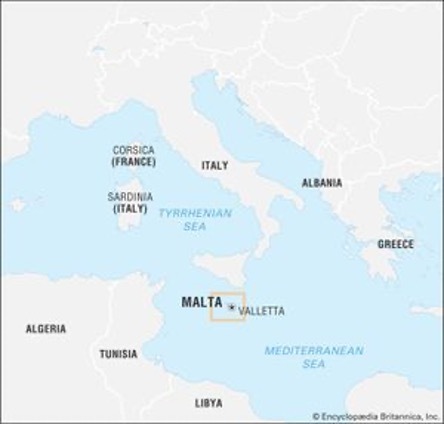
Malta, a Mediterranean island situated between Africa and the European Union, is driving economic growth while facing conflicting environmental conservation goals, providing a unique context for exploring sustainable development challenges illustrated in Figure 1, which shows Malta’s strategic Mediterranean position and emphasises its land area and vulnerability as a small island state. The island’s small size, encompassing only 316 km2 of terrestrial area and 3,830 km2 of territory of national competence, necessitates a strategic approach to spatial planning and resource management (EU MSP Platform, 2024; GOM, 2025). These geographical constraints, coupled with a population of approximately half a million, have significant implications for environmental sustainability and urban planning.
Several critical challenges, including urban sprawl, demographic pressures, and limited land resources, have marked Malta’s development trajectory. The NPF seeks to balance competing demands for economic growth, environmental conservation, and social equity (2015, GOM, 2016a, 2016b).
However, several persistent issues hinder sustainable development. Demographic pressures from population growth and economic expansion intensify demand for housing, transportation, and public services, placing additional strain on limited land resources (GOM, 2012; 2024). This includes urban sprawl, the spread of urban areas into previously undeveloped land that led to fragmented landscapes and increased infrastructure costs (MEPA, 2003). The infrastructure gaps resulting from high population density that strains existing infrastructure, with insufficient investment in renewable energy and waste management systems, exacerbate sustainability challenges. Environmental degradation issues, such as air and water quality, waste disposal, and clean energy infrastructure, also remain critical concerns for maintaining a high quality of life. Climate change impacts, including rising temperatures and sea levels, biodiversity loss, and water scarcity, further threaten Malta’s ecosystems and urban environments, complicating efforts to achieve long-term sustainability (GOM, 2012).
Furthermore, weak governance and a lack of public participation due to a lack of consensus during planning processes, along with limited civic engagement, undermine the effectiveness of policy implementation and create tensions between local and national interests (K. Azzopardi, 2019; Bonnici, 2019a, 2019b; Debono, 2019; The Malta Independent, 2019; Times of Malta, 2019).
.jpg)
The Maltese planning system is governed by the Development Planning Act (2016) and the Environment Protection Act (2016), which establish a dual framework for managing urban growth and environmental protection (GOM, 2016a, 2016b). These legislative tools underpin the NPF, which integrates strategic spatial planning with environmental considerations to address Malta’s unique development challenges (GOM, 2015).
The NPF is the Strategic Plan for Environment and Development (SPED) (GOM, 2015), within the legislative framework of the Development Planning Act (DPA) (GOM, 2016a) and Environment Protection Act (EPA) (GOM, 2016b), succeeding the 1992 Acts and 1990 Structure Plan. Enshrined under Article 3 of the DPA, it integrates SDGs through policies on compact growth, rural protection, and marine objectives.
The NPF establishes the statutory basis for development management and environmental safeguarding and provides the institutional platform through which national spatial policy is prepared, monitored, and reviewed. Within this framework, the NPF, as articulated through the SPED that functions as Malta’s strategic spatial policy instrument, provides national objectives and a sequential approach to land use that prioritises reuse and redevelopment before greenfield take-up, while linking national policy direction to subsidiary planning instruments, including local plans, that guide day-to-day development decisions (2015, GOM, 2016a, 2016b).
In policy terms, the NPF is not only a statement of spatial vision but also a mechanism for organising decision-making among actors and across scales. It sets strategic and thematic objectives across socio-economic development, environmental management, climate adaptation, and transport, and it frames where growth should be concentrated, prioritising the urban area and compact forms, while seeking to protect rural and ecologically sensitive zones (2015, GOM, 2016a, 2016b). Crucially, this strategic integration is designed to operate through dispersed implementation, in which national direction is translated by multiple agencies, local councils, professionals, and private actors involved in development (2015, GOM, 2016a, 2016b).
On paper, Malta’s NPF, as articulated through the SPED, the DPA and EPA, positions itself as a strategic instrument intended to deliver three interlocking outcomes: first, meaningful public participation in planning through consultation and engagement mechanisms, secondly, balanced development that enables economic growth while safeguarding environmental resources, and thirdly, integrated governance through coherent coordination of environmental, economic, and social policy objectives. These intentions reflect a strategic-planning logic that seeks to align multiple sectoral priorities within one national spatial framework, while relying on procedural mechanisms, such as consultation and institutional coordination, to translate policy objectives into implementation (2015, GOM, 2016a, 2016b).
1.2. Research Objective
The objective of the paper is to employ Foucauldian governmentality as an analytical lens to examine and explain the gap between Malta’s written planning policies and the lived implementation outcomes of the NPF. In relation to the study objective, the study reveals tensions in governance, public participation, and sustainability outcomes. Governmentality provides a lens for analysing how governing occurs through indirect steering, the conduct of conduct, policy rationalities, and a dispersed set of actors and technologies rather than through direct command alone (Dean, 2010; Foucault, 1991; N. Rose & Miller, 1992).
In Malta’s planning context, where sustainability claims are in the NPF agenda, growth imperatives, and limited land resources, this study seeks to move beyond simply evaluating whether the NPF works, and instead to interpret how power operates through planning procedures, institutional arrangements, and participation mechanisms to produce particular outcomes (Dean, 2010; GOM, 2015, 2016a, 2016b; Jessop, 2007).
To operationalise this objective, the paper is structured around three themes. First, the paper discusses the principles of governmentality through the concepts of governance at a distance, participatory engagement, and economic rationality. These principles are applied to the analysis of the NPF to demonstrate that contemporary planning and governance often rely on networked authorities, calculative techniques, and market-compatible rationalities to steer behaviour across institutions and populations (Jessop, 2007; N. Rose, 1999; N. Rose & Miller, 1992). Secondly, the study provides a critique of public participation in Malta’s NPF, interrogating the practice of public participation for democratic engagement referred to in the Maltese NPF against tokenistic participation that denies genuine redistribution of influence (Arnstein, 1969; Habermas, 1984; Innes & Booher, 2004). Thirdly, the research explores the tensions resulting from policy intent, such as that between balanced growth and environmental protection in the Maltese NPF. Such tensions are analytically important in governmentality studies because they can indicate how governance rationalities and technologies systematically shape the distance between what policies claim and what they deliver (Dean, 2010; Foucault, 1991; GOM, 2015, 2016a, 2016b).
1.3. Comparing the case of Malta to other small states and islands
By mirroring the challenges and opportunities faced by other small island states, such as Mauritius, the Seychelles, and Singapore, and comparing them with Malta’s governance strategies, innovative solutions emerge. One key insight is the tension between economic growth and environmental conservation. In Malta, high-density developments are promoted to protect rural areas, yet these often lead to public dissatisfaction and concerns over resource strain. Similarly, the Seychelles faces the challenge of balancing its reliance on tourism with ecological preservation. Its sustainable tourism model demonstrates how ecological imperatives can be integrated into economic planning to yield mutual benefits, a lesson applicable to Malta (Jessop, 2007). Policies such as eco-tourism incentives and marine conservation initiatives in the Seychelles illustrate how environmental sustainability can underpin economic resilience (Bass & Dalal-Clayton, 1995).
Singapore’s compact urban development strategies offer another compelling comparative example. With its limited land resources, Singapore has implemented high-density urban planning while prioritising green spaces and public amenities to enhance the quality of life. This approach aligns with the principles of ecological modernisation, demonstrating that economic development and environmental sustainability are not mutually exclusive but can complement each other when guided by strategic governance frameworks (Hajer, 1995). Malta can draw from Singapore’s success by integrating green infrastructure into its high-density developments and ensuring that public amenities align with community needs (Motha & Yuen, 1999; Pittmann & Day, 2019; Yuen, 2011).
Moreover, both Malta and other small island states face challenges related to fragmented governance. The analysis of Malta’s NPF underscores the need for centralised platforms to enhance inter-agency collaboration and policy coherence. In Luxembourg, governance fragmentation has similarly hindered the effective implementation of sustainability policies, highlighting the necessity of coordinated governance mechanisms to align diverse stakeholder interests (Affolderbach & Carr, 2016; Chilla & Schulz, 2014). These comparative insights emphasise the critical role of governance structures in facilitating sustainable outcomes.
Additionally, the lessons learned from Malta’s public participation mechanisms—albeit limited in effectiveness—illustrate the importance of meaningful stakeholder engagement. Arnstein’s (1969) ladder of participation underscores the distinction between tokenistic and substantive involvement. While Malta has made strides in incorporating public consultations, the lack of feedback loops often renders these mechanisms superficial. In contrast, successful participatory governance models, such as those in New Zealand’s environmental planning processes, show how empowering local communities can enhance policy acceptance and foster collaborative solutions (Crawford, 2016; Innes & Booher, 2004; OECD, 1996; Stanhope, 2000).
From a global perspective, Malta’s experience highlights the broader applicability of governmentality in navigating sustainability challenges. Foucault’s (1991) concept of governance at a distance is evident in the way local actors and non-state stakeholders mediate Malta’s centralised policy-making. This interplay mirrors governance trends in other constrained contexts, where state and non-state actors collaboratively shape policy outcomes (N. Rose & Miller, 1992). Such hybrid governance models offer pathways for small island states to address their unique challenges while contributing to global discussions on sustainable urban planning.
Comparative insights from other small island states underscore the potential of more inclusive participatory frameworks. In the Seychelles, participatory planning processes have successfully integrated local input to support sustainable tourism and environmental conservation goals (Bass & Dalal-Clayton, 1995). Similarly, Dutch planning has implemented collaborative planning practices that prioritise local voices in land-use decisions, fostering community ownership and reducing resistance to policy implementation (Balz & Zonneveld, 2018; Lang & Torok, 2017). These examples demonstrate how substantive stakeholder engagement can bridge the gap between governance intentions and public expectations, ultimately enhancing policy acceptance and effectiveness.
In Malta, transitioning from tokenistic to substantive engagement requires systemic reforms. The incorporation of feedback loops that visibly integrate public input into final policy decisions is a critical step. This aligns with Innes and Booher’s (2004) concept of collaborative rationality, where participatory processes foster genuine dialogue and consensus-building. Additionally, leveraging digital platforms for public engagement can democratise access to planning discussions, enabling broader participation. By adopting these measures, Malta’s planning framework can better reflect the principles of transparency, accountability, and inclusivity, strengthen governance outcomes and build public trust.
Mauritius also offers valuable lessons for Malta’s NPF challenges, mirroring resource constraints while advancing integrated sustainability. Vision 2020 drove economic diversification through agriculture, tourism, and finance—restructuring textiles, telecoms, and IT—without compromising environmental goals. The Maurice Ile Durable plan prioritised renewables, energy-efficient buildings, reduced ecological footprints, green jobs, and equity through Gini improvements, evolving into the 2020-2024 programme, which aligns with SDGs 4, 9, 12, 13, and 17 (PAGE, 2020; Republic of Mauritius, 2014). Malta could adapt these to bridge its de jure sustainability intentions with de facto high-stakes outcomes, enhancing governance coherence in small-island contexts.
1.4. Study methodology
Exploring governmentality within urban planning frameworks requires a multi-dimensional approach to uncover the interplay of governance strategies, power dynamics, and societal impacts. Adopting a mixed-methods approach, with ethical considerations, including informed consent and data anonymisation for data integrity, grounded in Foucauldian theory, explores how spatial planning frameworks, such as the Maltese NPF, influence sustainable development outcomes. By combining narrative, discursive, and quantitative methods, the analysis revealed the complexities of governance in urban and environmental planning, offering a novel interdisciplinary lens for evaluating policy effectiveness and stakeholder engagement through the lens of governmentality (Braun & Clarke, 2013; Creswell & Plano Clark, 2011).
The study interviews involved five key participants across different stakeholder categories, namely government planners, NGO representatives, professionals, and community members. Purposive sampling was employed to ensure representation of diverse governance perspectives, thereby fostering an engaging discussion on NPF themes and issues identified in the research. Documents analysed involved various written research and media articles from various authors narrating their experience and findings on these themes related to Malta’s NPF spanning from Malta’s First Development Plan in 1959 during Malta’s pursue for Independence to the 2016 planning reforms (M. Azzopardi, 2011; Baldacchino, 1998; Blouet, 1965; Briguglio, 1988, 1994; Doublet, 2002; GOM, 2015, GOM, 2016a, GOM, 2016b; Ouden, 1975; Simpson, 1969). The interview data and documents were used to interpret and justify the results from surveys conducted with five public participants to address the research objective on the implementation-intent gap.
The integration of qualitative and quantitative methods ensured a comprehensive analysis of how governmentality operates within Malta’s NPF. Qualitative methods provided depth and context to governance narratives, while quantitative techniques validate these findings and uncover broader trends. This mixed-methods approach illuminated how governance strategies translate into practical outcomes, offering actionable insights into optimising sustainable development practices and addressing policy implementation gaps (Bryman, 2012; Creswell & Plano Clark, 2011). This comprehensive framework also underscored the importance of participatory governance and data-driven decision-making in navigating the challenges of sustainable planning.
Quantitatively, survey indicators of participation quality, coordination, and sustainability will underperform relative to the NPF’s declared standards; qualitatively, interviews and policy–media discourse will evidence procedural symbolic consultation, development-first decision logics, and fragmented implementation (Braun & Clarke, 2013; Creswell & Plano Clark, 2011; G. Rose, 2016; Walsham, 2006). Together, these patterns would validate that the gap is not incidental but structurally produced by the NPF’s governmentality, indirect steering, market-led rationalities, and legitimating participatory forms, thereby rendering the gap both statistical and discursive in nature (Dean, 2010; Foucault, 1991; Jessop, 2007; N. Rose, 1999).
Narrative and discursive analyses played a pivotal role in understanding how governmentality manifests in spatial governance. Textual data from planning documents, policy statements, and media articles uncovered the power relations and governance strategies embedded in discourse (Vella, 2025; Walsham, 2006). The discursive analysis identified recurring themes shaping urban and rural planning, revealing how sustainability is framed as a policy objective and highlighting tensions between national priorities and local needs (G. Rose, 2016; Vella, 2025).
The interview protocol was then built deductively from two sources. First, it was anchored in the governmentality framework by Dean (1999) and Oels (2005), governance at a distance, participatory technologies, and economic rationalities, operationalised through analytic categories used in the study’s mixed-method design. Second, it drew on recurrent themes in Malta’s strategic planning trajectory, as foregrounded in the NPF: urban containment vs sprawl, development–conservation tensions, institutional coordination, quality of public participation, and policy implementation capacity. These themes were used to ensure comparability between what the NPF states and what stakeholders report encountering in practice. These provide qualitative insights into the operationalisation of governance strategies. These captured diverse perspectives and explored the interplay between local and national planning processes. They revealed how power is exercised, contested, and aligned with sustainability goals across governance levels (Bryman, 2012; Vella, 2025).
Inductive coding of interview transcripts and triangulation with survey and discourse materials generated additional themes not fully specified in the initial protocol. Triangulation with survey data shows these areas of low satisfaction in Maltese urban planning, infrastructure, and high-stakes development case studies. These emergent themes include consultation as procedural compliance rather than influence, tokenistic participation, fragmented governance and responsibility-shifting between agencies, a perceived development-first decision logic even when sustainability language is prominent in policy text, with economic overrides of environmental goals, and erosion of trust linked to the visibility of high-stakes outcomes and perceived inconsistencies in regulatory enforcement. These highlight the tensions between policy intentions and practical outcomes, such as procedural participation aligning with Arnstein’s (1969) tokenism critique, distinguishing study-derived insights from prior literature. Together, these emergent themes sharpen the governmentality interpretation by showing how formal participation mechanisms can function simultaneously as inclusion and control, and how integration on paper can coexist with fragmentation in implementation (Vella, 2025).
Quantitative methods complemented the qualitative insights with empirical evidence on the effectiveness of governance strategies. Surveys assessed public attitudes toward sustainability initiatives and perceptions of NPF policies, particularly regarding their alignment with community needs. The regression analysis identified factors affecting NPF outcomes and influencing stakeholder opinions, such as demographic characteristics or levels of policy awareness. At the same time, the ANOVA tests explored variations in perspectives across demographic groups, such as age, education level, gender, and income level (Creswell & Plano Clark, 2011). Visual data analysis, focused on case studies like high-stakes urban developments and infrastructure projects, illustrated the tangible impacts of governance strategies on spatial outcomes and environmental sustainability (G. Rose, 2016). This method highlighted the role of zoning laws, development regulations, and participatory mechanisms in shaping urban landscapes and reflects how governmentality influences spatial practices (Braun & Clarke, 2013).
The research hypothesises that there is a statistically and discursively observable implementation–policy intent gap in Malta’s NPF, driven by governmentality mechanisms such as governance at a distance, economic rationality, and tokenistic participation (Arnstein, 1969; Dean, 2010; Foucault, 1991; GOM, 2015, 2016a, 2016b; N. Rose & Miller, 1992; Vella, 2025).
2. Findings
The findings of the study are presented in terms of the three themes of governmentality principles, the effectiveness of public participation, and tensions in policy intent. Collectively, these themes offer a Foucauldian governmentality analysis of the policy-implementation gap in Malta.
The divergence between policy design and implementation is not treated simply as administrative failure or policy incompetence; rather, following Foucault’s (1991) concept of governmentality, it is interpreted as analytically revealing of how power operates through governance arrangements and technologies, how policy intentions translate, or fail to translate, into implementation, and what these dynamics reveal about the fundamental tensions in urban planning within constrained island contexts. National frameworks such as the NPF typically govern not through direct command, but through indirect steering, formal procedures, and dispersed responsibilities across networks of state and non-state actors, which is described as governing at a distance and shaping the conduct of conduct (Foucault, 1991; N. Rose, 1999; N. Rose & Miller, 1992). From this perspective, the implementation–intent gap becomes significant because it exposes the tensions inherent in relying on decentralised actors to realise central objectives, the difficulty of integrating competing priorities, like development capital, environmental conservation, community well-being, into a single framework, and the persistent challenge of achieving meaningful participation within hierarchical institutional settings (Dean, 2010; Jessop, 2007; N. Rose, 1999). Examining this gap through a governmentality lens, therefore, illuminates not only what diverges from policy text, but how governance rationalities, participation technologies, and stakeholder agency interact to produce outcomes that systematically depart from stated intentions (Dean, 2010; Foucault, 1991).
This governance arrangement is therefore directly relevant to a governmentality reading because it relies on indirect steering, procedures, and self-regulating behaviour rather than direct command in a manner observed by Foucault (1991), Dean (2010), and Rose (1999), creating the conditions highlighted by Dean (2010) and Jessop (2007) in which gaps between stated intentions and experienced outcomes can become structurally produced.
The NPF can be read as a technology of governance that according to Scott (1998) and Dean (2010) defines what becomes visible and prioritised like compact growth and strategic projects, normalises rationalities as defined by Jessop (2007) and Harvey (2005), like balancing development through market-compatible densification, and institutionalises what Arnstein (1969), Rose and Miller (1992), and Innes and Booher (2004) call participation through formal consultation stages that may function as democratic empowerment or as legitimising procedures. This research uses governmentality to interpret how these legal and procedural arrangements organise power relations in planning practice and help explain the observed implementation–intent gap (Dean, 2010; Foucault, 1991; N. Rose, 1999).
Regarding the effectiveness of public participation, the 2019 planning and construction controversies were accompanied by repeated claims in Maltese media that consultation is often experienced as procedural compliance rather than a genuine opportunity to influence outcomes (K. Azzopardi, 2019; Bonnici, 2019a, 2019b; Debono, 2019; The Malta Independent, 2019; Times of Malta, 2019). This diagnosis also resonates with the semi-structured interviews that similarly framed consultation as symbolic and late-stage, rather than as a meaningful feedback loop that shapes decisions (Interviewee 03, personal communication, August 8, 2023; Interviewee 05, personal communication, August 4, 2023), aligning with the established critique of tokenism in participation theory (Arnstein, 1969). In terms of balanced development, Maltese protest narratives and commentary around high-stakes intensification framed implementation as development-first, with environmental and community concerns seen as subordinate to construction-driven growth (K. Azzopardi, 2019; Bonnici, 2019a; Debono, 2019). Finally, stakeholders describe an integration gap in governance itself, the translation of strategic policy into coordinated delivery is frequently experienced as fragmented, a tension that can be read against Malta’s institutional/legislative configuration for planning and environmental governance (GOM, 2015, 2016a, 2016b), and is also reflected in interview accounts of inter-agency coordination problems and responsibility diffusion (Interviewee 03, personal communication, August 8, 2023; Interviewee 05, personal communication, August 4, 2023).
Tensions in policy intent within Malta’s NPF arise from discrepancies between the stated objectives of balanced growth, environmental protection, and public participation and the actual implementation outcomes, which are marked by fragmented governance and development-first priorities. Policy documents rationalise governance as integrative and participatory, yet stakeholder interviews and public discourse reveal tokenistic consultation, institutional coordination failures, and persistent urban sprawl that undermine sustainability goals. This gap, as analysed through Foucauldian governmentality, highlights how power operates through indirect steering and dispersed actors, producing de facto results divergent from de jure intentions. Recent critiques, including court challenges to height policies and calls for holistic NPF revisions, further expose these systemic tensions in Malta’s constrained spatial context, as highlighted by sustainable development challenges for Malta (Vella, 2025).
Policy documents of the NPF are thus not neutral descriptions of how things work, but as sites through which governance is rationalised and power is exercised. By examining both what policies say they will do and evidence of what occurs, from stakeholder interviews, public discourse, and implementation challenges, the research adopts a structurally informed descriptive approach in reporting what policy frameworks state and how institutions function, and a theoretically critical approach in analysing the mechanisms through which power operates (Vella, 2025).
3. Discussion of Findings: Core components and principles of governmentality applied to Malta’s NPF
Foucault’s concept of governmentality provides an analytical framework for examining how governance shapes urban development through rationalities, techniques, and institutional arrangements, rather than through direct command alone (Foucault, 1991). Power operates through the organisation of possible actions, by structuring the conditions under which actors make decisions and by normalising particular ways of thinking about problems, solutions, and responsibilities. This perspective broadens the locus of governance beyond the state to include non-state actors, such as NGOs, private developers, professional bodies, and civil society, reflecting Rose and Miller’s (1992) description of rule as the coordinated activity of “diverse authorities” (p. 173). In urban planning, such distributed authority is especially consequential because it enables states to govern complex socio-spatial processes through networks, delegated responsibilities, and calculative policy instruments rather than continuous intervention (Jessop, 2007).
In the Maltese context, governmentality helps clarify how sustainability aims are produced and contested through interactions among state institutions and non-state actors operating within regulatory and bureaucratic frameworks. Governance can therefore be understood as an institutional structuring of power that guides development toward nationally defined priorities (Mitchell, 1991), while spatial outcomes emerge from relational processes shaped by intersecting social and economic forces (Massey, 2005). Applying this lens to Malta directs attention to how planning outcomes reflect the negotiation of competing rationalities, economic growth, environmental protection, and social legitimacy, within an island territory marked by land scarcity and intense development pressure.
Malta’s planning system demonstrates governmentality through the ways in which strategic planning, regulation, and consultation organise what counts as a legitimate planning problem and authorise and implement decisions. The NPF functions as a strategic instrument that integrates environmental and socio-economic objectives while steering development through layered policy guidance and subsidiary instruments (GOM, 2015, 2016a, 2016b). These arrangements reflect how governance can be embedded in a policy architecture that simultaneously constrains and enables local action. As Raco (2003) argues, such governance configurations mediate sustainability through localised negotiations and institutional practices, rather than through a linear translation of national intent into local outcomes.
The NPF’s coupling of environmental protection with economic development is consistent with Hajer’s (1995) account of “ecological modernisation” (p. 73), in which sustainability is incorporated into state-led development strategies. In this sense, sustainability is not only a normative goal but also a policy rationality used to justify particular development pathways, especially where compact growth and densification are presented as instruments for balancing conservation and growth. The result is a planning rationale that can appear integrative at the level of policy design, while still being shaped in implementation by competing institutional priorities and actor interests.
Governmentality also foregrounds the role of governmental technologies, the operational tools through which policy rationalities are made actionable. In Malta, such technologies include zoning and development control, environmental impact assessment, strategic spatial planning, and formal consultation procedures. These instruments render land and development more administratively visible and governable, aligning with Scott’s (1998) argument that state planning often depends on forms of legibility and standardisation that make territory knowable and thus manageable. Planning instruments can also be understood as performative; they do not merely regulate development but actively shape the kinds of development that become feasible and desirable (Waage & Benediktsson, 2010).
Participatory instruments sit within this same technological field. Malta’s consultation processes are frequently justified as mechanisms for inclusive decision-making and collaborative policy formation, echoing the idea of “collaborative rationality” (Innes & Booher, 2010, p. 12). However, participation also risks becoming procedural or symbolic when it lacks feedback loops or real influence on outcomes, a problem long identified by Arnstein’s (1969) critique of tokenistic participation. From a governmentality perspective, participatory dispositifs can therefore function in two ways simultaneously, as avenues for inclusion and as techniques that legitimise decisions and stabilise governance by demonstrating procedural compliance.
A governmentality–discourse approach highlights that governing occurs not only through regulation but also through the discursive framing of policy problems and acceptable solutions (Foucault, 1991). The NPF exemplifies “governing at a distance” by establishing strategic objectives, limits, and conditions that shape development trajectories indirectly through policy frameworks rather than through continuous central intervention (N. Rose, 1999, p. 49). Such steering relies on dispersed actors to interpret and enact national direction, which can produce gaps between what policy claims and what implementation delivers, especially where responsibilities are distributed across multiple agencies and stakeholder groups.
These tensions are consistent with Harvey’s (1996) argument that urban governance is characterised by recurring conflict among growth imperatives, social needs, and ecological constraints. In Malta, this friction is expressed in the uneven translation of policy intent into consistent practice, including persistent concerns about the quality of engagement, coordination between actors, and the prioritisation of development pressures within a constrained territorial setting. Rather than treating such gaps as merely administrative shortcomings, a governmentality reading interprets them as analytically revealing how governance arrangements, participation technologies, and institutional rationalities can systematically produce divergence between stated objectives and lived outcomes.
Situating the NPF within critiques of neoliberal governance further clarifies how economic rationalities can dominate despite the use of integrative sustainability language. Harvey (2005) argues that planning is frequently aligned with capital accumulation, and Malta’s emphasis on high-density development, often justified as a means of conserving rural land, can be interpreted as a market-compatible sustainability strategy. Yet such approaches may also marginalise stronger ecological and equity commitments, revealing contradictions between sustainability objectives and the political–economic logics that shape implementation. This tension underscores the importance of distinguishing weak sustainability compromises from stronger sustainability approaches that impose firmer environmental limits and distributive commitments (Carter, 2024; Pearce et al., 1989; Spash, 2019)
3.1. Conceptualising Governmentality to Support Sustainable Public Participation
Foucauldian governmentality is used in this study as an interpretive analytical lens for examining how an NPF steers conduct through policy rationalities, institutional arrangements, and practical techniques, rather than as a claim that Malta intentionally applies Foucauldian principles. In small-island contexts, where land scarcity, concentrated institutions, and development pressures intensify governance dilemmas, this lens is particularly useful because it clarifies how power operates indirectly—through frameworks, procedures, expertise, and norms that shape what actors can reasonably do and how they justify decisions. Although governmentality has been criticised for its Eurocentric origins and potential limits of transferability (Dean, 2010, p. 17), its emphasis on the conduct of conduct and the enrolment of non-state actors offers strong conceptual traction for analysing Malta’s NPF governance architecture and its sustainability ambitions.
To operationalise governmentality for this paper, the analysis focuses on three concepts that illuminate the governance conditions under which sustainability and participation are either strengthened or undermined within the NPF system.
The concept of governance at a distance as strategic steering in modern rule is exercised less through direct command than through strategic guidance that is implemented by dispersed actors (Foucault, 1991). In Malta, the NPF establishes broad parameters that are interpreted and enacted by agencies, local councils, professionals, NGOs, and developers. This “conduct of conduct” governs by setting the field of possible action and aligning local choices with national objectives, while also creating implementation vulnerabilities when actor interests diverge from policy intent (N. Rose & Miller, 1992).
The concept of participatory governance mechanisms as subject formation and legitimacy shows that consultation, engagement, and awareness measures are not only democratic procedures but also governing technologies that aim to cultivate “autonomous” subjects who internalise policy goals and act accordingly (Dean, 2010). However, participation can become primarily procedural—functioning to legitimate decisions rather than to redistribute influence—echoing classic critiques of tokenism in participatory planning (Arnstein, 1969). In sustainability terms, the quality of participation matters because legitimacy, trust, and knowledge co-production shape whether policy objectives translate into durable implementation support.
Rather than treating implementation shortfalls as anomalies, the study treats gaps between policy design and lived experience as empirically observable evidence of how governance operates. These tensions reveal the effects of indirect steering, dispersed responsibility, and participation technologies on real outcomes, making them analytically valuable for diagnosing why sustainability and participation objectives do not consistently materialise. In this framing, the implementation–intent gap becomes a diagnostic site for identifying where governance redesign, like feedback loops, coordination, and enforcement consistency, may be required to strengthen sustainability delivery.
The NPF seeks to align environmental protection with development priorities through a mixture of regulation and market-compatible strategies, such as densification. This reflects a strategic-relational configuration in which state oversight and economic instruments are combined to pursue policy objectives (Jessop, 2007). The analytical focus here is not whether growth or conservation is right, but how economic rationalities are embedded in implementation and whether they displace ecological and social commitments—an issue central to evaluating sustainability performance in practice.
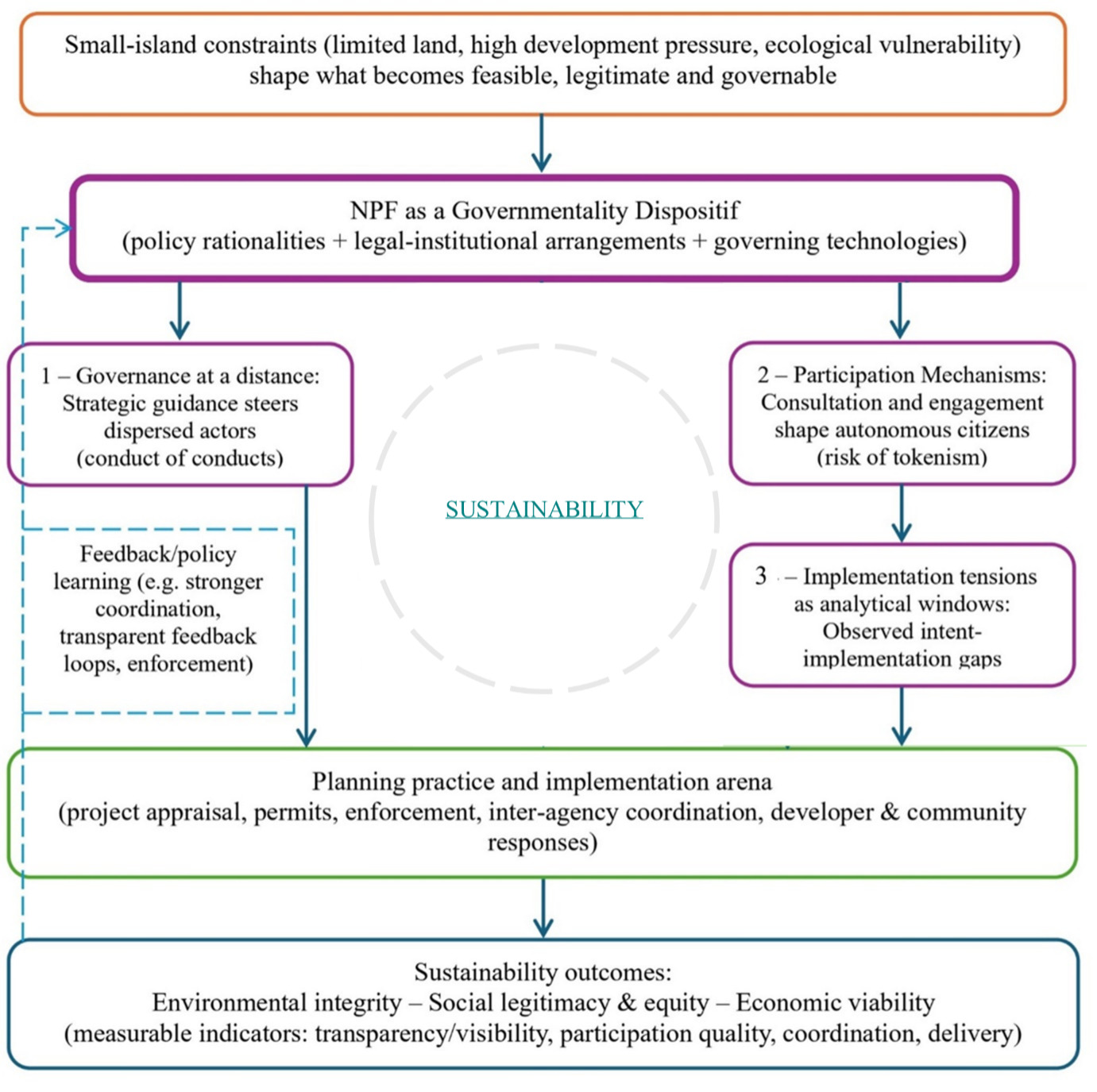
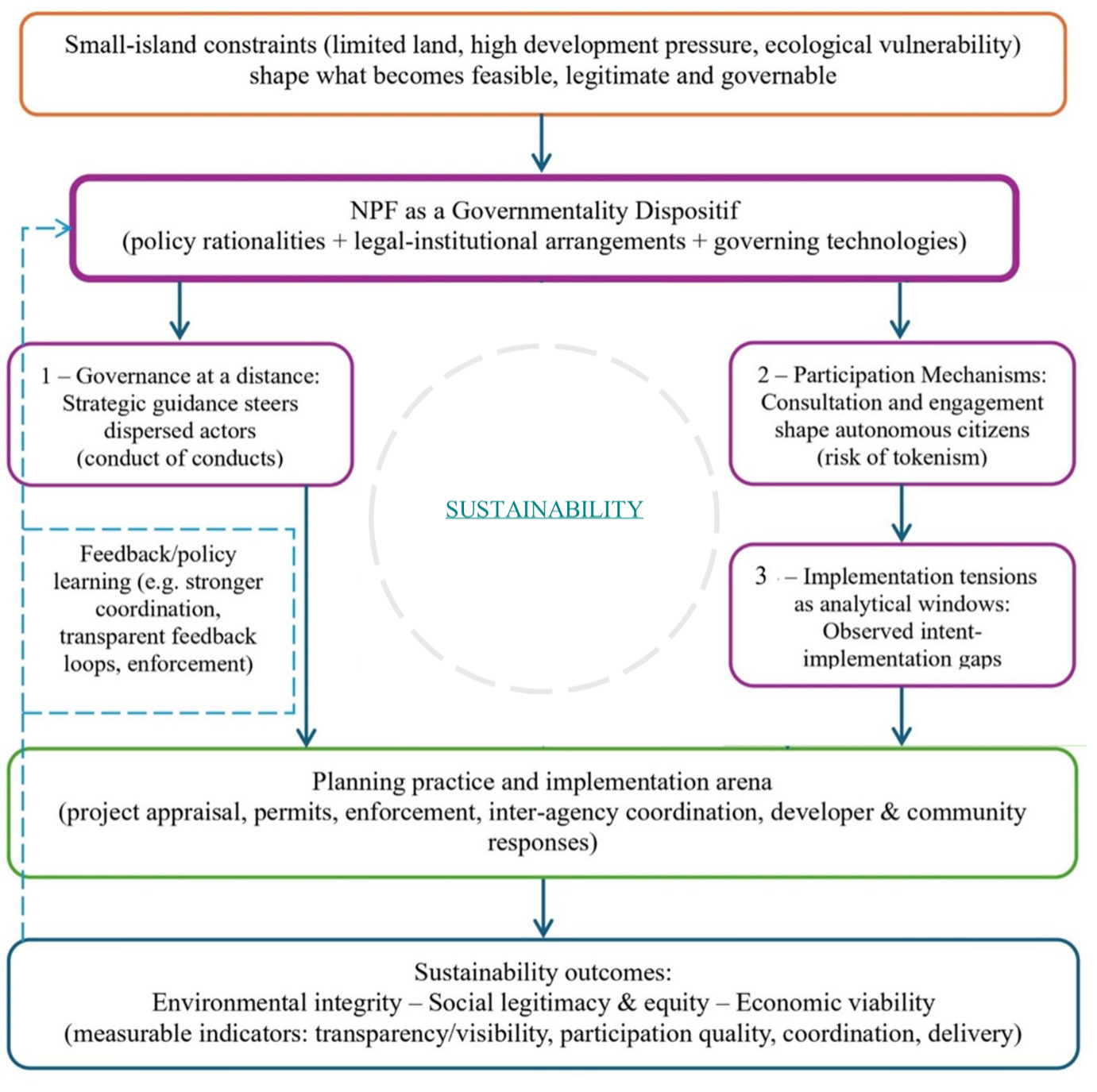
Figure 2 summarises how these three concepts connect. The NPF functions as a governmentality dispositif that mobilises steering, participation, and economic rationalities through specific technologies like regulation, consultation, assessment, and coordination. These mechanisms shape implementation practices and, in turn, sustainability outcomes. Importantly, observed gaps feed back into the system as opportunities for policy learning—highlighting where stronger transparency, coordination, and meaningful engagement can improve both sustainability and democratic legitimacy.
3.2. Governmentality and sustainable public participation in Malta’s urban planning
Within the findings, consultation mechanisms are repeatedly described as structurally constrained in their practical impact. Interview evidence reports that consultation frequently operates as a procedural requirement rather than deep engagement, with limited mechanisms to translate community input into actionable design or policy change, and with perceptions that decisions are already shaped before consultation windows close. These findings align with classic participation critiques, such as Arnstein’s tokenism, but crucially, the research’s empirical contribution is that the gap is measurable in the survey through low-visibility performance in implementation-oriented indicator sets and legible in interviews as procedural and predetermined engagement.
The challenge of fragmented decision-making and limited public participation often undermines the efficacy of such frameworks. By employing a Foucauldian perspective, we can critically examine how governance techniques, including policies and enforcement mechanisms, shape power relations and ultimately impact the sustainability of urban planning outcomes (Foucault, 1991).
A key mechanism producing the implementation–intent gap is the mismatch between policy rationalities, steering through frameworks and regulation, and how governance is experienced in practice. In the findings, this tension appears in the treatment of regulatory tools for development control through policies that set thresholds and requirements for height, density, and open spaces, as revealed by the case-study discussion, which shows implementation gaps in enforcement and consistency, including discretionary decisions that can override the intended discipline of policy tools.
In the findings narrative on high-rise regulation, the thesis notes that while development is meant to align with requirements such as open space provision and density controls, the implementation of the FAR policy revealed gaps in enforcement and consistency, with some schemes receiving height extensions through discretionary planning processes, a concrete expression of intent–implementation slippage.
The findings show that public participation often functions less as substantive co-decision and more as procedural compliance. Interview-based findings explicitly describe consultation during master planning and project-specific applications as often serving more as a procedural requirement than as a tool for deep community engagement, and note a recurring perception that decisions may already be predetermined, which limits the practical effect of participation.
Stakeholder engagement mechanisms, though formally embedded in national frameworks, frequently fail to facilitate substantive participation. Local communities and NGOs have repeatedly raised concerns that public consultations are largely procedural, serving to legitimise predetermined decisions rather than enabling meaningful influence (K. Azzopardi, 2019; Bonnici, 2019a; Debono, 2019). This aligns with Arnstein’s (1969 critique of tokenistic participation, in which engagement is reduced to symbolic compliance rather than fostering genuine dialogue or policy transformation. Public participation within the Maltese NPF illustrates the duality of inclusion and control inherent in the governmentality-discourse nexus. This centralisation of decision-making creates a disconnect between policy intentions and citizen expectations, leading to dissatisfaction and resistance (Habermas, 1984). Furthermore, the tensions between democratic ideals and bureaucratic practices are exacerbated by bureaucratic inertia and political interference, which hinder effective policy implementation and sustainable outcomes (Hajer, 1995).
Survey results reinforce the participation gap, showing that Fields of Visibility (X4), a category for transparency, decision legibility, and engagement, is not consistently strong across the indicator sets. The Fields of Visibility (X4) scores high in the National Vision set (7.8/10) but drops markedly in the Integrative set (4.0/10) and remains comparatively low in the Multi-dimensionality set (4.8/10). This pattern indicates that while respondents endorse the idea of transparent, participatory governance at the level of vision, they perceive lower transparency and engagement in the integrative, multi-dimensional realities of implementation.
The findings reveal recurring tensions between sustainability objectives and development outcomes, especially in high-rise contexts where social and environmental concerns are subordinated to profit-led pressures. Interview evidence stresses that development should not prioritise profit over people and residents. It links the poor contextual fit of high-rise forms to public resistance and reduced acceptance, illustrating how outcomes can deviate from the intended balance and place-sensitivity of development.
In Malta, economic priorities, most notably the promotion of high-stakes developments, are frequently foregrounded in policy agendas. The Maltese NPF explicitly encourages compact urban growth to conserve rural land, reflecting a governance model that privileges economic expansion and market-driven projects. These choices reflect underlying power dynamics that determine which issues are emphasised and which are marginalised, often relegating ecological sustainability and community well-being to secondary status. Public debates and national protests, such as those documented by Azzopardi (2019) and Bonnici (2019a, 2019b), further illustrate widespread concern over the prioritisation of construction and high-rise projects at the expense of environmental and social interests. This corresponds to Hajer’s (1995) and Raco’s (2003) critiques, in which discourses that frame environmental policy as economic opportunities marginalise ecological and community concerns and create subjects aligned with a growth-led agenda.
The quantitative results further support that implementation outcomes are closely tied to visibility and identity factors. Pearson correlation outputs reported in the results show a positive association for Fields of Visibility (X4) between indicator impact scores and category validation scores (r = 0.830; Sig. = 0.082; N = 5), suggesting that, even with small-N limitations, greater perceived transparency/visibility tends to align with improved perceived impacts. In contrast, Forms of Knowledge (X2) shows a negative association (r = −0.792; Sig. = 0.110; N = 5), indicating that concerns about knowledge/expertise integration are associated with poorer perceived impacts.
The results indicate that the perceived effects of NPF-linked development are not uniform across the population, but vary strongly when respondents evaluate tangible, everyday-life outcomes—specifically, infrastructure and density case studies. One-way ANOVA results show highly significant differences by age, income, and education, while gender is not significant for either infrastructure or density. For infrastructure scores: Age (F = 9.038; p < 0.001), Income (F = 12.448; p < 0.001), Education (F = 12.446; p < 0.001), versus Gender (F = 0.266; p = 0.609). For density scores: Age (F = 6.262; p = 0.001), Income (F = 9.571; p < 0.001), Education (F = 9.986; p < 0.001), versus Gender (F = 0.358; p = 0.553).
At the same time, the thesis reports no significant variation across socio-demographic groups for the indicator-category scores (Forms of Identity X1, Forms of Knowledge X2, Technical Aspects X3, Fields of Visibility X4), which it interprets as evidence of broad consensus on those higher-level planning dimensions. The contrast is important; shared views on overarching planning narratives can coexist with sharply different views on how projects land in practice.
These ANOVA patterns strengthen the implementation–intent gap. The research explicitly notes that perceptions of infrastructure and density exhibit greater variability because these interventions directly affect daily life, and because socio-economic position shapes how those impacts are experienced. In other words, even if the NPF’s intent is framed as broadly beneficial and sustainability-oriented, the implementation produces uneven lived experiences that translate into statistically different attitudes across age/income/education.
The gap is not primarily about gendered difference in this dataset, but about life stage and socio-economic exposure. Because gender is not significant while age/income/education are, the results suggest that dissatisfaction or endorsement is less about gendered grouping and more about. life-stage sensitivities, such as different tolerances for change, different reliance on services, and socio-economic capacity, such as the ability to buffer negative externalities and differential dependency on public goods. Importantly, this is not presented as speculation in the results section; it follows from the research-reported inference that these factors determine how the population experiences NPF outcomes.
The findings further interpret the ANOVA evidence as a governance signal; if project impacts are perceived very differently across age/income/education groups, then a one-size-fits-all implementation pathway risks amplifying resistance and legitimacy deficits, especially in density and infrastructure projects. The thesis explicitly connects these statistically significant socio-demographic variations to the need for governance and policy measures that align more effectively with SDG-oriented objectives, implying that implementation must be responsive to the distribution of lived impacts rather than assuming universal benefit. Thus, the ANOVA results show that the implementation–intent gap is experienced unevenly, with high-level sustainability framings attracting broad agreement. Yet, the implementation of density and infrastructure interventions generates statistically different perceptions across age, income, and education groups, precisely the domains where planning is most tangible and contested.
4. Conclusion
The findings support the paper’s central claim that the implementation–intent gap in Malta’s NPF is not incidental but structurally produced by the governance arrangements through which the framework operates. Three patterns are particularly salient: first, discretionary and uneven enforcement that dilutes policy discipline, secondly consultation practices that frequently operate as procedural compliance rather than substantive influence; and thirdly perceptions of implementation quality that are strongly shaped by visibility and transparency, with sharper divergence where development impacts are most tangible, notably high-stakes and infrastructures.
The governmentality as a structural explanation is evident in the implementation failures that align precisely with Foucauldian governmentality. The NPF governs at a distance via strategic guidance and dispersed actors, generating inevitable tensions when local incentives, land scarcity, and growth imperatives clash with national intent. In Malta’s 316km² pressure cooker, such misalignments amplify legitimacy crises and environmental erosion.
The persistent gaps in NPF implementation are evident when the NPF’s core objectives—meaningful public participation, balanced development, and integrated governance—remain systematically unrealised. Stakeholder interviews and on-the-ground outcomes reveal consultation as a late-stage ritual, inter-agency coordination as fragmented diffusion, and development patterns that contradict sustainability rhetoric through persistent sprawl and high-stakes dominance.
The development-first rationality is exposed when considering that, despite formal environmental-social integration, the study reveals economic rationalities overriding ecological limits, and participation is reduced to legitimating technology rather than power-sharing. Governmentality’s fields of visibility expose the core flaw: opaque decision-making rationales, inconsistent enforcement, and buried consultation feedback render sustainability performative rather than substantive.
4.1. Limitations and implications of the study
These conclusions should be interpreted with the study’s methodological constraints in view. Purposive interviews provide depth but are not statistically representative, and survey patterns offer indicative signals that would benefit from larger samples and replication. Transferability beyond Malta should be approached with caution, given the specific conditions of small-island governance and evolving policy contexts. Future research can extend this contribution through comparative small-island cases and longitudinal tracking of projects from consultation through approval and delivery. Evaluation designs that test specific interventions, structured feedback protocols, inter-agency coordination templates, or transparency standards, could provide practical evidence on which governance adjustments most effectively narrow the implementation–intent gap while improving sustainability outcomes and participatory legitimacy.
Malta’s NPF embodies weak sustainability by permitting natural capital substitution, replacing greenfield land with high-stakes urban capital through densification policies, prioritising economic growth amid land scarcity, yet yielding fragmented environmental outcomes such as sprawl and trust erosion. This neo-classical approach assumes that technological fixes, such as compact growth, offset ecological losses, but is critiqued for ignoring irreplaceable assets on small islands.
Strong sustainability demands non-substitutability of critical assets such as Globigerina limestone aquifers, coastal ecosystems, and farmland, treating them as absolute limits and rejecting growth-led trade-offs. Malta must pivot toward enforceable ecological ceilings in NPF revisions, such as binding rural buffers, biodiversity offsets, and Gini-aligned equity metrics.
A clear policy roadmap for development in Malta to achieve sustainability must embed a strong sustainability threshold by capping development footprints at established baselines and mandating zero-net-loss biodiversity through GIS-enforced monitoring. Malta must also leverage island comparatives such as Seychelles’ eco-tourism governance and Singapore’s green infrastructure mandates to develop resilient, non-substitutable models.
Planning reforms must shift from tokenistic participation to co-design via digital feedback and veto rights for vulnerable groups. Strengthening sustainability delivery in the NPF system requires procedural reforms that make participation consequential and implementation traceable, through demonstrable feedback loops. Utilising clearer documentation of how consultation inputs shape outcomes, stronger inter-agency coordination mechanisms that align environmental, social, and economic objectives at the point of implementation, rather than only in policy text, also strengthen sustainability. Digital engagement tools can broaden access, but they should be paired with institutional commitments to ensure that stakeholder input is auditable and that decision-making pathways are transparent.