
1.0. Introduction
Indonesia was founded on a set of core principles: Pancasila (the five principles), Bhinneka Tunggal Ika (Unity in Diversity), and Wawasan Nusantara (the Archipelagic Outlook). Pancasila functions as the foundational ideology and driving force that informs development across political, economic, and social spheres, as well as in cultural, mental, and spiritual domains (Soekarnoputri, 2021). The national motto, Bhinneka Tunggal Ika, was established to promote multiculturalism and foster unity among Indonesia’s diverse ethnic, cultural, and religious groups, forming a single national identity. It remains a central tenet of governmental policy (Hartanti & Ardhana, 2022). Wawasan Nusantara refers to a nationalistic worldview that continues to hold significant ideological influence. It provides a strategic framework for managing the nation’s territorial and social environment, reimagining a unified national identity, and advancing regional integration to achieve nationally defined objectives (Simarmata et al., 2023).
However, a significant disparity exists between these aspirational principles and the contemporary reality. A pronounced development gap is evident between Java, the island hosting the national capital, and the other islands within the archipelago. This inequality is particularly observable within the education sector. Statistical data from 2023 reveal a clear urban-rural divide in educational attainment. In urban areas, 98.5% of the population are primary school graduates, 92.8% are lower secondary (junior high) school graduates, and 73.2% are upper secondary (senior high) school graduates. By contrast, in rural areas, the figures are lower, with 96.8%, 87%, and 56.3% for each respective level. When combined, these figures indicate that only 66.8% of the total national population completes upper secondary education. Further illustrating this geographical inequity, provincial-level data from the same year show stark contrasts. For instance, the percentage of residents attaining an upper secondary school diploma or its equivalent was 88.1% in the capital province of DKI Jakarta, 58.3% in Central Java, and merely 39.5% in Papua (Kirana, 2024).
A substantial body of research that corroborates the existence of significant educational disparities between urban and rural regions in Indonesia is cited as follows. Studies indicate that rural educational institutions are typically staffed by younger and less qualified teachers and administrators, who consequently receive lower remuneration and benefits compared to their urban counterparts (Febriana et al., 2018; Pristiwati et al., 2025; Sugiono, 2017). Furthermore, these challenges are compounded by inadequate infrastructure—encompassing unreliable electricity, substandard school facilities, and insufficient transport—coupled with limited access to educational resources and parental attitudes that may not prioritise schooling. Scholarly consensus suggests that addressing these multifaceted challenges and enhancing academic quality in remote locales necessitates a dual approach of robust policy implementation and concrete practical actions. Effective resolution is posited to require collaborative efforts between local communities and relevant stakeholders, including philanthropic organisations (Hanafiah et al., 2025; Listrianti et al., 2024; Sapiah et al., 2025; Sutomo & Siregar, 2022; Yusron, 2025).
In the realm of policy implementation, the following research indicates that effective policies aimed at achieving educational equity require proactive governmental intervention, active community participation, and periodic monitoring and evaluation to enhance their effectiveness (Supianto et al., 2023). Furthermore, educational policy must be agile and sufficiently adaptable to accommodate local contexts. As Juharyanto et al. (2023) recommend, the solidarity of educational stakeholders in fostering a conducive working climate is required. Key considerations for policymakers include the creation of a comfortable and stimulating school atmosphere, the formulation of total quality standards grounded in the school’s specific context and humanistic approaches, and the continuous enhancement of collaborative team efforts within schools. This also entails establishing key criteria for principals’ policies based on integrity and a deep understanding of the local cultural milieu. The government’s alignment with the needs of remote schools can be demonstrated through flexibility in formulating performance standards that are attuned to local values. Finally, a further study recommends mitigating urban-rural disparities via the equitable distribution of resources, the provision of targeted training programmes, and improved engagement with all relevant stakeholders (Baharuddin & Burhan, 2025).
In contrast to extant scholarship, this article proposes to examine educational disparities in Indonesia through the specific lens of inter-island relations. This approach constitutes the novel contribution of the article. Rather than examining overt issues such as the scarcity of educational facilities, challenges of infrastructure and transport for students and teachers in rural regions, or the impoverished welfare of rural communities, it investigates a more intangible phenomenon: the inter-island relations constructed upon the myth of a unified Indonesian nation. This myth naturally presupposes a homogenous and singular entity, which obscures the genuine disparities in conditions and culture inherent to each island. Moreover, adopting this perspective on inter-island relations demonstrates that the islands of Indonesia possess distinct strengths, thereby challenging the perception that they are merely subordinate entities under the dominion of Java and the national capital.
2.0. Method
To show the educational gaps in Indonesia through inter-island relations, this article used four feature films—Sokola Rimba, Tanah Surga Katanya, Jembatan Pensil, and Di Timur Matahari—which respectively portray educational realities in Sumatra, Borneo, Celebes, and Papua. These films were chosen because they focus on the educational realities in the islands outside Java, where the Indonesian capital is located. These films portray the disparity between Java and other islands. The rationale for utilising film as a principal source lies in its recognised capacity to shape worldly knowledge across diverse genres and academic disciplines, functioning as a medium for representation, intervention, and provocation (Colman, 2009). Furthermore, film provides a creative lens through which everyday life can be depicted and interpreted (Mudjiono, 2011).
Synthesising these perspectives, it is evident that film exerts a dual influence: it acts as a source of knowledge for both scholarly and recreational purposes, whilst also reflecting and representing the social realities of daily existence. Consequently, owing to its ability to articulate social reality and generate novel insights, film constitutes a valuable medium for the examination of social phenomena. This methodological choice is corroborated by the work of Wibowo (2024), who successfully applied filmic analysis to explore the survival of the Javanese language in the Indonesian feature film Yowis Ben.
Secondary data comprised discourses on inter-island relations, sourced from a variety of media, including books, journal articles, and other publications pertinent to the topic. The research process was conducted in three stages. The initial stage involved data categorisation, which entailed a systematic investigation of the thematic concerns presented in the four films. The second stage encompassed data analysis, whereby the collated material was examined in accordance with the principles of inter-island relations. This analytical phase proceeded using four variables of inter-island relations—resilience, patchworks, correlation, and storiation, as advanced by David Chandler and Jonathan Pugh—which were employed to analyse the educational disparities between Java (the site of the Indonesian capital) and other islands. The final stage involved synthesising and concluding the analysed data.
These four variables each emphasise a distinct aspect: resilience is concerned with the inherent capacities and contextual affordances of local actors and agencies, treating these as the principal strengths to be mobilised, rather than relying on the imposition or export of external resources, knowledge, or aid. Patchworks examines the complex interweaving of human and non-human life within interconnected archipelagic spaces. Correlation denotes the ability to discern or apprehend underlying processes of transformation that exist beyond superficial appearances. Finally, storiation involves a relational mode of comprehension in which cause-and-effect dynamics link events across disparate islands.
In analysing the film, the author only used four variables of inter-island relations: resilience, patchworks, correlation, and storiation, proposed by David Chandler and Jonathan Pugh, without discussing the Anthropocene Island. This is because the chosen films portray interconnected phenomena that can be explained using the four variables. However, developing the whole Anthropocene Island concept needs further study and is beyond the scope of this article. That is the limitation of this article. Despite that limitation, this article shows that resilience, patchworks, correlation, and storiation can be used to analyse other problems beyond ecological problems, like climate change. Thus, this becomes the contribution of this article to island studies in general.
The analysis of the four films through this conceptual framework leads to the conclusion that educational concerns are fundamentally embedded within the wider socio-ecological fabric of island existence. The dynamics of life on the islands invariably entail intricate interrelationships among human and non-human actors—encompassing forests, land, sea, and rivers—as well as connections among the islands themselves.
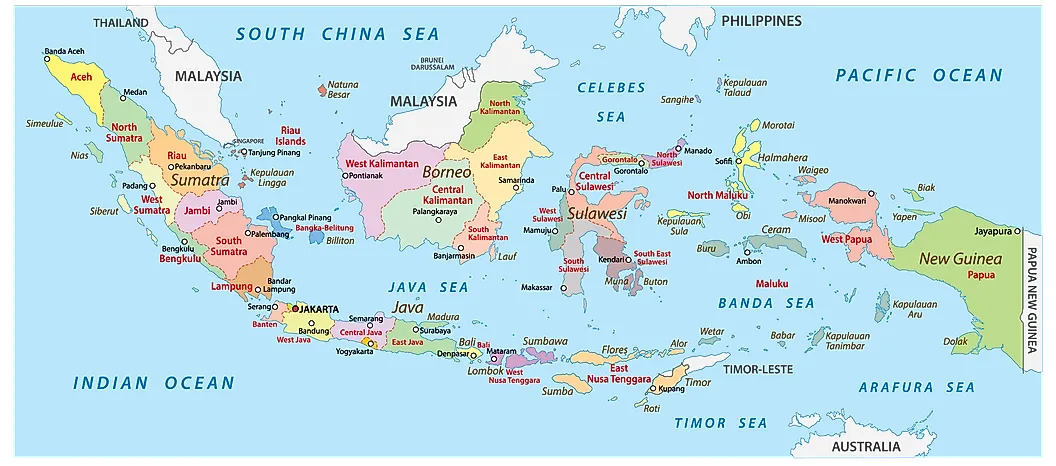
The picture below shows a map of Indonesia. This map shows that the Indonesian capital, Jakarta, is located on Java Island. This map also shows the set of films used as the main data in this article: Sokola Rimba was in Jambi, in Sumatra Island; Tanah Surga Katanya was in West Kalimantan, in Borneo Island; Jembatan Pensil was in Muna, Southeast Sulawesi, in Celebes Island; and Di Timur Matahari was in Tiom highland, in Papua Island.
3.0. Results and Discussion
3.1. Education disparities in the films
One of the causes of the educational gaps depicted in those films is the education centralisation policy during the New Order regime (1966-1998), namely, the imposition of standardised educational curricula from Java to the designation of Papua, alongside other outer islands like Sumatra, Borneo, and Celebes, as a destination for the state-sponsored transmigration programme. Research shows that Irian Jaya (the name of Papua during the New Order regime) has been a principal destination for the nation’s prominent transmigration programme.
This initiative entails the state-sponsored relocation of impoverished rural families from the densely populated core islands of Java, Madura, and Bali to less populous outer islands, including Sumatra, Borneo, Celebes, and Irian Jaya. From the governmental perspective, this redistribution of population is mutually beneficial: it provides land for landless migrants while ostensibly delivering modernising influences from more developed regions to indigenous communities.
However, this policy carries significant demographic consequences; if the planned number of Javanese migrants is settled in Irian, the indigenous population risks becoming a minority within its own province. Grievances already exist among the Irian people, who report being passed over for local government positions in favour of less qualified Javanese applicants. Furthermore, even in outer islands like Sumatra, Borneo, and Celebes, where migrants do not constitute an ethnic majority, transmigration schemes frequently appropriate indigenous farming and hunting lands. This confiscation typically occurs with inadequate compensation, offering minimal social benefits or future employment opportunities to the affected communities (Lorraine V., 2010).
A critical consequence of these combined policies has been the demographic marginalisation of indigenous populations, who have become minorities in their ancestral lands. This shift in population dynamics has profoundly impacted local systems, notably by altering the implementation and character of education in these regions, further diluting indigenous cultural presence.
Within the education sector, the programmes initiated during Indonesia’s New Order era continue to exert a significant influence today. Scholars argue that their legacy includes a tendency towards totalitarianism in education, characterised by a standardised approach to management—encompassing planning, implementation, and evaluation—as well as uniform school development models. This has led to a homogenisation of cultural patterns, a weakening of regional cultures, and the fostering of passive, ‘robotic’ human qualities marked by a lack of initiative and creativity. Ultimately, these factors are seen to suppress the potential of communities to cultivate generations capable of critical thought regarding their own educational conditions (Mubarok et al., 2023; Setyaningsih, 2017).
Although the government introduced educational decentralisation through Law No. 20 of 2003, a pronounced disparity in educational quality between Java and the outer islands persists. The implementation of this decentralisation policy remains an ongoing process of adaptation to Indonesia’s diverse socio-cultural landscape. According to analysis, at least three strategic issues continue to challenge its effectiveness: funding disparities, mechanisms for quality control, and the uneven professionalism of teachers (Ishak, 2021).
The cinematic narratives of Sokola Rimba, Tanah Surga Katanya, Jembatan Pensil, and Di Timur Matahari provide a vivid portrayal of the strategic issues in educational decentralisation identified by Ishak (2021), particularly concerning teacher professionalism and distribution. These films illustrate a chronic shortage of permanent teaching staff in remote regions across the archipelago. The settings include the forest interiors of Makekal Hulu in Jambi, home to the Anak Dalam tribe (Sokola Rimba); a border village in West Kalimantan (Tanah Surga Katanya); the isolated island of Muna off Southeast Sulawesi (Jembatan Pensil); and the highland village of Tiom in Papua (Di Timur Matahari). A central theme is how challenging geography deters qualified teachers from taking permanent posts.
Consequently, the educational experience for children is highly unstable. Students frequently attend school only to find no teacher present, forcing communities to rely on the dedication of volunteers. These individuals are typically either passionate educators specifically committed to remote areas, local graduates who return to their villages to teach, or professionals such as priests or doctors who provide informal instruction in their fields of expertise. This situation underscores the systemic failure to ensure consistent, quality education in underserved areas.
3.2. Resilience: the struggle of the people in the islands
Resilience prioritises the intrinsic, contextual powers and affordances of these actors and agencies as the primary strengths to be harnessed, rather than the imposition or export of external resources, knowledge, or assistance. In contrast to modernity, which is perceived to homogenise and reduce life to a common denominator by repressing forms of being that exist outside its norms, resilience thinking has been profoundly shaped by engaging with islands. This is because islands are imaginatively constructed as possessing the antithetical qualities: namely, the powers of creative, productive differentiation and individuation (Chandler & Pugh, 2021).
The theme of resilience in these four films is manifested through the adaptive strategies employed by communities confronting adversity, both individually and collectively. In Sokola Rimba, the central narrative conflict arises from the tension between modern development and the existential rights of the Anak Dalam tribe. This community’s nomadic lifestyle and profound dependence on the forest are threatened by the expansion of palm oil plantations, which encroach upon their ancestral lands. Resilience is exemplified through the character of Nyungsang Bungo, a child of the tribe who proactively seeks literacy skills from a teacher affiliated with a non-governmental organisation. His objective is to acquire the ability to read as a tool for defending his community, specifically to decipher and challenge agreements offered by plantation companies that would be detrimental to his people. However, this act of resilience generates internal conflict; his mother opposes his education, fearing that knowledge from the outside will entice the younger generation away from the forest and erode their cultural heritage. Despite this opposition, Nyungsang Bungo perseveres. The film’s conclusion affirms his resilience, showing him successfully reading the company’s agreement and alerting the tribal elders to its exploitative terms, thereby using the skill of literacy as a means of cultural and territorial preservation.
The central conflict in Tanah Surga Katanya stems from the stark socio-economic disparities on the border between Indonesian West Kalimantan and Malaysia. The Indonesian side is characterised by profound poverty, which stands in sharp contrast to the relative prosperity visible across the border. This inequality fuels a familial dispute between Grandfather Hasyim, a staunch nationalist, and his son, Haris. Having worked in Malaysia for an extended period, Haris returns to relocate his two children, prompting a confrontation with his father, for whom love of the Indonesian homeland is an inviolable principle. The resolution sees Haris departing with only his youngest child, as the eldest chooses to remain with his grandfather. The film further illustrates the consequences of regional neglect through the educational and healthcare infrastructure. The local school is severely understaffed, with teachers managing multiple classes, and the area suffers from poor communication signals and a dire lack of medical facilities. This deprivation is tragically emphasised when Grandfather Hasyim, critically ill, must undertake a long and arduous boat journey to reach a hospital, succumbing to his illness en route. His final injunction to his grandson is to remain in Indonesia.
The resilience of the characters is portrayed in their divergent responses to these adversities. Grandfather Hasyim embodies a patriotic resilience, clinging to his national identity despite the material deprivations, even refusing to seek treatment abroad. In contrast, his son, Haris, demonstrates a pragmatic resilience, securing his livelihood through migration, a change of citizenship, and marriage in Malaysia. The grandson who remains embodies a different form of fortitude, juggling care for his ailing grandfather with his education and work. His resilience culminates in a critical act of expression: reciting a poem that poignantly contrasts the official rhetoric of Indonesia as a land of milk and honey with the harsh realities of neglect experienced in his border community.
The central conflict in Jembatan Pensil revolves around the arduous pursuit of education by children in a remote area, set against a backdrop of poverty and severely limited infrastructure. This narrative highlights a profound inequality in educational rights, where inadequate school facilities are compounded by challenging geography. The children’s resilience is demonstrated through their daily struggle: they depart at dawn, traverse a dilapidated bridge, and carefully carry their shoes to preserve them for school, all to attend a free school established and taught by an elderly volunteer.
The central conflict in Di Timur Matahari originates in the protracted, year-long absence of a teacher, which deprives the children of their right to an education. Their daily hope for the arrival of an instructor from the city is consistently met with disappointment. This primary conflict is dramatically compounded by an inter-tribal war among the adults, who are the parents of the children. The situation escalates severely when one child’s father is shot and killed by the father of another child. A cycle of vengeance ensues, as the deceased man’s brother retaliates by burning down the village of the killer, an act for which he is subsequently killed by the opposing tribe. Witnessing this relentless violence, the children, who wish to remain friends, resolve to intervene. In a decisive act of courage, they interpose themselves between the two-armed factions, standing hand-in-hand and singing a song of peace. This powerful gesture of innocence and reconciliation ultimately persuades the adults to lower their arrows, join hands, and sing together, thereby breaking the cycle of revenge.
These cinematic narratives collectively illustrate that resilience and adaptation are driven by the agency and creativity of the individuals and communities themselves, rather than by external intervention from the state. This intrinsic power is manifested in distinct ways across the films. In Sokola Rimba, it is epitomised by Nyungsang Bungo’s unwavering determination to become literate against his mother’s wishes, proactively seeking education even in a transmigration settlement. Similarly, in Tanah Surga Katanya, the grandson exhibits agency through his conscious choice to remain with his grandfather, a decision that entails multifaceted responsibilities and culminates in the courageous act of reciting a critical poem to express dissent. The children in Jembatan Pensil demonstrate their resolve through a persistent collective effort to access education, a commitment that ultimately inspires the entire village to collaborate on building a new bridge. Finally, Di Timur Matahari presents the most profound example, as the children, weary of perpetual loss, exercise their own form of power by physically interposing themselves between warring factions, using a song of peace as their only available tool to halt the violence. In each case, the solution emerges from within the community.
As a community, in four different outer islands of Indonesia, the characters in the films face various difficulties. The form of the difficulties varies, but they have one similarity, namely, threatening the security of the communities’ lives. When their security is threatened, they use their potency to be creative and resilient in facing difficult situations, without relying on outside forces, including the state and the central government. The community’s internal capacity, which can be used as a force to create a resilient community, has also been identified by Lessy, Lassa, and Zander. They argue that to improve resilience in small islands, resilience assessment research must take into account non-traditional variables such as new climatic hazards, community agency, social capital, island sovereignty, and stakeholder participation (Lessy et al., 2026). Here, the community agency is identified as one of the important variables that should be included in research about small islands’ resilience.
3.3. Patchworks: human and non-human relations in archipelagic realities
Patchworks reveal the intricate entanglements of human and non-human life within interconnected archipelagos. Consequently, adopting an island ontology—which emphasises relationality and feedback loops—enables an understanding of the world as a composition of multiple, coexisting worlds (Chandler & Pugh, 2021). This dynamic is vividly illustrated in the film Sokola Rimba, which portrays the existence of the Anak Dalam tribe. Their nomadic, forest-dependent way of life embodies this deep interconnection. A key example is the tradition of melangun, wherein the entire community abandons its settlement following a death, seeking to distance itself from grief and misfortune.
This nomadic existence, however, brings their right to a traditional life into conflict with modernising forces, particularly the establishment of palm oil plantations and illegal logging operations, both instigated by external entrepreneurs and workers from Java. The film nuances this conflict by not solely depicting Javanese individuals negatively. It also features a Javanese woman, originally a transmigrant under the New Order regime, who facilitates the education of a tribe member and supplies the community with essential goods when they venture from the forest. Thus, the film demonstrates that within an island context, all lives—human and otherwise—are profoundly interconnected. The disruption of this balance, exemplified by deforestation for plantations and logging, consequently leads to the devastation of these interdependent forms of life.
The film Tanah Surga Katanya further illustrates the profound entanglement of human and non-human life forms through the circumstances of its characters. The protagonist, Grandfather Hasyim, resides with his two grandchildren in a stilt house adjacent to a river, sustaining the family through fishing. This establishes a critical dependency on the riverine environment for their livelihood. This reliance is further underscored by a pivotal narrative event: when Hasyim falls gravely ill, the river becomes his only route to medical aid, requiring a journey of several hours by boat to a city hospital. Tragically, his physical decline is such that he passes away en route, a direct consequence of the immense geographical and temporal distance imposed by this specific human-environment relationship.
Similarly, in the film Jembatan Pensil, the entanglement of human and non-human life forms is manifested through the relationship between the coastal community and the marine environment. The characters, who are predominantly fishermen from Muna Island, depend upon the sea for their economic sustenance. This interdependence extends to the younger generation, who must utilise natural resources for their education; this is depicted through their traversal of a dilapidated wooden bridge and their use of large banana leaves as makeshift umbrellas. The film further underscores the formidable power inherent in nature, which can defy human control. This is tragically illustrated by the narrative of a child who loses his father after a storm strikes while the father is fishing at sea.
The film Di Timur Matahari similarly explores the entanglement of human and non-human life forms through its portrayal of the children in Tiom. Their daily existence is deeply embedded within the natural environment, illustrated by scenes of them playing and walking barefoot across open fields. The material construction of their village—houses built from leaves and tree trunks—further signifies this direct reliance, while also highlighting a vulnerability, as these structures are easily destroyed by fire during tribal conflicts. This connection is rendered more profound through the character of an elder who acts as a messenger, interpreting and delivering news after listening to the wind; for instance, he informs the children that their teacher will not be arriving. Ultimately, the film contrasts this deeply physical and environmentally situated existence with modern urban life. The climax, where two warring tribes confront each other in an open field, presents conflict as a direct, tangible event within a natural setting, as opposed to the mediated disputes conducted through arguments and digital platforms common in contemporary society.
Collectively, these four films demonstrate that human existence on islands is fundamentally inseparable from other forms of life. Rather than being isolated, island life is characterised by its profound connectivity to the natural environment and its non-human inhabitants. This evidence directly challenges the continental perception of islands as insular and remote. Instead, the island ontology presented confirms that the world is, in fact, a composition of multiple, coexisting worlds, where human and non-human agencies are inextricably intertwined.
The connection between the natural environment and human life in the islands is strengthened by Foley et al. (2022). They say that islands are unique locations because they are surrounded by water, making travel difficult, or because they are isolated, encouraging cultural ingenuity. This idea is challenged and subverted by urban islands, which typically have strong administrative and physical ties to their surroundings. Therefore, connection rather than isolation may be the key to comprehending islandness, requiring consideration of the ways in which cultures of mobility and immobility are experienced.
3.4. Correlation: perceiving unseen phenomena behind apparent signs
Correlation describes a contingent relationship or the registration of an effect, which is dependent upon the specific affordances of an entity. Central to this concept is the capacity to perceive, sense, or register underlying processes of becoming that transcend what is immediately apparent in a superficial presentation (Chandler & Pugh, 2021). The four films exemplify this through signs and signals that render the invisible perceptible in various ways. In Sokola Rimba, for instance, the tradition of melangun—abandoning a settlement after a death—functions as a tangible sign of an intangible, collective grief. Furthermore, when Nyungsang Bungo’s mother opposes his education, her statement that pencils are a disaster serves as a powerful signal. Within this context, the pencil is semiotically charged; it is associated with external knowledge systems, specifically literacy and numeracy, and is thus perceived as a threat with the potential to alienate the younger generation from the Anak Dalam tribe.
In the Tanah Surga Katanya film, people use Malaysian Ringgit instead of Indonesian Rupiah, although they live in the Indonesian part of Borneo Island. This tangible sign shows an intangible meaning that they feel closer to Malaysia. In the film Jembatan Pensil, the title itself functions as a potent signifier of an intangible reality. This is illustrated in a pivotal scene where a child, after nearly drowning while crossing a dilapidated bridge, loses all his school supplies, including his pencil. In response, a boy proactively cuts his own pencil into parts and shares them with his friends. One day, when the teacher asked the students to make a sentence using the word pencil, the boy who cut his pencil said, “pensil … pensil … jembatan pensil … Ondeng ingin membangun jembatan pensil untuk teman-teman” which can be translated into “pencil … pencil … the pencil bridge … Ondeng wants to build a pencil bridge for my friends.” This metaphor evolves beyond the literal object to embody the child’s profound aspiration for his peers to continue their education—a symbolic bridge over the material obstacle. Consequently, the jembatan pensil represents not merely a film title, but the conceptualisation of a solution born from collective need and ingenuity. The narrative culminates in the material realisation of this symbol, as the community, galvanised by the children’s initiative, replaces the rotten structure with a new, sturdier bridge.
In Di Timur Matahari, a potent signifier of an intangible emotional state is manifested through the practice of a mother cutting her finger following her husband’s death. This ritual transcends mere physical mutilation; it is a profound symbol of grief for the loss of a spouse. The act conveys a sense that losing a partner is akin to losing a part of one’s own body, a sentiment materially inscribed upon the physical self through this Tiom tradition. Furthermore, the song sung by the children functions as another significant indicator of their inner world. Repeated daily at school whilst awaiting a teacher from the city who never arrives, and during their weariness of the perpetual tribal wars waged by their elders, this song articulates the children’s latent anticipation and profound exhaustion in the face of an unending cycle of conflict. The lyrics reveal a collective yearning for a peaceful coexistence, a desire that transcends the tribal divisions imposed upon them by their parents’ generation.
The four films mentioned above demonstrate that a phenomenon carries a deeper meaning than the actions visible to the naked eye. The melangun tradition depicted in the film Sokola Rimba, the use of Malaysian Ringgit by the characters in Tanah Surga Katanya, the title of the film Jembatan Pensil, and the tradition of cutting off fingers practised by the Tiom community in Di Timur Matahari all show that visible actions carry a deeper meaning. Therefore, in island life and inter-island relations, understanding the meaning behind an event is crucial.
3.5. Storiation: cause and effect relations among islands
Storiation rejects the notion of fixed spatial and temporal locations for objects and events. It posits, instead, a relational understanding where cause-and-effect dynamics interconnect occurrences across different islands (Chandler & Pugh, 2021). The film Sokola Rimba exemplifies this, depicting Javanese migrants engaged in illegal mining and entrepreneurial ventures to establish palm oil plantations. Their presence in Jambi is a direct consequence of the state-sponsored transmigration programmes of the New Order era, through which they imported cultural practices centred on permanent settlement, including the construction of houses and villages. This sedentary model stands in stark contrast to the nomadic epistemology of the indigenous Anak Dalam tribe. The establishment of these Javanese settlements, and the land-use customs they entail, directly encroached upon the forest, leading to the displacement of the Anak Dalam. The film narrates how Nyungsang Bungo and his clan have been forcibly relocated three times, a direct result of a national park development project initiated by the central government, thereby illustrating how remote policy decisions produce localised effects.
The film Tanah Surga Katanya elucidates this cause-and-effect relationship through the stark disparities evident at the Indonesia-Malaysia border in West Borneo. The visual juxtaposition at the border itself is telling: the roadway leading into Malaysia is properly paved, whereas the corresponding road on the Indonesian side remains an unpaved track. This material inequality is mirrored in the domestic spheres of the characters; Grandfather Hasyim resides in a rudimentary stilt house with minimal furnishings, while his son, Haris, lives in a substantial permanent dwelling in Malaysia and manages a shop.
A direct consequence of these asymmetrical conditions is the economic reality of Hasyim’s village, where the Malaysian Ringgit has supplanted the Indonesian Rupiah as the primary currency due to its practical utility in cross-border trade. This phenomenon critically challenges the myth of the sovereign, self-contained nation-state. It demonstrates that while the village may fall within the administrative boundaries of the Republic of Indonesia, its practical economic existence and sustenance are fundamentally dependent upon its relational ties with Malaysia.
Whilst the film Jembatan Pensil does not explicitly depict a relationship with other islands, its focus remains on the localised struggle for education. It portrays the daily challenges faced by children on Muna Island to attend school and the dedication of an elderly community member who volunteers to teach in rudimentary conditions.
In contrast, Di Timur Matahari highlights a different facet of educational disparity. It reveals how the prolonged, near-total absence of a teacher—for almost a year—not only deprives children of an education but also indirectly channels them into the cycle of tribal warfare perpetuated by adults. Their yearning for a teacher, which remains unfulfilled, underscores the profound inequality of educational provision on Indonesia’s easternmost island. The children are depicted as powerless amidst the conflict, their songs of peace serving as their only form of protest against the entrenched cycle of revenge. This situation critically illustrates how the unifying state philosophies of Pancasila and Bhinneka Tunggal Ika, which facilitated Papua’s integration into the Republic of Indonesia, have failed to ensure educational parity between the periphery and the centre, namely the island of Java.
The four films above show two types of cause-and-effect relationships in an island’s life: Jembatan Pensil and Di Timur Matahari films represent the cause-and-effect relations within an island. Meanwhile, Sokola Rimba and Tanah Surga Katanya films represent the cause-and-effect relations between islands. Here, the cause-and-effect relations happen due to economic reasons, like accessing goods and resources, finding land to build settlements, and accessing a better quality of life. However, these efforts to gain more resources and a better quality of life sacrifice the indigenous or local community in the outer islands. A similar phenomenon of the interaction among islands that was motivated by the need to pursue a better life, yet sacrificing the indigenous community in the small islands, also happens in another group of small islands in the Philippines.
The small islands of the Naranjo Group of Islands were linked by political, economic, and social connections. Islanders travel between islands within the group by boat, borrowing a boat from friends, relatives, or neighbours, renting a boat, or infrequently taking public transportation. Geo-social relationships between and among small islands let island societies exist, survive, and thrive. These relationships benefit the local economy and develop social bonds and kinship within the island group. The connection between and among islands compensates for the shortage of products and resources on other islands. However, these geo-social links may increase strain on the islands where these resources are exploited (Hilvano et al., 2023).
4.0. Conclusion
This analysis demonstrates that the nation-state, conceived as a homogenous entity, is a myth. Within the Indonesian context—a nation comprising over 1,300 ethnic groups—unification efforts through state slogans and national philosophies have not resulted in a uniform national entity. On the contrary, these very efforts have engendered significant disparities between life on the various islands and the centre of power in the national capital.
The four films examined centre on educational challenges on islands beyond Java, where schooling is often underdeveloped, reliant on limited infrastructure, and sustained by the voluntarism of local communities. Crucially, these educational issues are not isolated; they are intrinsically interwoven with the broader socio-ecological fabric of island life. An analytical framework employing the variables of inter-island relations—resilience, patchworks, correlation, and storiation—reveals that educational problems function dually, as both a potential solution and a direct consequence of the island’s relational dynamics. These dynamics invariably involve complex entanglements between human and non-human actors, including forests, land, sea, and rivers.
In Sokola Rimba, education emerges as a solution, empowering the Anak Dalam tribe to confront the threat of dispossession from palm oil expansion and a national park, as evidenced when Nyungsang Bungo reads a detrimental agreement. Conversely, in Tanah Surga Katanya, Jembatan Pensil, and Di Timur Matahari, educational inequality is a consequence of the asymmetrical relationship between the Javanese centre and the peripheral islands. The ramifications of this disparity are severe: in West Kalimantan, it manifests in the economic reality of border communities adopting a foreign currency, while in Papua, it forces school-age children into cycles of tribal warfare, perpetuating historical grievances in the absence of state-provided opportunity and stability.
DECLARATION OF COMPETING INTEREST
The author confirms that she has no competing financial interests or personal relationships that could influence the work presented in this article.